
Table of Contents (7)
The budget Micro‑ATX case that actually made me downsize
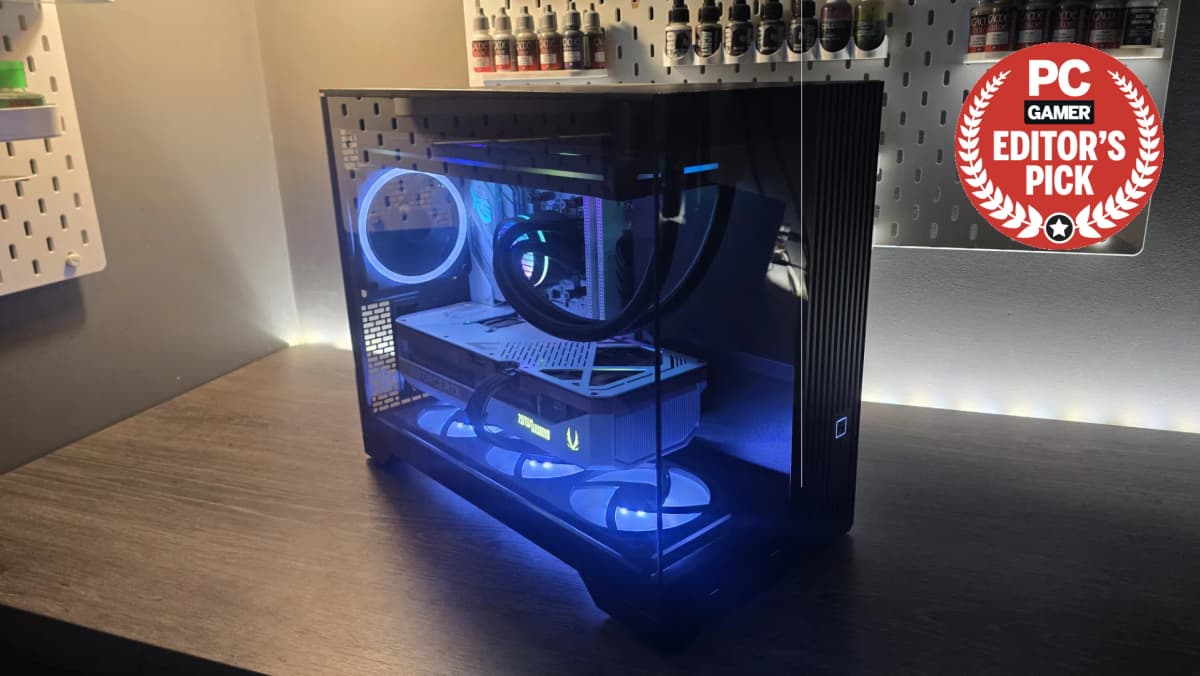
I’ve spent years telling myself I “need” a big mid‑tower for airflow, for future upgrades, for that one day I maybe, possibly, might add a second GPU again. You know the script. Then the Phanteks XT V3 turned up on my desk: a compact, unassuming Micro‑ATX chassis that costs about $66 / £60 and ships with three RGB fans already installed on the floor.
After a weekend of living inside this thing with a power‑hungry Intel Core i9 and a chunky RTX card, I came away thinking: yeah, big towers are kind of a scam for most people.
The XT V3 leans into what I love about small‑form and Micro‑ATX builds: you’re not losing much capability, but you are reclaiming a ton of desk space and forcing your build to be intentional instead of “just throw another drive and fan in there.” And the wild part is how much hardware this little box is willing to swallow.
Size, specs, and layout: small shell, big appetite
On paper, the XT V3 is very straightforward: a compact Micro‑ATX tower with support for ITX and mATX boards, full‑size ATX PSUs (up to around 150 mm), and GPUs up to roughly 430 mm long and 175 mm wide. In human terms: if it’s a modern “3-4 slot” gaming card, it probably fits.
The footprint is genuinely modest for what it offers. At roughly 460 x 235 x 370 mm, it lives comfortably on a desk rather than under it. Mine sits to the right of my monitor, and for the first time in ages my PC doesn’t feel like a black monolith looming over my keyboard.
Here’s the important support rundown:
- Motherboards: Mini‑ITX and Micro‑ATX (including rear‑connector boards)
- Fans: Up to 7 x 120 mm (3 bottom, 3 top, 1 rear)
- Radiators: Up to a 360 mm AIO at the top
- GPU: Up to 430 mm length, 175 mm width, 4 slots
- PSU: Standard ATX up to ~150 mm, mounted sideways at the top
- Drives: 2 x 2.5‑inch SSDs + 1 x 3.5‑inch HDD behind the motherboard tray
- Front I/O: 1 x USB 3.0 Type‑A, 1 x USB‑C (USB 3.2 Gen2x2), combo mic/headphone jack, power button
Most budget cases compromise in at least one of three areas: cooling support, GPU clearance, or front I/O. Phanteks dodges all three here. A 360 mm radiator up top in a case this small is already rare; pairing that with space for a full‑fat four‑slot GPU and including a modern 20 Gbps USB‑C on the front is just aggressive for the price.
And then there’s the freebie that sealed it for me: three 120 mm RGB reverse‑blade fans pre‑installed on the floor, blowing cool air directly up toward your GPU and CPU cooler. You’d usually spend a good chunk of the case’s price on just that fan trio alone.
Build experience: clever, cramped, and one nasty PSU lesson
I built my main daily driver into the XT V3:
- CPU: Intel Core i9‑14900K
- Cooler: NZXT Kraken Elite 240 mm AIO (top‑mounted)
- Motherboard: MSI MPG Z790i Edge WiFi (Mini‑ITX)
- RAM: 32 GB Kingston Fury DDR5 @ 6000 MHz
- GPU: Gigabyte RTX 5060 Ti Gaming OC 16 GB
- Storage: 2 TB Samsung 990 Pro M.2 NVMe
- PSU: NZXT C1000 80+ Gold (standard ATX unit)
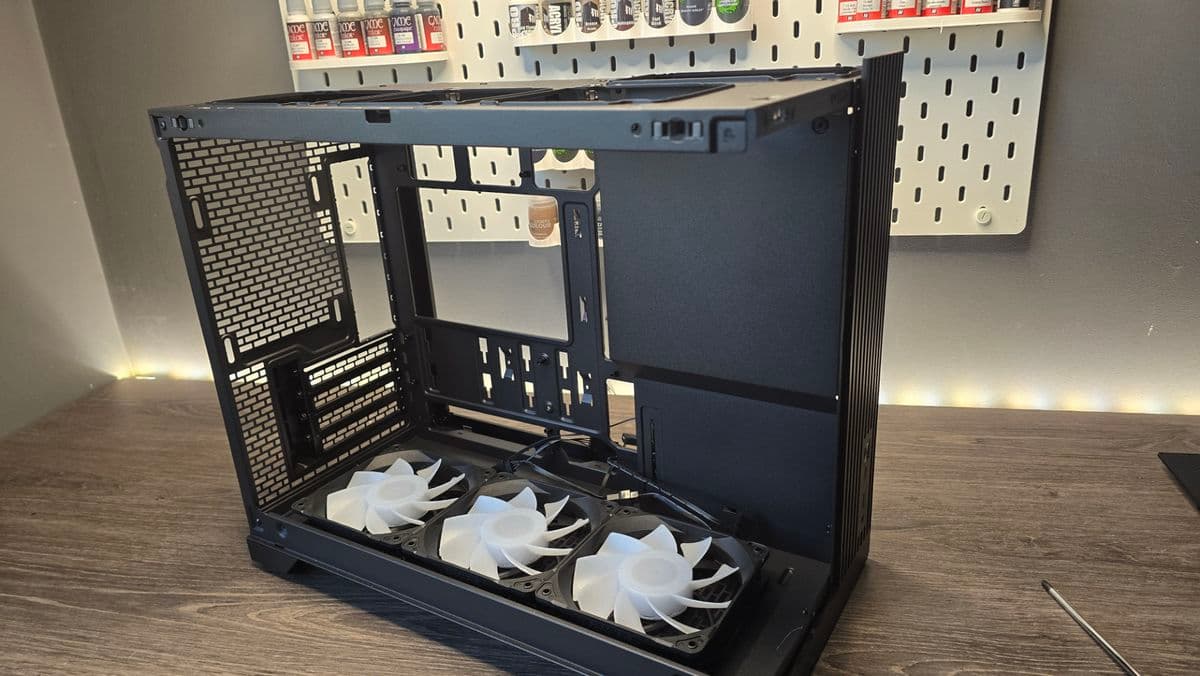
First contact with the case is a bit different from the typical “pop off side panel and go” routine. The XT V3 is kind of a top‑down puzzle. You remove the roof panel from the back, and that exposes the structural frame, the PSU mount, the radiator bracket, and the screws that hold the glass side panels in place.
Once those screws are out, both tempered glass panels lift off cleanly. There’s also a front glass panel that’s held in with another screw at the side. It feels much more secure than the usual “hope the clips survive shipping” design I’m used to. As someone who’s received a case that arrived with a side panel rattling around loose in the box, I appreciate this overengineering.
Inside, everything is compact but reasonably logical. There’s a simple PSU shroud / cable cover along the right side where I ended up stuffing most of my excess cabling and an NZXT fan controller. Behind the motherboard tray you’ll find the two 2.5‑inch and single 3.5‑inch drive caddies, and a few decent cable tie points. It’s not luxury, but it’s not cheap‑and‑nasty either.
The one real “gotcha” is the power supply. It mounts sideways at the top, and you connect it to the outside world via a short pass‑through cable that runs to the back of the case above your motherboard I/O. It’s a neat layout that keeps the PSU out of the way, but it absolutely changes the order you should build in.
On my first go, I installed the PSU early-just like I would on a normal mid‑tower-then tried to angle my modular cables up into it after the fact. That was a mistake. Getting my 24‑pin and 12VHPWR leads plugged in around the radiator and fans felt like playing Operation with thick braided noodles. The second time around I did it properly:
- Install motherboard, AIO, and fans first
- Route all power and PCIe cables roughly where they’ll end up
- Only then slide the PSU into its cage at the top
- Plug everything into the PSU while it’s still exposed from above
Follow that order and the build suddenly feels sane again. It’s still a smaller case, so you’ll bump your knuckles and swear at at least one cable, but nothing out of the ordinary for Micro‑ATX / ITX territory.
One last tip, learned the hard way: because the PSU switch faces inward, it’s frighteningly easy to forget to flick it on before you close up the case. I absolutely did a full “why the hell won’t this thing boot, what did I short?” panic before realising the rocker was still off. Don’t be me. Double‑check before you slide the roof back on.
Phanteks even throws in a little GPU anti‑sag bracket, which feels almost comically generous at this price. My 5060 Ti isn’t exactly a monster, but it still sat more confidently with that support in place.
Cooling and airflow: vertical wind tunnel in disguise
The XT V3 doesn’t sell itself as an “airflow edition” case with a mesh front, but the ventilation strategy is smart. Cool air comes in from the bottom (those three reverse‑blade RGB fans), some from the rear perforations, then hot air dumps out through the top radiator and rear exhaust.
With the 240 mm AIO mounted at the roof exhausting upwards, the whole system ends up behaving like a vertical wind tunnel. GPUs love this. Instead of fighting to suck air through a cluttered front panel, my card sits basically right above three fans blasting fresh air at it from below.
In actual use, my i9‑14900K and RTX 5060 Ti behaved exactly how I’d expect them to in a decent mid‑tower: stable clocks, no obvious thermal throttling in games, and only the usual worst‑case heat when I hammered them with synthetic stress tests. Considering how much wattage that CPU alone can pull, the fact this little box keeps it in check without sounding like a jet takeoff is impressive.
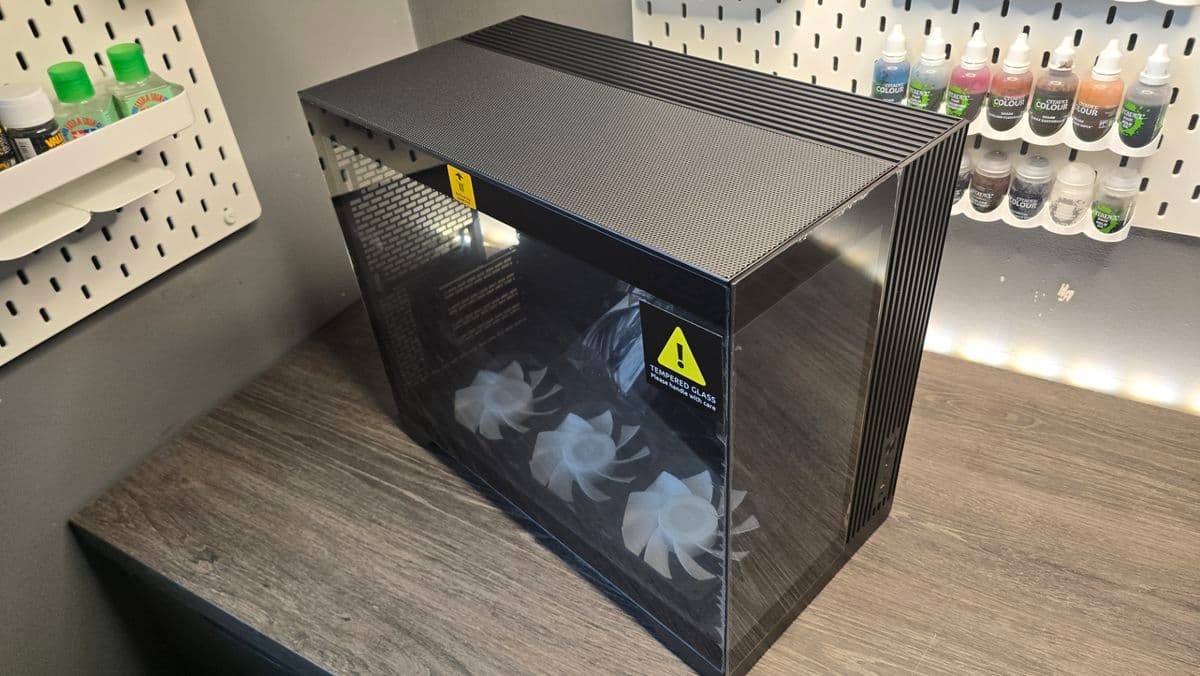
The included fans are definitely “budget RGB” rather than high‑end showpieces, but in terms of sheer airflow they’re more than adequate. And because they’re reverse‑blade, you get the lighting facing into the case while still using them as intakes on the floor without staring at fan backs. It’s a small aesthetic win that matters when your entire side is tempered glass.
The top and bottom of the chassis are well‑vented, and the base intakes sit behind a full‑length, removable dust filter. Slide that filter out every couple of weeks, give it a quick clean, and you’ll be fine. The only place I really wish Phanteks had over‑engineered things further is the rear: it’s a sea of perforations with no dust filtering at all.
That rear panel design is great for passive convection-hot air just bleeds out everywhere—but it does mean you’ll be hitting the case with compressed air more often than, say, a more closed‑off Fractal Terra‑style design that prioritises looks over open vents. Personally, I’ll take the slightly dustier but much cooler internals every time, especially in a case focused on value.
Noise and day‑to‑day feel: surprisingly chill for an i9 box
My biggest fear with smaller chassis is always noise. Shorter distance between your ear and the fans, more direct airflow paths, more chance of an annoying high‑pitched whoosh instead of a low, easy hum.
With the XT V3, set up sensibly, it’s not a problem. At idle and full desktop usage, the system is almost comically quiet. The three bottom fans spin slowly, the AIO fans barely tick over, and the open design means they don’t have to ramp hard to move air.
Under heavier gaming loads, you obviously hear it, but the character of the sound is good: more airflow rush than mechanical grind, and no odd resonance from the panels. The plastic front fascia doesn’t rattle, the glass feels solid, and even with my i9 pulling serious power in short bursts, I never hit that “okay, this is too much, I need headphones” stage.
On the desk, the XT V3 just feels pleasant to live with. Being able to glance over and see the full build through glass without a gigantic boiler of a case dominating the room is genuinely refreshing. I’ve used prettier cases—Fractal’s Terra is still in a league of its own for sheer style—but in terms of practicality and thermals at this size and price, the XT V3 is punching way above its weight.
Where the cheap price actually shows
Of course, you don’t get all of this for $66 / £60 without some compromises.
The most obvious one is materials. The glass panels look great, but the non‑glass bits feel firmly “budget.” The plastic on the front fascia doesn’t have the heft of higher‑end cases, and the internal paint and metalwork are purely functional, not luxurious. Nothing flexes worryingly, nothing cut my hands, but you can tell where Phanteks saved their pennies.
Storage support is the other clear limitation. Two 2.5‑inch mounts and a single 3.5‑inch bay, all behind the motherboard, is fine for most modern builds that rely mainly on M.2 SSDs… until you remember how SSD prices keep yo‑yoing, especially with AI hoovering up higher‑capacity drives. If you’re the type who hoards massive Steam libraries locally or keeps piles of media on spinning disks, you’ll feel boxed in here.
The PSU mounting method, as much as I ended up liking the final layout, is undeniably fussier than a regular bottom‑mounted supply. If you’re brand new to building, the pass‑through cable and unusual orientation might throw you for a loop, and getting the build order wrong makes the whole thing more frustrating than it needs to be.
And finally, dust. The bottom filter is great; the rear perforations are a bit too generous. You absolutely will be cleaning this case more often than a sealed‑up, airflow‑choked monolith. I don’t think that’s a bad trade for the temperatures you get, but you need to know what you’re signing up for.
Who the Phanteks XT V3 is actually perfect for
The XT V3 lives in a really nice sweet spot: not full tiny‑SFF madness like a sub‑10‑liter mini‑ITX sandwich case, but way more restrained than the average sprawling mid‑tower.
I’d say it’s ideal if you:
- Want a compact desk‑friendly build without going full “SFF tinkerer”
- Plan to use a powerful GPU and maybe a 240-360 mm AIO and don’t want to sacrifice either
- Are working with a real‑world budget and don’t want to spend more on the case than the motherboard
- Keep most of your storage on M.2 drives and only need a couple of SATA drives at most
- Care more about cooling and component support than luxury materials and designer looks
If you’re a storage hoarder, or you want ultra‑premium build quality, or you absolutely need silent, sealed‑up acoustics, this isn’t your forever home. But as a case that lets you build a properly high‑end gaming rig—modern GPU, hot CPU, serious radiator—in something that costs less than a single AAA release at launch, it’s kind of ridiculous.
FinalBoss // Gear
Level up your setup
01Graphics cardson Amazon→02Gaming laptopson Amazon→03High-refresh gaming monitorson Amazon→04Discounted game keyson Kinguin→Affiliate links · As an Amazon Associate, FinalBoss earns from qualifying purchases.
Want to Level Up Your Gaming?
Get access to exclusive strategies, hidden tips, and pro-level insights that we don't share publicly.
Ultimate Reviews Strategy Guide + Weekly Pro Tips