
Table of Contents (9)
A $650 nostalgia bomb in three hefty boxes
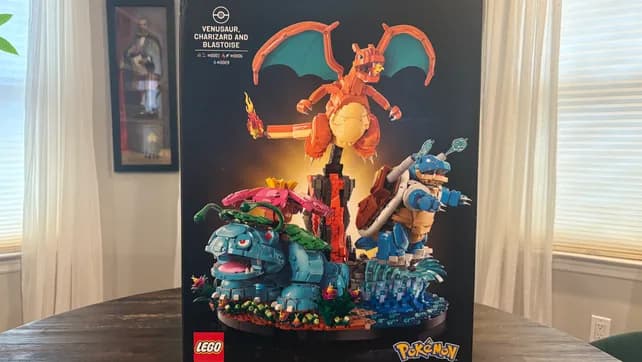
The first thing that hits you about LEGO Pokémon Venusaur, Charizard, and Blastoise (set #72153) isn’t the nostalgia, or the models, or even the Pokémon brand. It’s the sheer scale of the thing. Three large boxes, 6,838 pieces, and a price tag of $649.99, available only through the LEGO Store. This is LEGO and The Pokémon Company basically looking adult fans dead in the eye and saying: “You wanted a big, premium Kanto shrine? Prove it.”
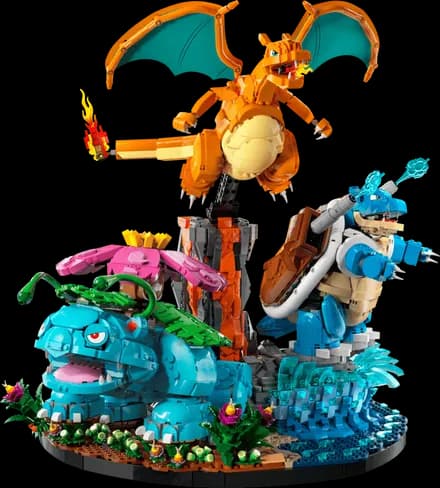
Conceptually, it’s simple in that very expensive way: three oversized, highly detailed builds of the original Kanto starters’ final evolutions, each on its own themed base. Venusaur in a dense jungle, Blastoise on a churning shoreline, Charizard frozen mid-flight above a volcano. Built separately, they’re self-contained dioramas. Click the bases together, and the whole thing becomes an absurdly cool centerpiece that reads like a massive museum display for people who grew up blowing all their allowance on link-cable battles.
On paper, it sounds like a Frankenstein of other big LEGO characters and dioramas – bits of Mighty Bowser, Rivendell’s waterfalls, and the large Chewbacca’s texturing tricks are all clearly in the DNA here. But the question is whether those pieces actually come together into something that earns its price, or if this is just an easy nostalgia tax wrapped in Pokémon branding.
Short answer: it’s absolutely one of LEGO’s strongest licensed display pieces to date, and the more time you spend digging into the details, the more that becomes obvious.
The build experience: three journeys, zero stickers
Breaking a set this big into three self-contained boxes is more than a shipping decision; it changes how the whole build feels. Instead of grinding through 6,800 pieces worth of one giant, monotonous project, you’re effectively getting three full premium sets back-to-back. Each box gives you one Pokémon plus its environment, so you’re constantly alternating between creature and scenery work. That shift in focus keeps the process from ever really dragging.
The environments themselves use techniques LEGO fans will recognize instantly: stacked plates to suggest uneven ground, wedge slopes to build rock faces, curved tiles to smooth things out, and some clever SNOT (studs-not-on-top) tricks to give the terrain more depth. It’s familiar ground, but because each biome has its own vibe – jungle density, flowing water, molten rock – it never turns into that repetitive slog you sometimes get with, say, a sea of identical roof tiles or pavements.
Where the set really flexes is in the Pokémon builds. Each one starts from a sturdy Technic-based skeleton and gradually grows outward into those chunky torsos, snapping jaws, and thick limbs that feel like they walked straight out of the Game Boy sprites and later 3D models. There’s a particular moment for each where the silhouette clicks, usually when the head and back detailing go on, and that’s the emotional high a lot of big-character sets chase. Here, it lands across all three.
A massive quality-of-life win: there are no stickers in this box. None. Every detail is either brick-built or printed directly on elements – even the cloth parts that form Charizard’s wings carry printed flame patterns. At this price point, that should be the standard, but LEGO doesn’t always follow through on that. Here, they do, and it makes a huge difference to both the build experience and how durable the finished models feel.
Hidden inside each Pokémon’s torso is a tiny, thematic Easter egg: a little symbol echoing its elemental type. Fire in Charizard’s chest, a water motif buried within Blastoise, and a nature/grass detail for Venusaur. You never see them once the model’s sealed up, but you know they’re there – like slipping a heart into a Build-a-Bear. It’s the kind of indulgent detail that makes a premium set feel personal rather than purely ornamental.
Venusaur’s jungle: subtle, massive, and quietly the star
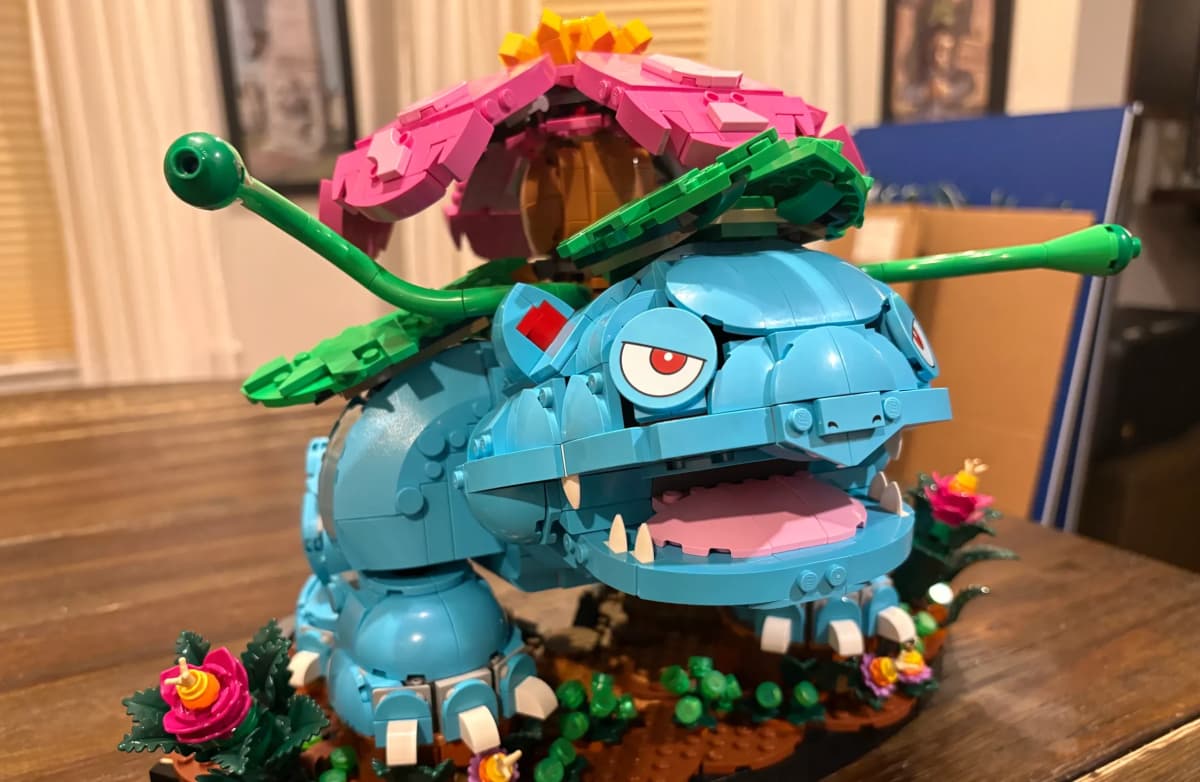
Photos don’t really sell how big Venusaur is compared to the other two. The designers actually lean into forced perspective to hide the difference: Venusaur is closer to the “ground”, hugging a low jungle floor, while Blastoise is perched mid-height on a wave and Charizard is way up in the air. Line them up, and your brain kind of assumes they’re all comparable in size. In reality, Venusaur is a beefy chunk of plastic.
The jungle base is where the set’s environmental work stands out the most. There’s this layered effect of roots, soil, and foliage that comes from stacking plates in different greens and browns, then planting a forest of foliage elements at different angles. Small flowers, broad leaves, and vine pieces combine into something that feels chaotic but carefully composed, the way the better LEGO botanical sets do it. The contrast between Venusaur’s heavy, squat body and the soft curves of the petals above it reads perfectly from across the room.
Venusaur’s body uses a lot of the same structural thinking as Mighty Bowser: big shell-like plates wrapped around an internal frame, with that slightly exaggerated cartoon chunkiness. The head sells the personality – wide mouth, heavy eyelids, and the right mix of smooth curves and visible studs to keep it recognizably LEGO. It’s the least “dramatic” pose of the three, but it radiates this stubborn, immovable presence that fits the character.
In terms of building, Venusaur’s section feels like the most dense. You spend a lot of time stacking internal supports and layering slopes to hide all that engineering. It’s satisfying in the same way big architecture sets are: you can feel the weight of what you’ve created when you lift it, and there’s a weird pleasure in knowing that under those calm leaves is a ridiculous amount of structural overkill.
Blastoise’s shoreline: water tricks and shell tech
Blastoise gets the most dynamic base. The whole scene is sculpted around a wave crashing up against rocks, with translucent blue elements and curved plates forming little eddies and splashes. If you’ve seen LEGO Rivendell’s waterfalls, the design language will feel familiar: layering plates and tiles in different shades of blue and white to give the illusion of motion, then wrapping them around a more neutral core so it doesn’t look like a single-colored blob.
The transition from sand to water to rock is nicely handled too. Tan, nougat, and grey elements blend in subtle gradients rather than harsh lines, so Blastoise feels like it’s genuinely planted in the scene instead of just bolted on. That helps a lot when you eventually snap the three biomes together; the seams feel intentional, not like three random vignettes fighting for attention.
Blastoise’s shell is very clearly a cousin to Bowser’s. Large, angled plates form the main dome, with ridged sections and color blocking building up those iconic panels. The cannons integrate cleanly into the top section; they look like part of the shell rather than awkward add-ons. The limbs are thick and blocky, but there’s enough contouring with slopes and rounded elements that it doesn’t come across as a stiff, old-school LEGO creature.
That hidden water symbol tucked away inside the torso is a neat touch for a model that otherwise screams brute-force tank. It gives Blastoise a bit of that “guardian spirit” flavor, which matches the way it anchors the middle of the combined display. Visually, it’s the bridge between the organic jungle on one side and the hellfire volcano on the other.
Charizard’s volcano: cloth wings and layered lava
Charizard is easily the most eye-catching of the trio. The whole build is engineered to feel airborne: the base rises up into jagged rock spires and lava vents, then a support structure lifts Charizard above everything else, as if it just launched itself off the crater’s edge. It’s a clever bit of staging that instantly makes the combined display feel taller and more dramatic.
The volcano base uses a color gradient that’s surprisingly subtle for something built from bright plastic: intense orange and red down in the molten core, darker shades creeping in as the lava cools, and then blackened, newly formed rock at the edges. That layered approach is similar to how LEGO handled Chewbacca’s fur, where stacked tones create depth without needing complex shaping. Here, it sells the heat of the scene without overwhelming Charizard itself.
The wings are the most unusual structural element in the whole set. Instead of being completely brick-built, they lean on large cloth pieces stretched over a frame, with printed flame designs and panel lines. That does two important things: it keeps the overall weight down (critical if you’re suspending the model in the air), and it gives the wings a more organic, flexible look than a solid wall of plastic plates would. The printed graphics tie them back to the rest of the model so they never feel like a cheap shortcut.
As a character build, Charizard has the most obvious posing options – angling the head, adjusting the neck and tail, tweaking the arms – but it’s still very much a display-first model. You can get a few distinct attitudes out of it (slightly more upright vs. lunging forward, roaring vs. more neutral), yet the weight distribution and the way it connects to the base encourage you to find a pose you like and leave it there. This isn’t something you idly swoosh around during a Netflix binge.
Posing, display, and the clever forced-perspective trick
One of the smartest choices here is how the three biomes interlock. Each base is fully self-sufficient – you can display Venusaur’s jungle, Blastoise’s shore, or Charizard’s volcano on its own without anything looking “missing” – but their edges are designed to slot into each other into a wider, flowing landscape. Jungle fades into sand, sand bleeds into volcanic rock, and the verticality ramps up from left to right.
That layout does two things. First, it makes the whole structure feel enormous without requiring some ridiculous single baseplate that would be a nightmare to move. Second, it hides the scale differences between the Pokémon themselves. Venusaur may actually be the largest model body-wise, but because it hugs the ground, Blastoise feels like the mid-ground anchor and Charizard reads as a distant aerial threat. It’s the same kind of forced perspective trick theme parks use with castle towers and facades, just translated into bricks.
Articulation-wise, you should think of this more like Mighty Bowser or the big Marvel figures than an action figure. There are enough joints and hinges to angle heads, tilt limbs, and inject some personality, but every connection has to carry the weight of these chunky builds. So you get expressive posing rather than wild, acrobatic stances. Once you’ve dialed in a look you like for each of them and locked the biomes together, the overall effect is incredibly striking – a full Kanto starter showdown frozen in time.
From a practicality standpoint, this is not a small footprint. With all three bases joined, you’re looking at a serious chunk of desk or shelf space. The tradeoff is that, unlike some tall, vertical-only display sets, this one rewards being at roughly eye level and a couple of feet back. It’s meant to be seen as a single tableau, not just as three separate statues.
Price, value, and how it stacks up to other LEGO Pokémon sets
There’s no sugarcoating it: $649.99 is a punchy number. But purely on the classic LEGO math of “about ten cents a piece,” 6,838 pieces would typically nudge this well into the low $700s, especially with a premium license attached. The fact that it comes in under that rough rule of thumb actually makes it a better value than it first appears, at least within the strange economy of adult LEGO collecting.
Compare it to the separate LEGO Pikachu and Poké Ball set, which has already raised eyebrows for a high price, a somewhat fragile final model, and a lot of repetitive yellow building. This Kanto starter trio is clearly pitched at the same adult-fan demographic, but the experience is much richer. The builds are more varied, the color palette across three biomes keeps things lively, and the final models feel more like anchored, permanent display pieces rather than conversation starters you’re scared to dust.
It’s also worth noting that this is a LEGO Store exclusive. That means no big-box discounts, no sudden 25% off flash deals. If you want it, you’re paying full freight, at least for the foreseeable future. On the flip side, that exclusivity helps it feel like an “event” piece in the same vein as some of the giant Star Wars or Icons sets – something you plan around, build over multiple nights, and then give pride of place on your shelf.
Build-time wise, an experienced adult builder can easily stretch this out over a dozen-plus hours without rushing, especially if you treat each box as its own mini-project. That’s a lot of hands-on time, which helps soften the blow of the price if you’re the kind of person who values the build journey as much as the finished model.
Who this set is (and isn’t) really for
This is not a kids’ toy in any practical sense. Yes, it’s Pokémon. Yes, it will absolutely melt the brain of any child who sees the box art. But the density of the build, the number of bags, the structural complexity, and the fact that it’s three large, display-first models all scream “adult collector” rather than “throw it on the floor and reenact gym battles.”
If you’re an adult Pokémon fan with a soft spot for the original Kanto starters and you already gravitate toward big LEGO display sets – Star Wars UCS, Ideas, Icons, the recent Nintendo collaborations – this is almost suspiciously targeted at you. It slots neatly next to things like the NES set or the Question Block: that same blend of gaming nostalgia and brick-built showpiece energy.
Where it becomes a tougher sell is if you only truly love one of the three starters. There’s no way to buy these separately; you’re committing to the whole trio. If you’ve been a die-hard Charizard fan since the trading card days but never cared much for Venusaur, you’re still paying for an enormous, beautifully designed Venusaur whether you like it or not. The upside is that the three biomes are self-contained, so you can absolutely display your favorite and stick the others somewhere else without the set feeling incomplete.
It’s also not the best entry point into LEGO if you’re just curious about the hobby. The build is long, the instructions assume you can handle complex sub-assemblies, and the models aren’t something you’re likely to tear down for parts immediately. This is more of a “I already know I love spending evenings buried in bricks” kind of purchase.
Where it stumbles
For all the praise, the set isn’t without its rough edges. The most obvious is the buy-in cost. Even within LEGO’s own ecosystem, $650 is rarefied air. It automatically locks a lot of Pokémon fans out, especially younger ones, and means this will mostly live in the homes of older collectors rather than the kids who probably want it most.
Space is the other major hurdle. Combined, the three bases take up a serious chunk of real estate. You can split them apart to fit narrower shelves, but the best effect is undeniably with all three locked together, and not everyone has a spare altar-sized slice of shelving just waiting for a plastic Kanto shrine.
From a pure LEGO-nerd standpoint, there’s also the reality that once you’re done, you’re probably not rebuilding this into something else anytime soon. A lot of the parts are tied up in color-specific, purpose-shaped assemblies: Venusaur’s plant, Charizard’s lava, Blastoise’s shell. Sure, you can part everything out and MOC to your heart’s content, but in practice this feels like a “build once, display forever” set. If your favorite thing about LEGO is unlimited reconfiguration, this kind of hyper-specific sculpted model is less flexible than a big box of generic bricks.
Finally, while the Pokémon themselves are poseable enough to keep them from looking static, they’re not highly articulated figures. If what you really want is to reenact battles with wild mid-air poses and dramatic tumbles, this will frustrate you. The weight of the builds and the way they key into their bases inherently put some limits on how playful you can be with the finished models.
FinalBoss // Gear
Level up your setup
01Best-selling Switch 2 gameson Amazon→02Switch 2 accessorieson Amazon→038BitDo controllerson Amazon→04Discounted game keyson Kinguin→Affiliate links · As an Amazon Associate, FinalBoss earns from qualifying purchases.
Want to Level Up Your Gaming?
Get access to exclusive strategies, hidden tips, and pro-level insights that we don't share publicly.
Ultimate Reviews Strategy Guide + Weekly Pro Tips