
Table of Contents (9)
The RTS that told me to put my mouse down and shut up
The first time I played Majesty: The Fantasy Kingdom Sim, I thought my game was broken.
I was a classic late-’90s RTS goblin: Warcraft II hotkeys wired into my fingers, dragging boxes around tiny sprites, barking out attack-move orders like some caffeinated field marshal. So when I booted up Majesty, built my first warrior guild, recruited a few heroes… and then realized I couldn’t actually tell them to do anything, my brain did a hard blue-screen.
My brand-new ranger strolled out of town, ignored the giant rat chewing on my marketplace, wandered into the fog of war, and promptly discovered a troll camp he had zero business poking. He died, alone and screaming, while I hammered the mouse trying to click-drag him like an idiot.
That was the exact moment I realized: this isn’t really an RTS. This is an MMO where all the players are NPCs, and I’m the overworked game master trying to keep the zone from completely collapsing.
Years later, after sinking a frankly embarrassing number of hours into both RTS and MMOs, I’ve come back to Majesty and it still feels more forward-thinking than most modern “innovative” strategy games. The units in this twenty-six-year-old game behave more like real MMO players than half the AI party members I’ve dragged through dungeons in the last decade.
“RTS where you can’t control units” massively misses the point
There’s a lazy way people still describe Majesty: “Oh yeah, that’s the RTS where you can’t control your units.” Technically true, completely wrong vibe.
What Cyberlore actually did was strip away direct unit micro on purpose and ask a much more interesting question: what if every hero on the map had their own priorities, anxieties, and greed-like MMO players-and your job wasn’t to click faster, but to design a world they wanted to engage with?
Rangers prioritize exploration, pushing into unknown territory whether you’re ready or not. Rogues are magpies with daggers, beelining for whatever looks most lucrative. Gnomes just want to build stuff. Paladins go hunting for capital-E Evil like they’ve got a personal vendetta. Every class has a personality baked into its AI, and you feel it immediately.
These aren’t faceless RTS “units.” They have names, levels, inventories, favorite haunts. They pick up gold from kills, run back to town to spend their hard-earned cash at your blacksmith or marketplace, then trudge back out with better gear. They gain experience, they get attached to certain routes, they form little cliques dumping into the same tavern. They even assess risk before joining a fight-sometimes deciding, very sensibly, that your suicide bounty isn’t worth dying over.
That messy autonomy is the whole magic trick. You’re not commanding an army; you’re curating an ecosystem.
Majesty turns the RTS player into a zone designer
Once you accept that you’re not the commander, Majesty clicks into place: you’re the zone designer of a live MMO shard that just happens to be single-player.
Your main tools aren’t control groups and formation commands. They’re buildings, shops, guilds… and most importantly, flags. Those flags are where the MMO DNA becomes glaringly obvious.
You don’t shove heroes toward objectives; you slap down a bounty flag and bribe them to care. Exploration flag on the dark corner of the map? That’s essentially an “uncover this part of the zone” quest. A kill flag on a dragon lair with a fat purse of gold? That’s a high-level raid marker. Heroes sniff the reward, check the danger, and decide if they’re in. If the gold’s low, you get a trickle of lowbies wandering in to die. Crank the bounty, and suddenly your heavy hitters form a loose, uncoordinated raid party.

Sound familiar? It should. It plays out like every unguided MMO pick-up raid you’ve ever seen: rogues sprinting in first and dying, rangers scattered, wizards hanging so far back they might as well be in another time zone. Healers lagging behind because they stopped to patch up some idiot fighting three skeletons on the road. Majesty captures that chaotic, “who pulled the boss?” energy frighteningly well.
And remember: this was year 2000. The genre-defining MMO quest model hadn’t been codified by World of Warcraft yet. No question marks over heads, no breadcrumb chains. Just raw incentives and wandering AI. Looking back with modern MMO eyes, it feels shockingly familiar—because we’ve now spent two decades living in worlds built around exactly these kinds of invisible nudges.
The joy and pain of disempowerment
Let’s be honest: sometimes Majesty is infuriating.
I’ve watched a level 18 warrior—who’d been with me since the opening minutes of a mission, loaded with enchanted gear I paid through the nose to unlock—decide to solo a lich tower on the edge of the map because his risk tolerance ticked over some internal line. Dead. Gone. No frantic micro to save him, no clutch heal I forgot to cast. Just a gravestone and a dip in my tax revenues.
Players have always been split on this. Some bounce off immediately: “The heroes ignore me, the AI is dumb, I lost because my idiots wouldn’t follow orders.” Others, especially folks who love chaotic simulation games, lean in and start telling stories: that one rogue who survived everything, the paladin who became a legend, the ranger who discovered half the map and died like a moron in a sewer.
I’m firmly in the second camp now, but it took time. I had to unlearn decades of RTS muscle memory and accept that my skill in Majesty isn’t about raw execution. It’s about understanding personality-driven systems and exploiting them. It’s about building the right temples that won’t conflict, placing shops where traffic will be high, setting bounties just big enough to tempt the right level of hero without bankrupting the kingdom.
That “disempowering charm” is the core design statement: you’re not god, you’re management. You can’t make people do what you want; you can only make what you want appealing. In other words, you’re basically running live ops on a fantasy MMO server without the support ticket queue.
The economy is pure game-design nerd bait
Most RTS economies boil down to: make peasant, click tree, repeat until victory. Majesty flips that too. There are no resource piles to hand-harvest; gold circulates through an automated economy you prod rather than babysit.
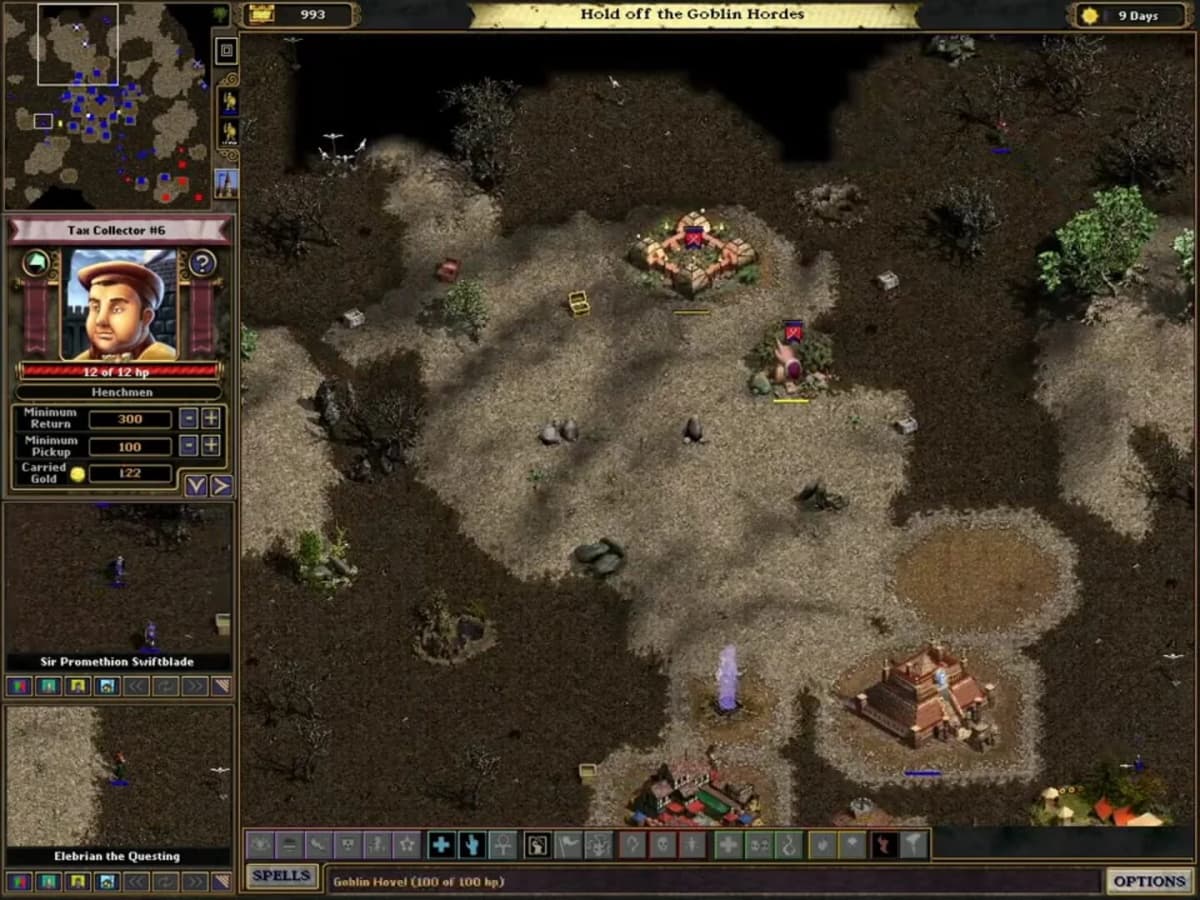
Tax collectors trundle between buildings scraping up coins, caravans haul income from trading posts, heroes earn gold from kills and quests, spend it in your shops, and a chunk of that filters back to you. You don’t tell a peasant to cut wood; you build something worth taxing and make sure someone can walk there without getting eaten by a werewolf.
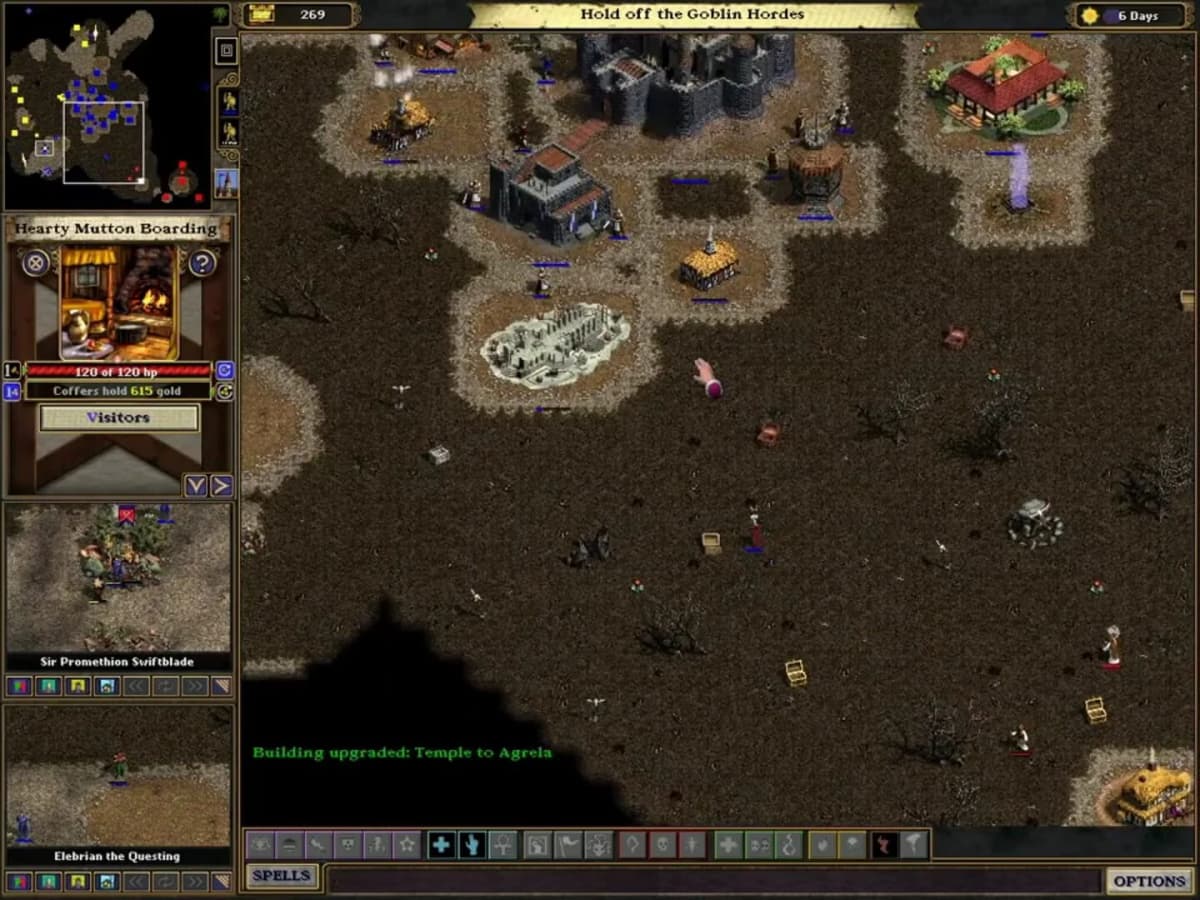
That leaves your brain free for more interesting questions: should you drop another guardhouse to make this suburb safer, or gamble on a luxury shop that might attract higher-level heroes and more tax? Do you invest in upgrading a wizard tower’s spells—those late-game nukes can feel “pay-to-win” on certain maps because they scale with your swollen coffers—or pour gold into bounties to lure a proper kill squad to that Medusa den?
It’s the same big-picture vs. busywork split that made something like Total War stand out from legions of traditional base-builders. But Majesty doesn’t just offload chores; it uses the economy to reinforce the MMO fantasy. Heroes are effectively your playerbase. They grind mobs for loot, spend their spoils in town, fund your power curve. You are, quite literally, monetizing their adventure loop.
Heroes with actual lives beat anonymous deathballs
One of the reasons I keep coming back to Majesty instead of, say, replaying yet another boilerplate campaign in a modern RTS is simple: I actually care about these idiots.
Because heroes persist, level, and gear up, they stop being disposable. Losing a level 15 paladin hurts more than losing a whole control group of marines. You remember the paladin. You watched her clear dens, limp back to town at 2 HP, splurge on a shiny new sword, then swan-dive into a graveyard full of skeletons because your bounty looked too tempting.
The game even leans into that attachment mechanically. You can pay to resurrect high-level heroes, which turns into this grubby calculation: how much is this one unit’s history worth to me right now? Do I burn precious gold to bring back my veteran ranger because he knows half the map, or accept his death and trust that the next generation will learn faster with better infrastructure?
Compare that to the anonymous zerg of units in most RTS campaigns. You might get a named hero or two, but your army at large is cannon fodder. Majesty quietly makes every hero a mini-ARPG protagonist with their own gear treadmill and life story. They’re closer to Diablo characters or MMO mains than traditional RTS pawns.
We should be stealing this design in 2026, not ignoring it
What drives me a bit nuts is how few games really picked up where Majesty left off.
We’ve had auto-battlers, MOBAs, and a wave of “hands-off” strategy that removes direct control, but almost all of them flatten their units into pure math pieces. They might have synergies and traits, but they don’t feel like people. On the other side, we’ve got immersive sims and management titles full of NPC schedules and needs, but they rarely lean into the explicit MMO analogy of “you run the zone, they run the build.”
Majesty nailed that feeling in 2000. It understood that there’s something inherently compelling about being the one setting up the playground instead of the one climbing the slide. Watching your systems collide, heroes improvise, and sometimes absolutely wreck themselves on your content is its own flavor of fun—Dwarf Fortress players, city-builder sickos, and old-school MMO fans all know this instinctively.
Yet most modern strategy design is still obsessed with “fair” control and perfectly responsive units. God forbid the AI have too much personality and make suboptimal choices; someone might call it jank on a forum. The safest design path is to ship another tight little tactics sandbox where everything obeys, and nothing really surprises you after hour five.
I’m not saying every RTS should turn its units into headstrong weirdos who ignore your orders. But I am saying we’re leaving a huge amount of design space on the table by avoiding controlled chaos. Give me more games where I influence, not command. More games where NPCs feel like MMO players with their own goals and build choices. More games that make me feel like I’m running content, not just clearing it.
Majesty’s jank is real—but it’s honest
None of this means Majesty is some untouchable masterpiece. It has all the awkwardness you’d expect from a 2000 PC strategy title: occasionally dumb pathfinding, ranged heroes deciding melee is their true calling, late-game maps that chug if you’ve turned the entire kingdom into a bustling Disneyland for murderhobos.
And yeah, the campaign ramps into some downright cruel scenarios where success can feel like it hinges on abusing high-cost spells or finding the perfect opening build. I’ve definitely seen players bounce off the difficulty spike, muttering that the game starts to feel “pay-to-win” once global spells and giant gold pools get involved.
But the thing is, the rough edges are in service of a clear, weird vision. When a wizard suicides into a troll den, it’s not because the devs were too lazy to code “stay back and fireball from range.” It’s because that wizard evaluated the bounty, his level, the enemies nearby, and decided to gamble. When heroes ignore your modest flag but swarm a juicier one, it’s not the UI bugging out—it’s your players chasing better loot.
The line between “AI flaw” and “emergent personality” is razor-thin, and Majesty certainly stumbles over it sometimes. But at least it’s walking that line. Most games don’t even try.
Why I keep going back to my chaotic little kingdom
Every couple of years, I reinstall Majesty “just to see if it holds up.” Every time, I end up burning an entire weekend watching tiny AI heroes live their best (and often very short) lives while I shuffle buildings and flags around like some deranged dungeon master.
I come back because it reminds me that games don’t have to flatter me with perfect control to respect my intelligence. Because it trusts me to understand incentives instead of hand-feeding me quest markers. Because its world feels alive in a way that has nothing to do with higher-res textures or open-world bloat, and everything to do with systems smashing into each other in interesting ways.
Most of all, I come back because it scratches an itch almost nothing else does: the fantasy of being the one behind the curtain, pulling the levers that make heroes think they made their own choices.
In an era where “live service” usually means battle passes and FOMO, Majesty quietly delivered a different kind of live service decades ago: a simulation where your “players” log in, chase loot, wipe on bosses, gear up, and slowly turn your sleepy kingdom into a bustling MMO hub. You don’t get a cash shop. You do get gnomes complaining, “But I’m just a gnoooooome!” as they die buying you a few more seconds to finish that marketplace.
If more devs in 2026 looked back at that and said “let’s steal that energy,” I’d be a very happy ruler indeed.
FinalBoss // Gear
Level up your setup
01Top-rated gaming headsetson Amazon→02High-refresh gaming monitorson Amazon→03Gaming chairson Amazon→04Discounted game keyson Kinguin→Affiliate links · As an Amazon Associate, FinalBoss earns from qualifying purchases.
Want to Level Up Your Gaming?
Get access to exclusive strategies, hidden tips, and pro-level insights that we don't share publicly.
Ultimate Gaming Strategy Guide + Weekly Pro Tips