
Table of Contents (8)
A tiny spaceship that derailed my weekend
Minishoot Adventures is the kind of game you scroll past on Game Pass thinking, “Cute art, I’ll try it later,” and then suddenly it’s 2am and you’re muttering “one more cave” for the fifteenth time.
I completely missed it when it launched on PC two years ago. It was just another thumbnail in a sea of pixel-art indies. The recent console release finally pushed me over the edge: I booted it up on Xbox Series X “just to see how it feels” and ended up hammering through the campaign across a couple of evenings, then combing back through the map for secrets.
The pitch sounds like a gimmick: classic top-down Zelda-style exploration fused with twin-stick, bullet-hell combat, except you’re a tiny spaceship instead of an elf with a sword. The surprising part is that it doesn’t feel like a mashup at all. It feels like someone built a proper 2D Zelda and then asked, “What if every fight was a micro boss arena from a really good shmup?”
That answer turned out to be one of the most satisfying little action-adventures I’ve played in years.
Twin-stick bullet hell wearing a Zelda cape
You control a chibi spaceship from a top-down view, left stick for movement, right stick to aim, triggers to shoot and boost. That’s it. No weird context actions, no overcomplicated weapon wheels. Within ten minutes it clicked so hard that going back to slower, animation-heavy action games felt clumsy.
The controls are the star. This thing is precise. Your ship accelerates and stops instantly, and hitboxes feel generous in the best way: if it looks like you squeezed between two bullets, the game agrees with you. I had multiple “I should’ve died there” moments where I instinctively glanced at my health bar and realized I’d actually threaded the needle.
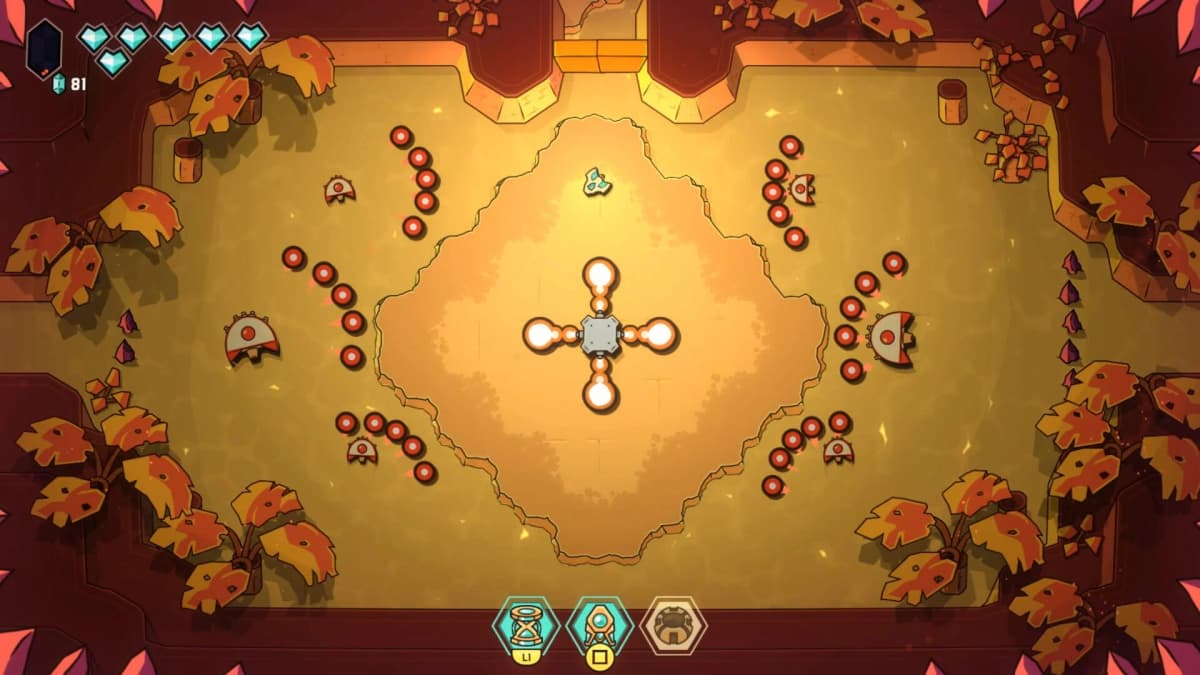
The combat encounters are short but dense. You’ll wander the overworld, slip into a cave or room, and boom: walls seal up, enemies appear, and the screen fills with patterns. It’s not full-on Touhou chaos, but it borrows that bullet-hell language: spirals, waves, slow-moving orbs herding you into danger. You’re always reading patterns more than reacting on raw twitch alone.
One early arena sticks with me. A cramped cave, turrets on the corners spraying fans of projectiles, then a wave of fast, suicide-dashing drones. On my first attempt I tried to clear the drones aggressively and just got shredded. On the successful run, I ended up hugging the safe lane along the edge, picking off turrets first, then cleaning up the rest. The fight lasted maybe thirty seconds, but the route-planning and little micro-corrections made it feel almost like a mini speedrun challenge.
The important bit: it’s tough without feeling cheap. On default difficulty, I died plenty, but I never felt like the game lied to me. There are three difficulty/assist setups to lean on if you want more or less pressure, including options to loosen the aiming requirements so you don’t have to be a twin-stick veteran to enjoy it.
Exploration that actually respects your curiosity
Underneath the shooting, Minishoot really is a Zelda-like at heart. There’s a compact overworld split into familiar biomes – forest, desert, gloomy caves, ruined tech – but the way it connects feels hand-crafted rather than checkbox open-world design.
Structure-wise, your broad goal is clear: free a set of major crystals from four main “dungeons” scattered around the map. What the game doesn’t do is slap giant quest markers and breadcrumb trails everywhere. After the first hour I had that old-school notebook feeling: “Okay, I saw a suspicious cracked wall near the waterfall, there was a blocked tunnel in the desert I can’t cross yet, and something glowing behind a water gap in the forest.”
New abilities – a dodge-roll to cross gaps, hovering over water, stronger boosts, that sort of thing — quietly unlock new paths all over the map. The fun is in remembering or noticing where they apply. At one point I’d just upgraded a movement ability in a dungeon, and on my way out I spotted an optional side path I definitely could not reach before. Chaining a precise boost into a roll across a tiny gap to grab a health upgrade, after staring at that collectible for two hours, was genuinely more satisfying than beating some AAA bosses I’ve fought this year.
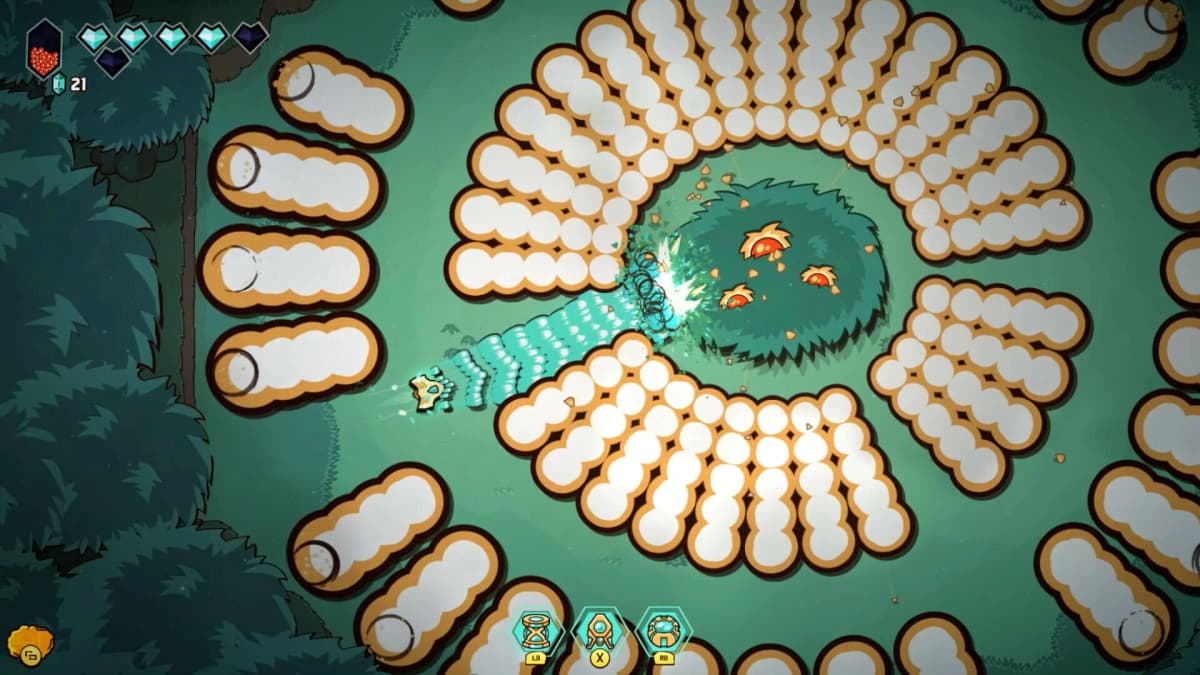
The world is littered with tiny caves and hidden nooks. Some are short combat challenges, others are almost puzzle rooms where you have to manage switches, hazards, and your movement toolkit without the usual Zelda crutch of “push the block on the obvious tile.” Because you’re a spaceship, puzzles lean more toward spatial awareness and dodging than crate-pushing logic, which keeps everything fast-paced.
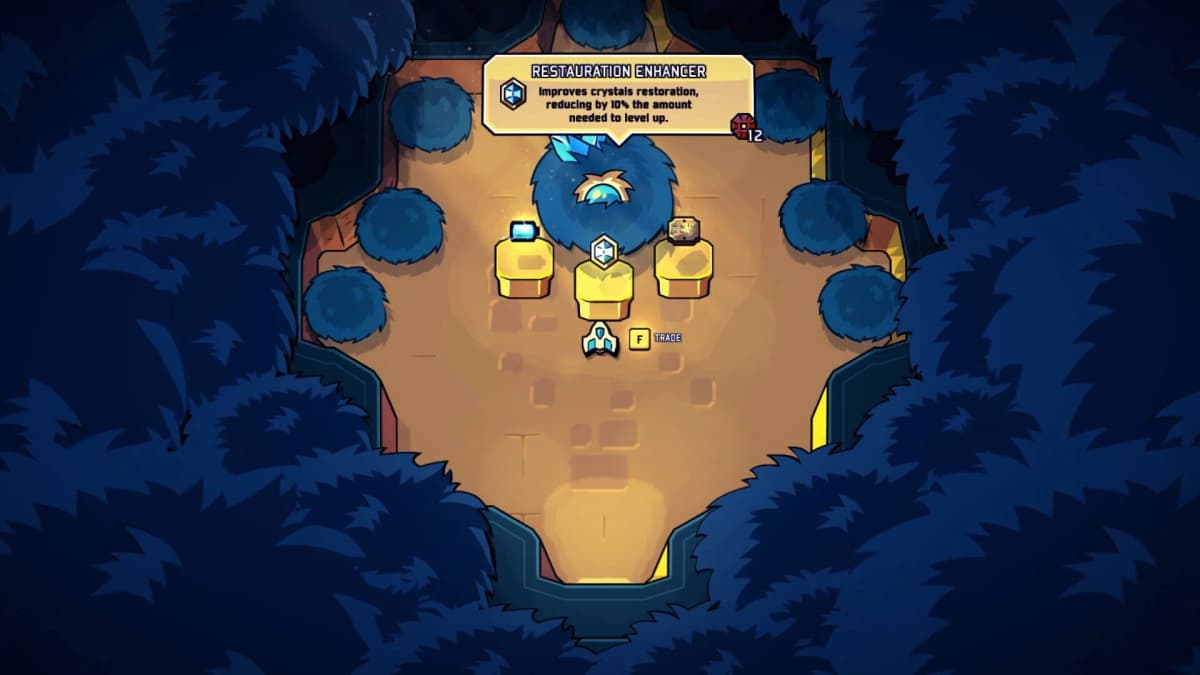
What I really appreciated is how rarely the game wastes your time. When Minishoot hides something, it’s almost always worth it: permanent health or shield upgrades, chunks of currency, or meaningful shortcuts. You don’t get five minutes of backtracking for a single coin. It trained me to investigate every slightly off-looking wall or suspiciously empty corner, because nine times out of ten, there is something there.
Progression and upgrades: the good kind of carrot
Your ship gradually turns from “barely scraping through rooms” to “confidently surfing bullet storms,” and the way that arc unfolds is a big part of why the game is hard to put down.
There are two main tracks: core abilities you unlock by progressing (the equivalent of Zelda’s new tools) and incremental stat boosts you buy or find. The latter uses a simple red crystal currency you get from enemies and chests. You funnel it into things like fire rate, shot range, damage, shield capacity, or boost regen at a few upgrade stations scattered around the world.
Some reviews called the upgrade progression a little slow, but playing blind on Game Pass I never felt hard-gated by grind. I naturally hit enough side rooms and caves that I was steadily improving without consciously farming. When I did backtrack to grab an extra chunk of currency, it was because I’d seen a juicy new upgrade node and could practically feel how it would change upcoming fights.
The key is that upgrades noticeably change the feel of the ship. A small bump to fire rate can be the difference between being forced into constant kiting and being able to stand your ground for a second and shred a wave before it closes in. Extending shot range subtly shifts encounters from panicky close-quarter dancing to something more surgical. It’s all very readable and tactile.
By the time I hit the last dungeon, I looked back at a forest cave that absolutely demolished me early on and walked through it first try. That return-trip power fantasy lands perfectly because it’s built on both your upgraded kit and your improved pattern recognition, not just arbitrary numbers climbing.
Boss fights: fair, readable, brutal if you get sloppy
A hybrid like this lives or dies on its bosses, and Minishoot absolutely understands that. Each main dungeon has a set-piece fight that leans hard into bullet-hell design without turning into pure memorization.
One mid-game boss — a towering, multi-phase guardian — starts out fairly tame: a few radial bullet patterns, gaps you can boost through, a safe corner or two. Once you pop its shields, it begins layering slow, sweeping beams with faster, aimed shots. On my first few attempts, I kept boosting instinctively, which actually pushed me into danger; the safe play was short, tiny nudges, trusting the hitbox, and saving boost only for the really ugly overlaps.
What I loved is that every time I died, I could point to the exact split second I messed up. Either I got greedy for damage and lingered in a bad lane, or I misread the direction of an incoming wave. There’s no “off-screen attack you couldn’t anticipate” nonsense. The game telegraphs cleanly and gives you enough tools; it’s on you to execute.
And if you do slam into a wall, the difficulty options are there. You can tone things down a notch so boss attacks hit a little softer or give yourself a wider margin for error without turning the game into a cakewalk. I didn’t touch them until one optional arena late in the game that I stubbornly banged my head against; knowing the sliders were available made the challenge feel voluntary rather than mean-spirited.
Performance and controls on consoles and PC
Most of my time was on Xbox Series X via Game Pass, with a short PC check-in just to see how mouse/keyboard felt. On console, it’s basically rock-solid: crisp 2D visuals, snappy loading, no frame hitches even when the screen is full of projectiles and particle effects.
Gamepad is absolutely the intended way to play. The analog aiming feels tuned perfectly to the ship’s movement speed, and the subtle vibration cues when you take damage or graze hazards add a lot of feel. On PC, mouse aiming is obviously laser-precise, but I actually preferred the slight friction of a stick, because it forces you to commit to lines and arcs rather than twitch-correcting everything instantly.
The Switch 2 and PS5 ports follow the same story from what I’ve seen and briefly tried: 60fps, clean image, no intrusive UI scaling weirdness. This is not a hardware-pushing showcase, but for a game where threading bullets is the core experience, performance being a total non-issue is exactly what you want.
Where Minishoot stumbles (a little)
For all the praise, a couple of rough edges kept it just short of instant-classic territory for me.
First, the presentation’s more functional than memorable. The art is cute, readable, and clean, but after a few hours I realized I couldn’t really picture many individual enemies in my head. The biomes are pleasant to look at rather than striking. It’s the kind of game that looks better in motion than in screenshots, but it never hits that “whoa, I need to show someone this scene” level.
That also applies to feedback on your weapons. Your basic blaster feels great to control, but visually and audibly it could use a bit more punch. I kept wishing for just a little more screen shake or a meatier impact sound once I’d upgraded it. In a genre where you’re firing constantly, that lack of big, crunchy feedback is noticeable.
Which leads neatly into the audio mixing. The soundtrack itself is fine — upbeat, slightly melancholy electronica that fits the vibe — but on several occasions the music swelled just enough to drown out the finer details of my shots and hit cues. Nothing game-breaking, and you can manually tweak levels, but out of the box it feels a touch off. In a bullet-hell game, sound is part of your situational awareness, so having it a bit muddled is a shame.
Finally, the campaign is compact. I hit credits in a bit under 10 hours while still leaving a handful of secrets behind. Personally, that’s a sweet spot — better a tight 8-10 hours than a bloated 25 — but if you’re expecting a sprawling, weeks-long epic because “Zelda-like,” temper that expectation. This is more A Link to the Past in scope than Tears of the Kingdom.
Who this is really for
If you live for discovering every last heart piece in a Zelda overworld and you also have a mild addiction to arcade shooters, this is a no-brainer. Minishoot captures the brain-tickling joy of poking at walls for secrets and layers on the adrenaline of bullet-dodging combat without either side feeling compromised.
If, on the other hand, you mainly play action-adventures for story or big emotional character arcs, this won’t scratch that itch. The narrative is light seasoning rather than the main course. Your motivation is almost entirely mechanical: get stronger, see what’s behind that suspicious rock, survive the next wave.
Also worth flagging: if bullet-hell patterns give you anxiety just looking at them, even the easiest settings might push your comfort zone. The assists help, the hitboxes are fair, but the fundamental loop is still “navigate dense fields of projectiles with precision.” For some players, that’s heaven. For others, it’s a panic attack in waiting.
As a Game Pass download, though? It’s one of the easiest recommendations on the service right now. The first hour will tell you immediately whether the movement and shooting click for you, and if they do, you’re in for a dangerously moreish weekend.
FinalBoss // Gear
Level up your setup
01Best-selling Switch 2 gameson Amazon→02Switch 2 accessorieson Amazon→038BitDo controllerson Amazon→04Discounted game keyson Kinguin→Affiliate links · As an Amazon Associate, FinalBoss earns from qualifying purchases.
Want to Level Up Your Gaming?
Get access to exclusive strategies, hidden tips, and pro-level insights that we don't share publicly.
Ultimate Reviews Strategy Guide + Weekly Pro Tips