
Table of Contents (7)
Living with the Audeze Maxwell 2: from “wow” to “why not more?”
The original Audeze Maxwell has been my “I know this is going to hurt, but put it on anyway” headset for the last year. Every time I reached for it, I braced for that hot spot on the top of my skull, then forgave it the second the soundstage opened up. Incredible planar-magnetic audio in a body that felt like a gym session for your neck.
So when the Maxwell 2 landed on my desk, I did what any hopeful masochist would do: I dropped my daily drivers, charged it up, and spent three weeks using it on PC, PS5, Switch, and my phone. Audeze promised better comfort, the same audiophile-grade drivers, some new SLAM tech on the low end, and a cleaner software experience. At $329 / £339, this thing is stepping into a ring full of heavy hitters like SteelSeries’ Nova line and Razer’s BlackShark series.
By the end of those three weeks, my feelings were split right down the middle. The Maxwell 2 absolutely nails the two most important pillars: sound quality and long-session comfort. But it also stubbornly refuses to join the modern “premium gaming headset” club when it comes to features and quality-of-life niceties. It is still, very clearly, an audiophile headset that wandered into a LAN party and refused to change clothes.
Comfort: the one big thing Audeze really did fix
My biggest question going in was simple: can I wear this bloody thing for more than two hours without my skull complaining? With the original Maxwell, the answer was usually “no.” That ski-band style strap was narrow and the cups felt like they were hanging off a rope tied around my head.
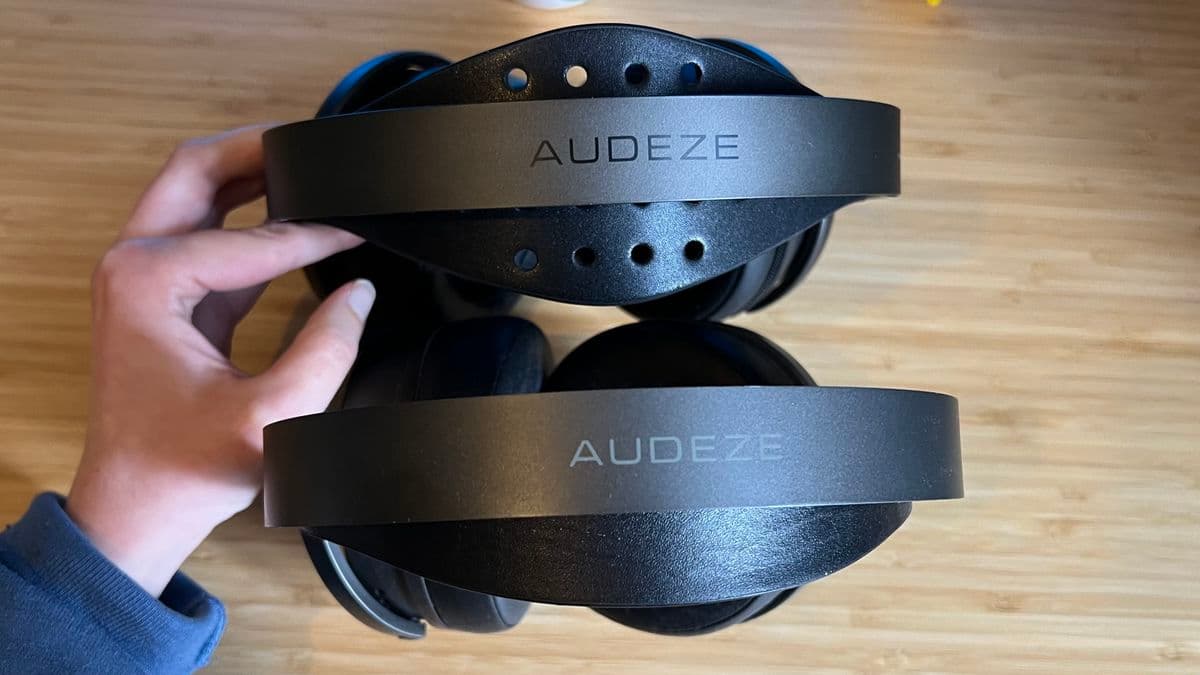
The Maxwell 2 keeps the general industrial-tank aesthetic, but widens the headband strap and tweaks the clamp force. Those sound like tiny changes on paper; in practice, they’re the reason I can actually recommend this to humans with skulls. The weight is still up there, and the cups are still big, but the load is spread out properly now. After three-hour runs of Doom: The Dark Ages on PC and long chill sessions in Spider-Man: Miles Morales on PS5, I didn’t get that “top of head bruise” feeling that the first Maxwell loved to gift me.
The leatherette earcups are thickly padded, almost square inside, and they fully engulf my ears without touching the outer edge. Clamp pressure is firm enough to feel secure but not Beyerdynamic-vice levels of tight. With my chunky glasses frames, I did get a very slight hotspot after about four hours, but it was minor and never turned into pain. This is miles ahead of the OG Maxwell, and honestly better than some lighter headsets that get lazy with their padding.
It doesn’t quite reach the “disappears on your head” sensation of something like the ultra-floaty Turtle Beach Atlas Air or the featherweight mid-range sets from SteelSeries, but for a planar-magnetic headset with 90mm drivers, this is comfortably in the “yeah, I can live in this” zone instead of the “only for special occasions” drawer.
Audio: still the cleanest gaming sound I’ve heard
The reason anyone is even looking at the Maxwell 2 is simple: planar-magnetic drivers. Audeze is reusing the same 90mm planar units from the original with a quoted 10Hz-50kHz frequency response. On paper that sounds identical, and honestly, in practice, it mostly is. That’s both the best compliment I can pay this headset and the first sign of why this sequel feels conservative.
In-game, the clarity is wild. Booting up Clair Obscur: Expedition 33, I immediately noticed how every little musical flourish sat in its own pocket. Strings, ambient effects, and timing-critical dodge cues all floated distinctly instead of smearing together. It felt less like a “wall of sound” and more like someone had laid the soundtrack out on a table in front of me.
I use Doom: The Dark Ages as a stress test for headsets because it’s pure chaos: chugging guitars, demon screams, explosions everywhere. Most gaming cans turn it into a big, bassy soup. The Maxwell 2 lets you hear each layer of that soup without watering it down. The growl of the soundtrack still hits, but the individual shotgun blasts, reload clicks, and enemy roars never vanish into the background. I never felt like the low end was swallowing the rest of the mix, which happens constantly on punchier, V-shaped headsets.

Competitive play benefits just as much. In CS2, footsteps and reloads come through like the game bumped them up a priority queue. Directional cues are laser sharp; I could reliably tell not just “left or right” but “slightly behind and above” on multi-level maps. It’s the same advantage I remember from the original Maxwell, and it’s still one of the best arguments for planar in a competitive context.
Music listening is where the Audeze DNA really flexes. Tracks like Grandmaster Flash’s “The Adventures of Grandmaster Flash on the Wheels of Steel” feel almost remixed by sheer virtue of how much space the Maxwell 2 gives everything. Vocals sit cleanly over the top, hi-hats stay crisp without fizz, and instruments are allowed to breathe in a way I rarely hear from “gaming” products. Throwing on heavier, more processed stuff like Grandson still maintains that clarity without turning the low end into mud.
There is a catch, though, and it’s the same one Audeze has always had in this gaming space: the bass is tight, but it’s not going to punch you in the teeth by default. Compared directly to something like the Razer BlackShark V3 Pro or SteelSeries Arctis Nova Pro Wireless, the Maxwell 2 feels more clinical and less warm. You can absolutely coax more grunt out with the Bass Boost preset, and tracks like “Figure It Out” by Chandler, Stafford Beats & YNG Martyr suddenly slam much harder, but it never quite becomes that subwoofer-in-your-head vibe those other sets go for.
Audeze’s newer SLAM tech is meant to enhance low-end impact and spatial positioning. Side by side with the original Maxwell, I could convince myself there’s a touch more weight in the lower mid-bass and slightly cleaner separation down low, but we’re firmly in “iterative” territory here. If you’re coming from the first Maxwell hoping for a night-and-day audio upgrade, you’re not going to find it. You’re buying roughly the same stellar sound with better comfort and a few tweaks, not a full-on sonic revolution.
Battery life: the marathon runner with no pit crew
Battery life on the Maxwell 2 is, in plain terms, ridiculous. Audeze claims up to 80 hours. In my testing, that figure felt believable: across a week of evening gaming (two to four hours a night) plus another few hours of music during workdays, I still had close to half a charge left by the weekend. I wasn’t babying it either – volume was around 60-70%, mostly on 2.4GHz with a bit of Bluetooth music in between.
Compared to a lot of premium headsets, that’s a flex. It outlasts the Razer BlackShark V3 Pro and absolutely stomps on headsets in the 20–30 hour range. But raw hours don’t tell the full story. SteelSeries’ higher-end Nova models, for example, lean on hot-swappable batteries or docks, so you rarely think about charging at all – you just drop the headset on a base station or swap a cell and keep playing.
With the Maxwell 2, the system is old-school: plug a USB-C cable in and wait. The huge battery means you’re not doing that often, which softens the blow, but once you’ve lived with truly hot-swappable or docked charging, being yanked back to “tether it overnight” feels less premium than the price tag suggests.

Features and software: audiophile brain, gamer body
This is where the Maxwell 2 starts to feel like it belongs to a slightly different era of gaming headsets. It gives you the basics: 2.4GHz low-latency wireless via a USB-C dongle, Bluetooth, and a wired option. Switching the dongle between PC, PS5, and Switch (via dock or handheld) worked without drama. Latency on 2.4GHz felt rock solid – I never noticed desync in rhythm games or gunfights.
The problem isn’t what’s there; it’s what’s missing for a $329 / £339 “flagship” in 2026. The most frustrating omission is simultaneous 2.4GHz and Bluetooth audio. This has quietly become one of my must-have features. Being able to pipe in Discord or a phone call over Bluetooth while running game audio through the dongle is just part of my normal routine now. I also like tossing on my own Spotify playlist on my phone while grinding in something like Fallout 76 or Planet Coaster.
The Maxwell 2 simply doesn’t do that trick. It’s either 2.4GHz or Bluetooth, one at a time. If you’re coming from a headset that already juggles both, this will feel like a step backward, not sideways.
On the software side, Audeze has clearly improved things over the original Maxwell’s barebones feel. The desktop app is cleaner, you get a 10-band EQ, and there are a handful of presets tailored for different use cases – competitive FPS, bass boost, more neutral listening, that sort of thing. It does what it needs to do, and if you’re the type who likes to nudge frequencies around until everything feels just right, you’ll have enough control.
But again, stack it next to what SteelSeries is doing on its high-end Nova line and the gap shows. There’s no deep per-game preset library, no elaborate spatial processing layer you can endlessly tinker with, none of the “gamer candy” extras. If you want that kind of ecosystem, the Maxwell 2 will feel pragmatic rather than luxurious.
Microphone: “good enough” on a very expensive headset
The detachable boom mic is probably the most underwhelming part of the Maxwell 2 package. On paper, it’s a hypercardioid mic with AI noise reduction. In practice, it’s… fine. My friends on Discord consistently described it as “clear but thin.” They could hear me perfectly, but there’s a lack of richness or body to the sound compared with mics on some Razer and Beyerdynamic headsets I’ve used recently.
The noise reduction is a mixed bag. With a fan running nearby and a mechanical keyboard clacking away, the Maxwell 2 did a decent job of suppressing background sounds without turning everything into mush. Under heavier loads – loud music in the room, people talking behind me – it sometimes clipped the top of my words, especially if I spoke softly. It’s totally usable for gaming and casual chat, but if you’re hoping to ditch your standalone mic, this isn’t quite there.
A gaming headset at this price doesn’t need a broadcast-grade microphone, but when the sound and build quality are this premium, the “just okay” mic stands out like a scuff on a sports car.
Who the Maxwell 2 is really for
After three weeks of swapping between the Maxwell 2 and some of my usual suspects – high-end SteelSeries cans, Razer’s bassy monsters, and more mid-range all-rounders – a pattern emerged. Every time I wanted to just listen, whether to a demanding game mix or to music while working, I instinctively reached for the Audeze. Every time I needed creature comforts – dual wireless, hot-swappable batteries, fancier software – I reached for something else.
If you’re the kind of person who already owns, or has been eyeing, proper audiophile headphones and you want that level of fidelity in a convenient wireless gaming package, the Maxwell 2 is one of the strongest arguments on the market. The clarity, staging, and separation are good enough that you start to forget you’re listening to a “gaming headset” at all. And now that the comfort is genuinely solid, it’s no longer a “great sound if you’re willing to suffer” proposition.
On the other hand, if you value flexibility and slick UX as much as pristine audio, the compromises sting. The lack of simultaneous Bluetooth and 2.4GHz is hard to swallow when cheaper wireless headsets offer it. The absence of hot-swappable batteries or a charging dock feels old-fashioned. The mic is usable but unremarkable. When you compare that to rivals that sacrifice a bit of sonic purity for a warmer sound and throw in a bunch of everyday conveniences, the Maxwell 2 can feel slightly one-dimensional.
I also wouldn’t recommend this as an upgrade path from the original Maxwell unless comfort is your number one priority. The audio improvements are subtle, the feature set is largely the same, and the price isn’t exactly impulse-buy territory. If you already own the OG and have made your peace with the fit, you’re not missing a whole new tier of performance here.
FinalBoss // Gear
Level up your setup
01Top-rated gaming headsetson Amazon→02High-refresh gaming monitorson Amazon→03Gaming chairson Amazon→04Discounted game keyson Kinguin→Affiliate links · As an Amazon Associate, FinalBoss earns from qualifying purchases.
Want to Level Up Your Gaming?
Get access to exclusive strategies, hidden tips, and pro-level insights that we don't share publicly.
Ultimate Reviews Strategy Guide + Weekly Pro Tips