
Badwater changed the logic of river planning in Timberborn. A settlement that could survive by thinking mostly about drought storage now has to think about separation first: where clean water goes, where contaminated flow goes, and how quickly the system can switch between the two. That is why the most reliable current advice treats badwater as a routing problem, not a storage problem.
If you want the short version before the deep dive, it is this: divert badwater as close to the source as your terrain allows, keep your drinking water and farm supply on a separate branch, use a dual-channel setup that can flip automatically, and only look for power or industrial value after your colony’s clean-water loop is protected. Trying to “hold” badwater in the same river or reservoir you depend on is what creates the long, messy recovery periods that wipe out crops and force emergency hauling.
Table of Contents (8)
What badwater is supposed to do in Timberborn
In current Timberborn play, badwater is not just an ugly river state or a minor inconvenience. It is a contamination mechanic that turns a shared waterway into a hazard if you do not isolate it early. You encounter it through the game’s contaminated-flow systems rather than as a crafted resource you deliberately unlock first. That distinction matters, because the colony usually meets badwater as a disruption before it ever uses it as an economic tool.
That is also why player discussions split on how interesting it is. Some players see it as mostly a logistical nuisance layered on top of an already demanding water economy. Others think it adds a meaningful design challenge because it forces cleaner infrastructure and makes river control more than a question of dam height. Both readings can be true. What is not really disputed is the practical consequence: if badwater reaches your main drinking supply or irrigation network, the colony pays for it immediately.
Your first priority is not power, it is survival
Broad community advice is consistent on one point: protect farms and potable water before you try to extract value from badwater. Losing a possible power source is annoying. Losing crop irrigation or contaminating the settlement’s water path can become a colony-ending spiral, because food and drinking water failures compound faster than most production setbacks.
- Protect settlement-facing reservoirs first.
- Keep farm and irrigation channels on the clean side of the system.
- Make the badwater branch a dead end, off-map outlet, or isolated industrial loop.
- Treat power generation from badwater as a bonus layer, not the core plan.
That order helps because it simplifies every later decision. Once clean water is isolated, you can experiment with using badwater. If clean water is not isolated, every experiment carries settlement-wide risk.
The most reliable layout is a dual-channel T-valve
The layout that shows up again and again in player guides is a dual-channel “T-valve” design. One branch continues toward your main reservoirs, pumps, farms, and settlement water infrastructure. The other branch acts as a waste chute. In clean conditions, water is allowed through the settlement branch. When contamination appears, the system closes the clean path and opens the waste path so badwater gets dumped somewhere harmless.
The important part is not the exact shape of the canal. The important part is that the split happens early. If your control point sits too far downstream, the upstream river section can fill with badwater before your infrastructure reacts. That leaves you with a long flush time even after the valves switch correctly, because the contaminated stretch still has to clear out before clean flow fully returns.
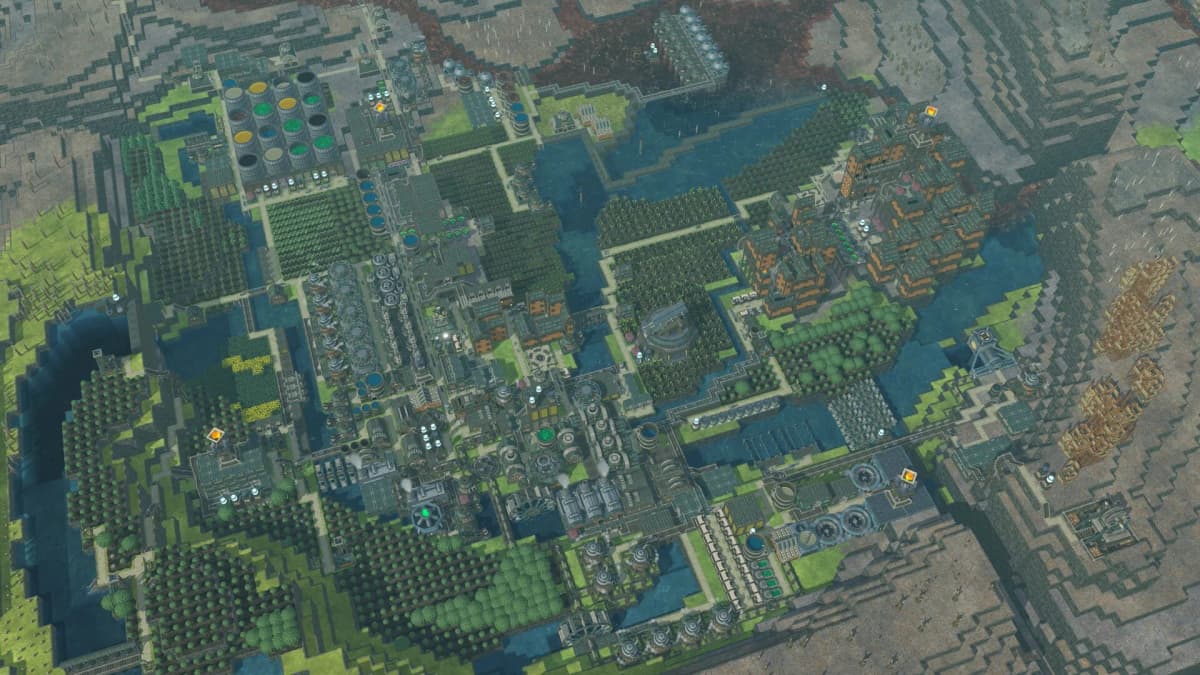
In practice, a good T-valve setup usually does three jobs at once:
- It gives clean water a protected route toward storage and irrigation.
- It gives badwater a path that does not reconnect to the colony’s main river.
- It creates a single control point, which makes later automation much easier.
This is why the “just build more reservoir space” answer underperforms. More storage does not solve contamination if the wrong fluid is entering the same network.
Why automation matters more than manual floodgates
Manual floodgates can work early, especially on simple maps or when you are still building out your first safe canal. The problem is reliability. Badwater is most punishing when you react late, and manual systems depend on noticing the event, pausing the game at the right moment, and flipping every relevant structure in the correct order. That is a lot to ask once your colony has multiple channels, stacked reservoirs, and power loops.
That is why recent tutorials lean toward Sluices, fill valves, or throttling valves tied to contamination-aware logic. The advantage is not elegance. The advantage is that the system flips at the source without waiting for player attention. Clean-water infrastructure stays isolated by default, and the badwater branch becomes the automatic fallback.
A recurring rule of thumb in player setups is a 5% contamination threshold. Multiple guides use some version of “close the clean branch when contamination rises above 5%, reopen it when it falls below that line,” or the reverse depending on the structure involved. That should be treated as a common practical trigger, not a universal law. It is useful because it is early enough to catch contamination before it spreads too far, but exact best settings can vary with map layout, flow volume, faction tech, and patch changes.
If you are building automation, the safer mindset is: choose a threshold that protects the clean branch early, then test whether the system clears quickly. The number matters less than the routing. A perfect trigger on a bad layout is still a bad system.

Where to send badwater once you have isolated it
Once the contaminated branch is split off, you have three broad uses for it. The first is disposal, and that is the easiest one to recommend. A dead-end canal, an off-map exit, or any dedicated route that cannot backflow into your main river is the lowest-risk answer. This is the best choice when the colony is still stabilizing, when the map gives you an easy downhill dump route, or when your settlement cannot afford a recovery failure.
The second use is controlled industrial handling. Community discussion often points to isolated pumping or processing setups where badwater stays inside a purpose-built loop. The key word there is isolated. If you are going to pump or route it around working buildings, do not let that loop reconnect to farm channels, central reservoirs, or general-purpose river traffic.
The third use is power generation. Some late-game builds route badwater through waterwheels or down vertical shafts to squeeze useful energy out of a hazard. This can be efficient, but it should come after you already trust the diversion system. Power builds tend to be the point where players reconnect channels for convenience and accidentally reintroduce contamination risk into the colony’s clean-water side.
The safe rule is simple: if you cannot clearly explain where contaminated flow ends and how it stays separate the whole way, it is not isolated enough to be a production asset yet.
Badwater source protection is where player opinions start to diverge
There is less agreement on the best way to protect or cap badwater sources than there is on the need to separate them. Some players argue that a formalized cap is unnecessary and that a cheaper levee-plus-overhang enclosure can do the job. Tutorial-style builds more often favor explicit valve, sluice, or canal infrastructure because it is clearer to control and easier to integrate into automated logic.
The useful takeaway is not that one camp is correct on every map. It is that map geometry changes the answer. Tight terrain with obvious choke points favors engineered valve systems because one control node can manage the whole river. Awkward terrain, short-term budgets, or early colony constraints may push you toward simpler enclosure tricks until the settlement can afford a cleaner rebuild.

That uncertainty is also why “optimal” badwater design is still not fully settled. Community consensus is strongest on the broad strategy and weaker on the exact structure mix. Manual gates, automated sluices, and more elaborate valve networks can all work if the split happens early and the clean branch remains truly separate.
Common failures usually point to the same design flaw
When a badwater system fails, the symptom can look different, but the root cause is often the same: separation happened too late or not completely.
- Your reservoir stays contaminated for too long: the diversion point is probably too far downstream, so the upstream river body is acting like temporary storage for badwater.
- Farms die even though the main river was switched: your irrigation path is still connected to the shared water network somewhere you overlooked.
- The system works manually but not consistently: the colony has grown past what hand-switched gates can safely manage.
- Power setups keep causing recovery headaches: the badwater loop is producing value, but it is not truly isolated from your clean-water branch.
That is why the best correction is usually structural, not reactive. More pumps, more emergency hauling, or more storage only mask the issue if the water is still sharing the wrong channel.
The long-term role of badwater in a strong colony
Badwater works best in Timberborn when you stop treating it like a special event and start treating it like a second class of river traffic. Clean water and contaminated water want different infrastructure. Once you design around that fact, badwater stops being a random crisis and becomes a logistics layer you can predict: clean branch for survival, waste branch for disposal, optional isolated branch for industry or power.
If you are rebuilding an older settlement for the current design, that one change in mindset matters more than any single building choice. Separate early, automate the switch if possible, place the control point near the source, and only monetize badwater after food and potable water are already safe.
FinalBoss // Gear
Level up your setup
01Graphics cardson Amazon→02Gaming laptopson Amazon→03High-refresh gaming monitorson Amazon→04Discounted game keyson Kinguin→
Affiliate links · As an Amazon Associate, FinalBoss earns from qualifying purchases.
Want to Level Up Your Gaming?
Get access to exclusive strategies, hidden tips, and pro-level insights that we don't share publicly.
Ultimate Guide Strategy Guide + Weekly Pro Tips