
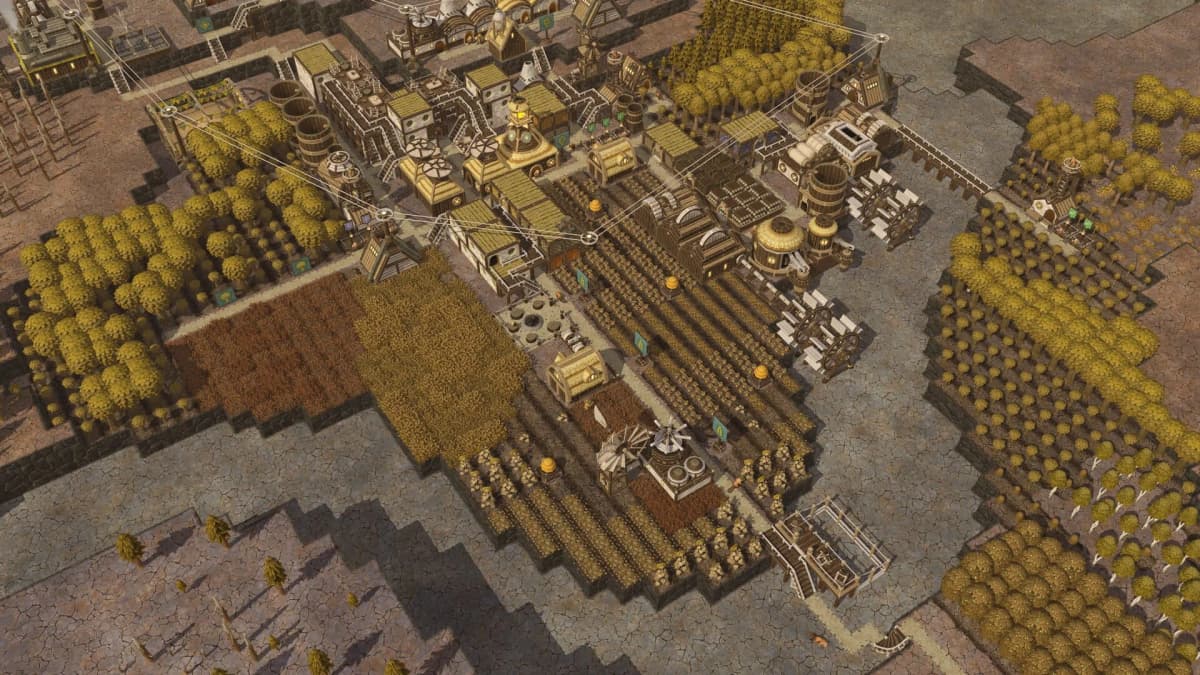
Timberborn’s water game used to be mostly about surviving droughts with bigger reservoirs. Once badwater became part of the planning problem, that stopped being enough. A colony that relies on dams for everything will usually hit the same wall: clean water storage gets contaminated, irrigation collapses at the wrong moment, and downstream canals swing between flood and empty. The fix is to stop treating every water block like it does the same job. In both real waterworks and Timberborn, the distinction is functional: dams are for holding and raising water, sluices are for controlled release and routing, and valve-style tools are for maintaining a target level where you need stability rather than bulk storage.
If you want the practical answer first, use dams to build reservoirs and extend irrigation, use sluices to decide where water or badwater goes and when it is allowed through, and use fill valves to keep downstream channels at a chosen depth without manually babysitting the system. The most reliable clean-water setup is almost never “one giant lake behind a dam.” It is a reservoir feeding a controlled line, with badwater split off early into a bypass, waste canal, off-map exit, or an industrial loop that never touches drinking storage.
Table of Contents (10)
The short version: what each tool is actually for
- Dam: Raises water level and stores volume. Great for early reservoirs and irrigation reach. Bad at full separation because water spills over once it reaches its overflow height.
- Sluice: A control piece for release, direction, and threshold-based routing. Best when you need to break pressure chains, isolate branches, or send badwater somewhere specific.
- Fill valve: A depth regulator. It opens to maintain a downstream target level, which makes it excellent for stable canals, farm rows, and refill basins.
The easy mistake is using a storage tool as a routing tool. A dam can make a river survivable; it does not make that river selective. When badwater hits, the dam will still behave like a dam. It will hold until it spills, and then it will spread the problem. Sluices and fill valves are what let you decide which water reaches which space.
When dams are the right answer
Dams are still the foundation of most early and midgame colonies because they do two things extremely well: they increase the standing water level in a river, and they turn flowing water into stored water. That matters for irrigation range, pump uptime, and drought survival. Current guide material consistently treats dams as the earliest and most efficient way to extend green land without redesigning the whole valley.
The key number to remember is that a standard dam is not a full-height wall. Community-tested references place its spill point at roughly 0.65 of a tile. That is why dams are so good for shallow reservoirs and so poor for contamination control. If the water behind it rises high enough, it goes over. For clean water management, that is often perfect. For badwater containment, it is a trap.
Use dams when your goal is one of these:
- Creating a shallow upstream reservoir that keeps pumps and crops alive longer.
- Backing up a river so irrigation reaches fields that would otherwise dry out.
- Smoothing out seasonal changes before the water reaches the rest of your settlement.
Do not use a dam as your main badwater separator. If you need a full barrier, that is a levee or a fully controlled gate job. The common failure case is putting a dam between a clean reservoir and a badwater-prone branch, then assuming the line is safe because the water looks calm most of the season. The first surge proves otherwise.
Why sluices matter more than older “just build another wall” advice
Sluices are where Timberborn’s water control becomes precise. In practical colony layouts, they work as elevation-setting, one-way control points that let you hold a downstream level, stop reverse contamination, and deliberately route badwater away from clean storage. That makes them much closer to a discharge-control tool than a storage block. The underlying logic matches real water systems: the more demanding the pressure difference and routing problem, the more you want a dedicated control mechanism instead of a passive barrier.
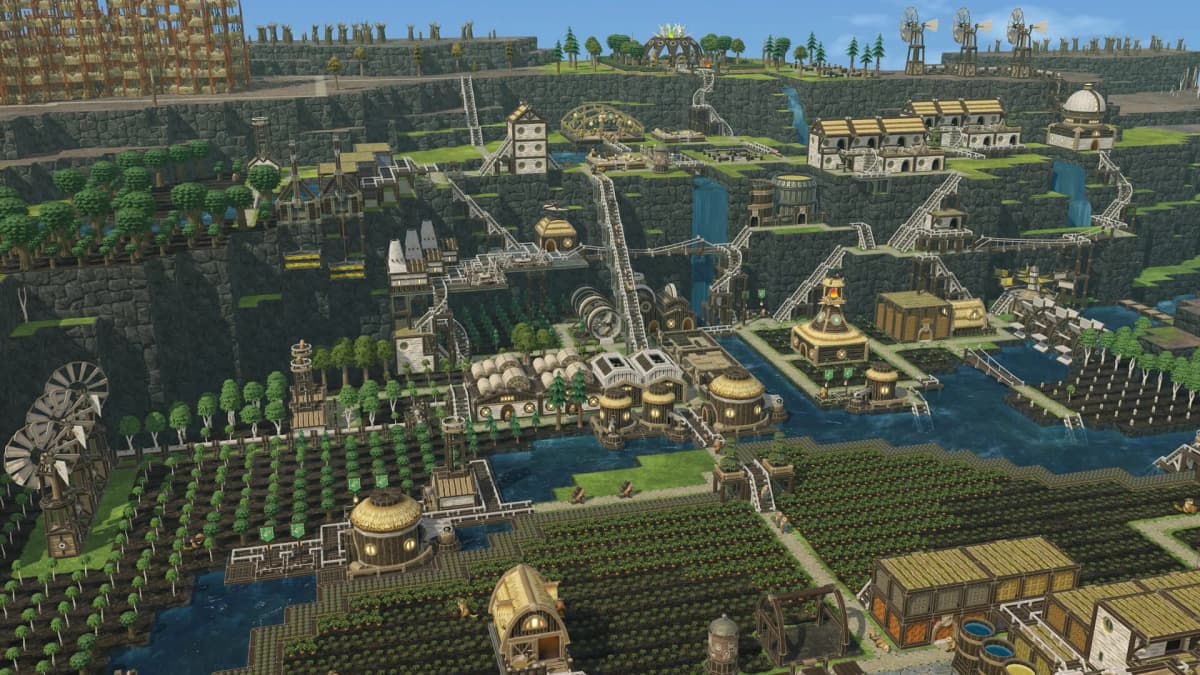
This is why current badwater guides tend to solve the issue at the junction, not at the reservoir. You split the contaminated flow early, send it into a dead-end canal, off-map outlet, or industrial basin, and keep your clean-water chain physically separate. A sluice placed in the right chokepoint does three jobs at once: it prevents backflow into the main line, it lets you choose a pass level, and it breaks the “one bad tile poisons everything downstream” problem into smaller controlled segments.
Use sluices when your goal is one of these:
- Sending badwater into a bypass channel before it reaches your pumps or farms.
- Protecting a clean reservoir from downstream pressure or reverse spread.
- Creating a stepped river where each basin has its own controlled level.
- Replacing manual seasonal switching with a more stable routing system.
A good rule is simple: put the sluice at the decision point, not at the cleanup point. If a river branch can become badwater, place the control block where that branch splits from the clean system. If you wait until the contamination is already inside your storage lake or irrigation channel, the sluice is no longer choosing a route; it is only limiting the damage.
Sluices also outperform “just stack more dams” when head pressure builds across height changes. Even outside Timberborn, heavier sluice-style controls are the preferred answer in high-head situations because they are built for active regulation. The in-game lesson is the same: use the control piece where water level differences are doing work against you.
Where fill valves fit in
Fill valves solve a different problem from both dams and sluices. They are not there to hold a river back and they are not mainly there to choose a destination. Their value is downstream stability. Current guide material describes the fill valve as a one-way outlet that keeps a target depth on the far side by opening when that side drops below the set level. In other words, it behaves more like an on/off depth regulator than a fine flow meter.
That makes fill valves perfect for:
- Keeping irrigation trenches wet without overfilling them.
- Feeding a district canal from a reservoir without constant manual gate changes.
- Recharging a farm basin after drought or after a badwater diversion event.
The mistake here is expecting a fill valve to replace a routing system. It cannot decide which liquid you should accept into the network. It only maintains the level once the source side is acceptable. Put differently: sluices choose the lane, fill valves smooth the lane.
Three routing patterns that stay reliable
1. Early-game reservoir with badwater bypass
This is the safest simple layout. Build your main clean-water reservoir with dams on the primary river. Before that river reaches your pumps and fields, carve a side canal that leads away from the settlement. Put the sluice at the split, not halfway down the waste canal. The clean branch continues toward storage and farms; the bad branch has only one job, which is disposal.
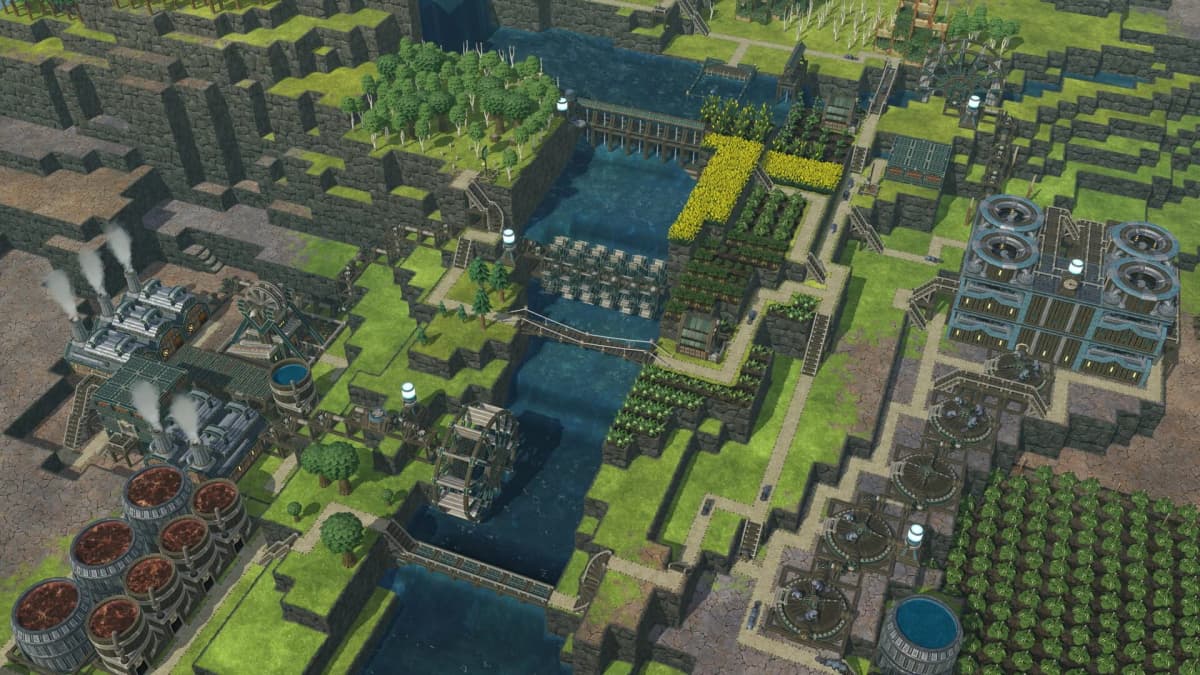
Why it works: the reservoir still does what early reservoirs are supposed to do, but the risky liquid is handled before it shares space with your useful water. If the map allows it, the best destination is an off-map exit. If not, a dead-end containment trench is better than polluting your main basin.
2. Stepped basins for clean-water districts
For larger colonies, divide the river into separate basins instead of one long uncontrolled corridor. Each basin gets its own storage role. Sluices control transfer between basins, and fill valves keep the district-side canals at the depth you want. This is slower to build, but it is much more fault-tolerant. One contaminated or drained segment does not instantly ruin every farm below it.
Why it works: you stop thinking of the river as one object. Each step becomes a chamber with a clear purpose: storage, routing, consumption, or disposal. That is the shift from surviving water to managing it.
3. Industrial badwater loop, clean water isolated
If you are far enough along to use badwater deliberately, keep that loop separate from drinking and irrigation water. Route badwater from its source or seasonal inflow into its own channel, basin, or processing area through a sluice-controlled branch. Do not store it in the same reservoir you depend on for crops, even temporarily. The common high-reliability community pattern is to treat badwater as something to move through a purpose-built lane rather than something to stockpile beside your town.
Why it works: a mixed-use reservoir saves space but creates cascading failures. A dedicated badwater loop costs more blocks up front and saves entire districts later.
Troubleshooting the most common failures
- Your clean reservoir keeps getting contaminated: there is usually no true separation. Replace any “holding” dam at the contamination boundary with a full barrier or a properly placed sluice-controlled split.
- Downstream farms keep drying even with a large reservoir: storage volume is not the issue. Add a fill valve to maintain the farm canal depth, or break the line into smaller controlled basins.
- Badwater still reaches pumps during surge periods: your diversion is too late in the route. Move the control point upstream to the first branch where the badwater can be sent away.
- The river feels unpredictable after terrain changes: too many passive blocks are doing active-control work. Simplify the system so each segment has one job: store, route, or regulate depth.
- You built one massive lake and now every fix is expensive: divide it. Large shared reservoirs look efficient, but modular basins are much easier to debug and protect.
The rule that keeps the whole system readable
If a block is there to hold water, it is usually a dam problem. If it is there to decide where water goes, it is a sluice problem. If it is there to keep a useful channel at a stable level, it is a fill valve problem. Most broken Timberborn water networks are not short on capacity. They are short on role separation. Once clean water storage, badwater disposal, and canal depth are treated as three different jobs, the layout stops fighting itself.
FinalBoss // Gear
Level up your setup
01Graphics cardson Amazon→02Gaming laptopson Amazon→03High-refresh gaming monitorson Amazon→04Discounted game keyson Kinguin→
Affiliate links · As an Amazon Associate, FinalBoss earns from qualifying purchases.
Want to Level Up Your Gaming?
Get access to exclusive strategies, hidden tips, and pro-level insights that we don't share publicly.
Ultimate Guide Strategy Guide + Weekly Pro Tips