
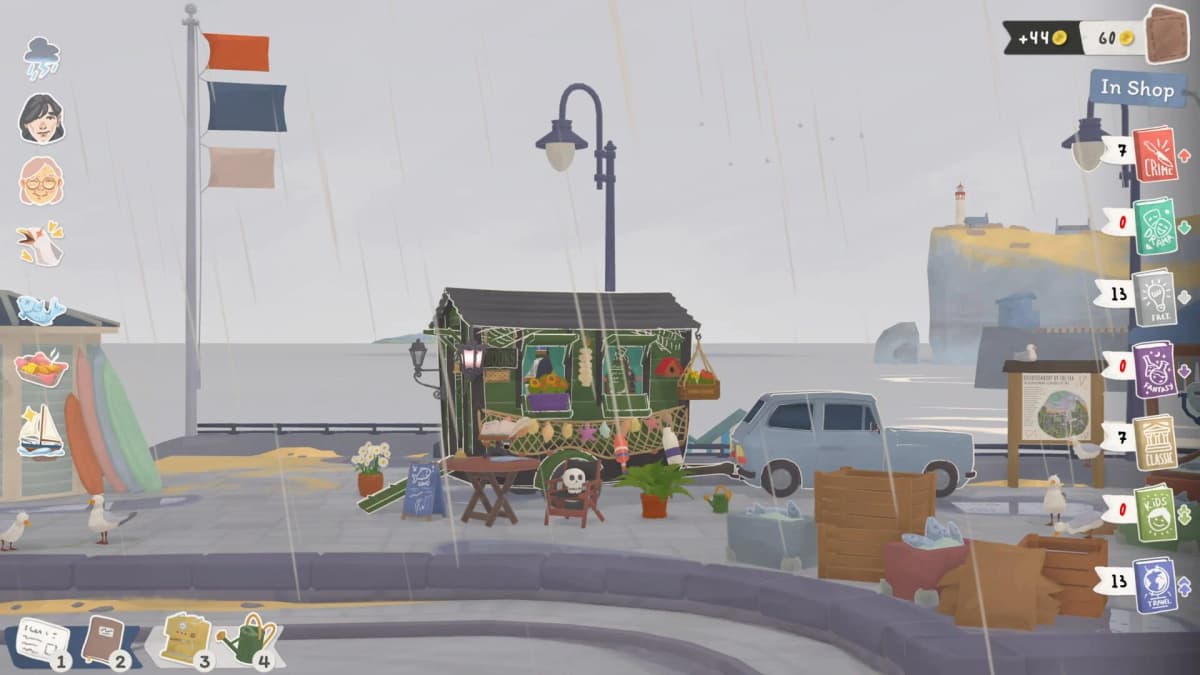
Tiny Bookshop has more heart in one careful book recommendation than most shop sims find in an entire upgrade tree. I parked my little second-hand trailer in a new spot, arranged the shelves, watched customers wander over, and quickly realized that Neoludic Games cares far more about human connection than squeezing every possible coin from a paperback.
I loved that immediately. I also felt the limits of that gentleness once the daily rhythm settled into place. Tiny Bookshop gave me a warm, bookish escape full of real titles, small-town conversations, and satisfying matches between reader and book. It also asked me to repeat its core routine often enough that the magic occasionally wore thin around the edges.
Table of Contents (8)
Key Takeaways
- I found Tiny Bookshop’s best idea in its recommendation system, where choosing the right title helped customers and pushed their personal stories forward.
- I loved the pauseable day structure because it let me enjoy the shop’s relaxed pace without feeling rushed by every customer interaction.
- I found the real-book descriptions, book bottles, mystery boxes, and timed word bubbles genuinely effective at making discovery feel tactile and personal.
- I felt the loop grow repetitive during longer sessions, especially once parking, stocking, decorating, and selling became familiar routine.
- I recommend it strongly to readers who want a slow, story-led cozy sim, while players craving deep management pressure should wait.
A Bookshop Where the People Matter More Than the Profit
I never treated Tiny Bookshop like a race toward financial domination, because the game never rewarded me for thinking that way. I ran a mobile second-hand bookshop attached to a car, moved between locations each day, bought stock, decorated my trailer, and opened for business. The money mattered, of course, but I got the real satisfaction from recognizing what a customer needed and putting the right book in their hands.
That choice gives Tiny Bookshop its identity. I could sell several books in a day and still remember the one recommendation that landed perfectly: a customer offered a few clues through a brief conversation, I combed through my inventory, and I picked a title whose description fit their mood or interest. A successful recommendation could increase the day’s sales and move that person’s story along, but I cared more about the tiny sense of recognition behind it.
I found myself reading the descriptions instead of skimming for a price tag. Because the shelves contain real books, the act of browsing had texture. I wasn’t selecting a vague fantasy novel with a made-up stat bonus. I was thinking about genre, tone, subject matter, and the little details that might make a book feel right for somebody standing at my counter.
That is the strongest reason to play Tiny Bookshop. I spent my best moments treating each interaction like a small act of literary matchmaking. The game turned a simple shop transaction into a personal exchange, and it kept pulling me back because I wanted to see where those recurring customers and townsfolk would go next.
Pauseable Days Give the Cozy Loop Room to Breathe
I appreciated the pauseable day system more than I expected. Tiny Bookshop has customers, books, sales, requests, and timed prompts competing for attention, yet it never forced me into frantic multitasking. I could stop the flow of the day, inspect my shelves, reread a book’s description, consider a request, and make a choice without turning a pleasant browsing game into a test of reflexes.
That pause button changed the entire mood of the shop. I could let a customer’s request sit for a moment while I considered whether their few keywords pointed toward romance, mystery, a personal memoir, or something stranger. I could also take in the trailer itself: the books, the decorations, the little visual touches that made the business feel like mine rather than a spreadsheet with a storefront attached.
I still felt pressure in the right places. Timed word bubbles gave conversations a snap of urgency, especially when I was trying to catch the right clue before it vanished. Those moments kept me attentive without making me anxious. I had to listen, react, and connect the customer’s language to the books I owned, but I never felt like the game was punishing me for wanting to think.
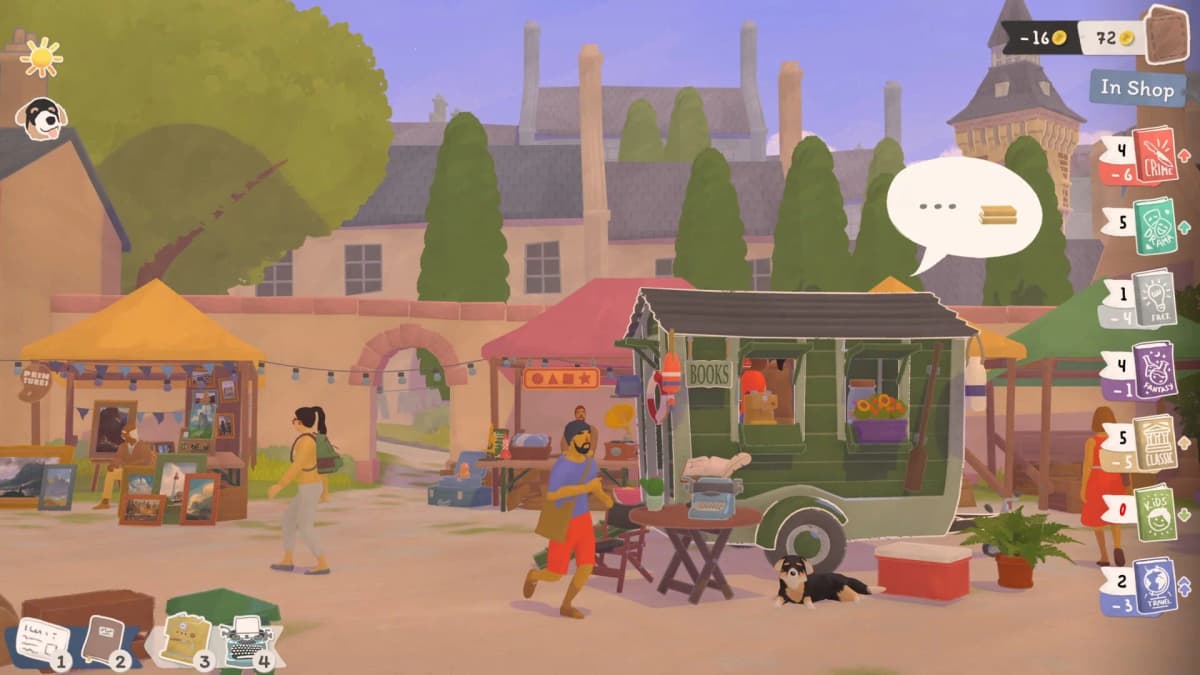
That balance is difficult to get right. Tiny Bookshop uses time as a nudge, not a whip. I could play a day at a relaxed pace, pause when the shelves demanded my attention, and still feel the passing of time as customers came and went. For a game built around quiet reading and conversation, that pacing fits perfectly.
The Book Bottles and Mystery Boxes Keep the Shelves Interesting
I enjoyed the book bottles and mystery boxes because they gave my inventory a little jolt of surprise. Tiny Bookshop needs that uncertainty. Buying books could have become a completely mechanical restocking task, but these discovery moments kept me curious about what might enter the trailer next and who it might eventually suit.
I found myself building small mental connections between books and customers as my shelves filled. A newly found title was never only another object to sell. It could become the answer to a future request, a way to improve a relationship, or the missing piece in a customer’s ongoing thread. That prospect made stocking the shop feel more deliberate than simply buying whatever was cheapest.
The real-book descriptions also did serious work here. I spent time reading them because they became practical tools for recommendations, yet they also strengthened the fantasy of owning a tiny second-hand shop. I felt like I was sorting through a collection with history and personality rather than managing anonymous inventory categories.
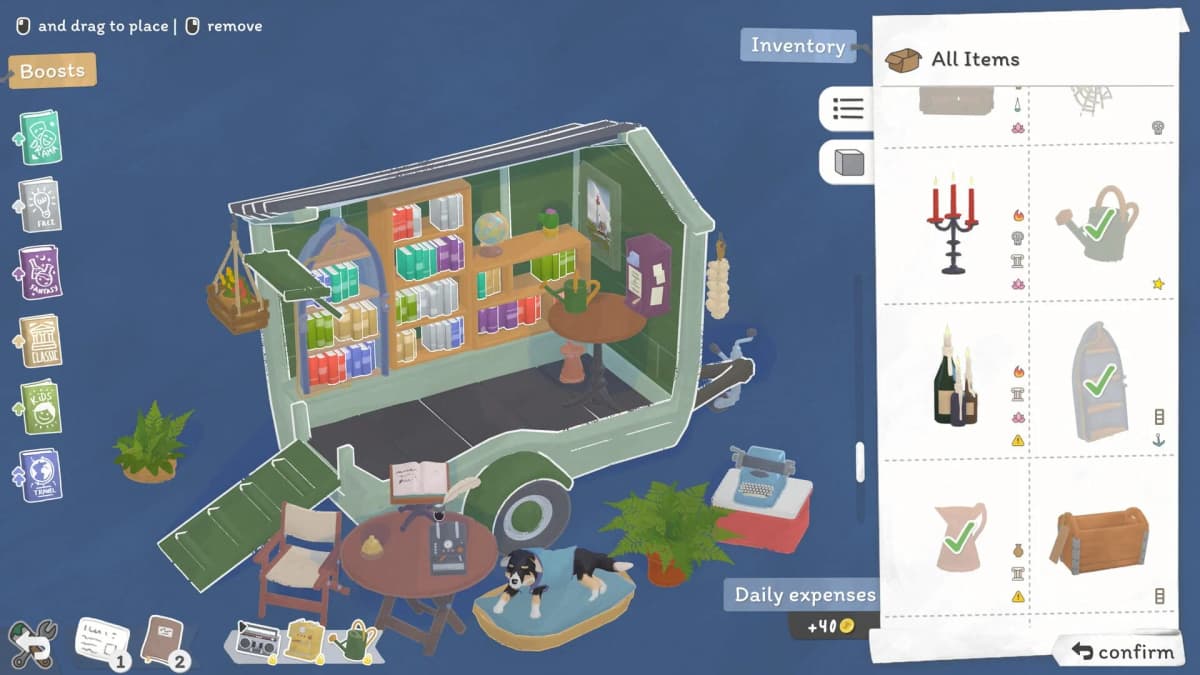
Decorating completed that feeling. I liked giving the trailer its own character, even when decoration remained more about atmosphere than hard optimization. Tiny Bookshop understands that a cozy shop must feel inviting before it can feel efficient. I wanted my shelves and ornaments to reflect the kind of place where someone might linger, talk about a favorite author, and leave with an unexpected find.
The Routine Eventually Shows Its Repeated Seams
I felt Tiny Bookshop’s weakness whenever I pushed through several days in one sitting. The cycle of arriving at a location, arranging stock, opening the shop, serving customers, and preparing for the next day stays pleasant, but it does not keep transforming itself. The same gentle cadence that makes the game calming can make it feel overly familiar.
I never wanted harsher systems or aggressive profit targets shoved into the game. That would betray its whole point. I wanted more moments that made the routine feel newly alive: more surprises from my stock, more memorable turns in the customer stories, and more reasons for my choice of location and shop presentation to matter emotionally from day to day.
The repetition hit hardest when I approached the game like a management sim. Tiny Bookshop has a business layer, but it does not have the appetite for deep economic tinkering. I could buy books, sell books, manage a limited collection, and make my trailer prettier, yet I never found the kind of dense systems that reward obsessive efficiency.
I consider that a strength until I don’t. When I played in short, relaxed bursts, the routine felt like a comforting ritual. When I treated it as a long-form management challenge, I noticed how little friction, risk, and mechanical escalation sat beneath the lovely presentation. The game works best when I let the people and their requests set the pace.
Who Should Buy Tiny Bookshop
I recommend Tiny Bookshop to players who read book descriptions for fun, enjoy slow-paced daily routines, and value small character moments over giant mechanical systems. I also recommend it to anyone who wants a cozy game that respects their time and never turns a customer request into a stressful performance test.
I would buy it for the recommendation mechanic alone if personal stories and literary discovery appeal to you. Matching a book to a person gives every successful sale a warmth that ordinary shopkeeping games rarely reach. I kept returning because I wanted to help people, not because I wanted to crack an economy wide open.
I would wait if you need complex management systems, constant mechanical variety, or a demanding challenge curve. Tiny Bookshop keeps its ambitions small and intimate. I found that focus refreshing, but I also felt the repetition before I was ready to call the loop endlessly replayable.
I also like the mobile approach. The iOS and Android version has touch-first controls, a free demo, and a one-time purchase to unlock the full game. That structure suits a game I enjoyed in shorter pockets of time, where one or two shop days felt soothing instead of overly familiar.
I can also point console players toward the next wave of releases: Tiny Bookshop arrives on PlayStation 5 and Xbox Series X|S on April 10, 2026, with an Xbox Game Pass launch on day one. It is already available across PC and Steam, Nintendo Switch, iOS, and Android.
Bottom Line
I came away from Tiny Bookshop convinced that its anti-min-max philosophy is exactly right. I never needed the game to make me feel like a retail genius. I wanted it to make me feel like the owner of a welcoming little trailer full of books, half-remembered recommendations, and customers whose stories mattered beyond the cash register.
I loved the pauseable days, the timed word bubbles, the real-book descriptions, and the quiet satisfaction of finding the right title for the right person. I also felt the daily loop repeat itself too plainly once the novelty faded. Tiny Bookshop earns its charm through care, not complexity, and I respect it for knowing exactly where its heart is.
TL;DR
I recommend Tiny Bookshop for readers and cozy-game players who want thoughtful recommendations, low-pressure shopkeeping, and character-driven storytelling. I would wait for a sale if you need a deep management sim with constantly evolving systems. My final score is 8/10.
FinalBoss // Gear
Level up your setup
01Top-rated gaming headsetson Amazon→02High-refresh gaming monitorson Amazon→03Gaming chairson Amazon→04Discounted game keyson Kinguin→Affiliate links · As an Amazon Associate, FinalBoss earns from qualifying purchases.
Want to Level Up Your Gaming?
Get access to exclusive strategies, hidden tips, and pro-level insights that we don't share publicly.
Ultimate Reviews Strategy Guide + Weekly Pro Tips