
Table of Contents (9)
Toy Battle: 15 minutes of war on the kitchen table
The first night I opened Toy Battle, my partner and I said the classic lie: “One quick game before bed.” Four battles and almost an hour later, we were still hunched over the tiny battlefield, arguing about whether that suicidal rubber duck play had been genius or nonsense.
Toy Battle is a compact two-player strategy game by Paolo Mori and Alessandro Zucchini, published by Repos Production and illustrated by Paul Mafayon. It just walked away with the As d’Or 2026 – the French “Game of the Year” prize at the Festival International des Jeux in Cannes – and immediately went back into print after an early sell-out. That’s a lot of hype for a little box promising 15‑minute games and rules simple enough for an eight-year-old.
On paper, it’s “just” a tile-placement skirmish: you play toy troops onto a shared board, trying to either storm your opponent’s headquarters or outscore them by controlling key regions. In practice, Toy Battle sits in that sweet spot I’m always hunting for in two-player games: easy to teach, genuinely tense, and mean in the best way.
Across roughly 20 matches over a week – with a mix of casual and try-hard moods – the game kept revealing little tactical wrinkles without ever losing its breezy pace. It’s not a heavy brain-burner, and some people will bounce off the luck in the draw. But as a fast, thinky duel that fits in a backpack and a lunch break, Toy Battle absolutely earns the attention it’s getting.
Key takeaways after a week with Toy Battle
- Player count: strictly 2 players. This is designed as a duel and nothing else.
- Play time: about 15 minutes a game. Our fastest was 8, our longest around 20.
- Rules: teachable in under 5 minutes; kids around 8+ can genuinely play.
- Gameplay: tile placement + area control + a roster of quirky toy units.
- Variety: 8 different battlefields, each with a small rules twist or layout trick.
- Feel: constant tug‑of‑war between expanding your line and striking the enemy HQ.
- Luck vs skill: random tile draws absolutely matter, but good players still win more.
- Components: charming art, solid tiles; only real issue is readability when stacks get tall.
How it works: racks, routes, and rubber ducks
Mechanically, Toy Battle is disarmingly simple. Before each game, you pick one of eight battlefield boards: maybe the castle plains, a floating cloud city, or a volcanic jungle. Each layout has two opposing headquarters (HQs), a cluster of neutral bases in the middle, and printed paths and regions that will matter later.
Each player has their own little army of toy tiles. You don’t shuffle them into a deck; instead, they sit in a personal pool. You draw three at random to form your starting “rack” (it’s basically a Scrabble rack standing upright so your opponent can’t see your pieces), and you’ll slowly refill it as the game goes on, up to eight tiles.
On your turn, you do exactly one of two things:
- Draw two random tiles from your reserve, adding them to your rack (up to eight), or
- Deploy one tile from your rack onto the board.
Deployment is where all the rules – and all the mind games – live. You can place a troop:
- On an empty neutral base,
- On top of one of your own tiles (reinforcing it),
- On top of an enemy tile with lower strength, capturing it, or
- Directly into your opponent’s HQ… which wins you the game on the spot.
The catch: every tile you place has to stay connected to your own HQ by an unbroken chain of bases you control. You’re effectively extending a line of influence from your HQ out into the map. If you overextend and your opponent cuts your path, suddenly half your army is no longer eligible for reinforcements. My first “oh no” moment was watching two of my proudly advanced robots get stranded because a single, smug skeleton cut my supply line.
Each unit type has a strength value and a special power. A few that dominated our arguments:
- Skeleton (1 strength): pathetically weak in a fight, but lets you draw extra troops when deployed.
- Robot (5 strength): a solid attacker that forces your opponent to discard a random tile from their rack.
- Dinosaur (7 strength): a massive brute with no ability, used when you just want to smash something.
- Rubber duck: can sit on top of any unit regardless of strength, but loses to literally everything.
The full roster covers different little tricks, but those four alone tell you a lot about the game’s tone. You’re constantly weighing tempo (playing a weak unit now for its ability) against board presence (saving for a beefier troop later). Toss in a few special bases on each map that trigger extra effects when you control them, and soon you’re juggling short-term combos, long-term positioning, and the ever-present possibility of an HQ rush.
There’s a second win condition layered on top of the HQ race: medals. The board is divided into regions, each surrounded by several bases. Control all the bases encircling a region, and you instantly grab the medals shown there. Hit the medal target for that battlefield, and you win even if the enemy HQ is still standing. In our early plays we tunnel-visioned on rushing the HQ; by game five, we were pulling off sneaky medal victories that felt almost like winning on points in a fighting game.
On the battlefield: why these short duels feel so tense
One of the first things that struck me is how complete each game arc feels despite the short length. You start with lowly units, nervously poking out from your HQ, trying to secure a foothold in the central no man’s land. Then midgame hits: both players have a spine of connected bases, scary units start to appear, and every placement feels like a small dare. Late game is all about nerve: you’re either reinforcing a path for a decisive HQ strike or desperately patching holes in your regions before your opponent snatches that last medal.
In one particularly memorable match on the cloud city board, my partner committed hard to a broad front, dropping mid-strength units to lock down multiple regions. I turtled instead, hoarding tiles turn after turn while they teased me about “not playing the game.” Then in three consecutive turns I played skeleton, robot, dinosaur along a single path, punching a tunnel through their line and dropping a final piece straight into their HQ. It felt outrageously unfair… until we swapped seats and I got punished for the same greedy stockpiling on the next map.
That’s Toy Battle’s rhythm: you’re always one or two placements away from disaster. Because of the connectivity rule, a single captured base can suddenly flip an area from safe to exposed. Because units stack, large piles represent both security (harder to overthrow) and risk (lose that base and the whole tower is gone). And because each map has tiny twists – extra medals here, riskier paths there – it never feels like you’re just playing the same grid with a different illustration.
The end result is that the game invites both casual trash talk and serious calculation. We had turns where someone casually slammed a rubber duck on top of a dinosaur just because it was funny, and others where we stared in silence at the board for a solid minute, visualising three moves ahead. That mix is exactly what I want from a short two-player title.
Random draws, real skill: does Toy Battle feel fair?
If there’s one thing that might turn off hardcore strategists, it’s the randomness. Your troops come from a personal pool, but you draw them at random to your rack. Sometimes you’ll pull exactly the piece you need to complete a devastating combo. Sometimes you’ll be sitting on a handful of ducks when what you really want is a dinosaur.
I had a couple of games where my opening draws were obviously better: early skeletons to build up my hand, a robot at just the right time to snipe a key tile from my opponent. Those wins felt a bit cheap. But across a lot of plays, a pattern emerged that I recognise from other “light but sharp” games like Jaipur or Schotten Totten: luck dictates the tactical skirmishes, but skill guides the overall battle.
Some of the ways better play shines through despite the randomness:
- Timing your draw turns. New players tend to spam deployments every turn, then crash into a wall when they run out of useful tiles. Experienced players treat drawing as an investment, especially right before a map’s big confrontation zones.
- Understanding your army’s composition. Even though the draw is random, you know roughly how many copies of each unit exist. There’s a big difference between playing your last dinosaur recklessly and holding it back as a late-game deterrent.
- Prioritising paths vs regions. Chasing both the HQ and medals at once is a trap. Strong players identify early whether the map layout favours a rush or a slow bleed of points.
- Accepting losses. Sometimes sacrificing a strong unit to shore up your path is better than contesting every fight. The game rewards players who can let a region go in order to secure the real win condition.
That said, you do need to be okay with swings. If you hate when your opponent top-decks the perfect card in a card game, you will absolutely curse Toy Battle now and then. The saving grace is that each match is so short. A “that was nonsense, rematch” moment is fixed in 15 minutes, not an entire evening blown on a single skewed result.
For me, the randomness fits the toy-war theme. It feels like rummaging around in a messy toy box, grabbing whatever plastic critter comes to hand and making the best of it. As long as you walk in expecting a tactical skirmish rather than a deterministic abstract like Chess or Go, the mix of chaos and calculation is satisfying.
Production, art, and that annoying stack problem
Repos Production usually knows how to make an inviting box, and Toy Battle is no exception. The tiles are thick and pleasant to handle, the battlefields are cleanly laid out, and Paul Mafayon’s art strikes a nice balance: colourful and playful without turning the game into a pure kids’ toy. The little robot, in particular, has this slightly smug face that makes losing to it sting a bit more.
Iconography is generally clear. After the first game we rarely had to peek at the player aid to remember what each unit did. The maps also cleverly use colour and borders to indicate regions and medal areas without drowning you in symbols.
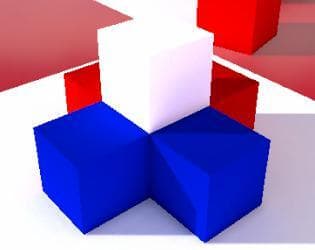
The one genuine production flaw is readability when tiles start stacking. Because you’re allowed – and often encouraged – to pile units on top of each other, some bases end up as three or four tiles tall. When both players are leaning over the table, trying to remember whether that tower is two of yours and one enemy, or the other way around, it can get messy. We had a couple of moments where we miscounted control of a region simply because the stacks were hard to parse at a glance.
It’s not game-breaking, and you quickly get into the habit of straightening stacks and announcing big captures aloud to keep things clear. But compared to how polished the rest of the production feels, it stands out as the one “I wish they’d solved this better” aspect.
I also tried a few games on the digital adaptation over on Board Game Arena, and funnily enough, that’s where the stacking issue disappears entirely. The interface makes it trivial to see who owns what at all times. If you’re curious about Toy Battle and want to test the waters before buying, the online version is a genuinely good representation of the tabletop feel.
Who Toy Battle is really for
After a dozen or so matches with different people, a clear picture formed of who’s going to love this game and who might shrug.
- Perfect for: couples who enjoy head-to-head games; roommates looking for a quick strategy fix; families with kids around 8–12 who can handle light take-that; hobby gamers who want a sharp filler between heavier titles.
- Less ideal for: players who hate any form of randomness in strategy games; people allergic to direct confrontation; groups who mostly play at higher counts and rarely have exactly two at the table.
For me, Toy Battle slides neatly into the same mental shelf as games like Jaipur, Hive, or Schotten Totten: tight two-player experiences that respect your time but still reward repeated play. It’s not trying to be your new “main game” that eats whole evenings. It’s the opener, the closer, or the “we’ve got 20 minutes before dinner, want to fight over some plastic dinosaurs?” option.
Coming into it, I was a bit skeptical about the As d’Or buzz. 2025 and early 2026 have been stacked with excellent two-player releases; Toy Battle didn’t have an obvious gimmick beyond “toys fighting on a board.” A few sessions in, I understood why it cut through the noise: it’s aggressively focused on doing one thing very, very well. No bloat, no campaign mode, no collectible nonsense. Just a clean little duel system that almost anyone can grasp and almost everyone can enjoy at some level.
Bottom line: a tiny box that earns its As d’Or (9/10)
After a week of living with Toy Battle, the As d’Or 2026 win no longer feels like a surprise headline; it feels obvious. This is exactly the kind of design that award juries – and honestly, my own table – should be celebrating: compact, approachable, and polished, yet still smart enough that you keep thinking about past matches in the shower.
It isn’t flawless. Stacked tiles can be hard to read. A few games are going to swing on lucky or unlucky draws. If you only like your strategy games long, crunchy, and deterministic, you’ll probably respect Toy Battle more than you’ll love it.
But as a fast two-player clash you can teach to non-gamers, pull out on weeknights, and still enjoy after dozens of plays, it’s outstanding. The eight battlefields keep things fresh, the toy theme softens the blows just enough, and the decision space is richer than the rules would suggest at first glance.
TL;DR
- Toy Battle is a two-player-only, 15-minute strategy game about rival toy armies fighting over shared battlefields.
- Rules are extremely simple – draw or deploy a tile – but the connectivity, stacking, and medal systems create real depth.
- Eight different maps with small twists keep the game from feeling repetitive even after many plays.
- Random tile draws can swing individual games, but better players still win more over time.
- Production is charming and compact, with one notable flaw: tall stacks of tiles can be hard to read quickly.
- If you like quick, tactical duels with a bit of chaos and direct confrontation, Toy Battle is an easy recommendation.
- If you want long, heavy, perfectly balanced brain-burners, this will feel more like a clever snack than a full meal.
FinalBoss // Gear
Level up your setup
01Top-rated gaming headsetson Amazon→02High-refresh gaming monitorson Amazon→03Gaming chairson Amazon→04Discounted game keyson Kinguin→Affiliate links · As an Amazon Associate, FinalBoss earns from qualifying purchases.
Want to Level Up Your Gaming?
Get access to exclusive strategies, hidden tips, and pro-level insights that we don't share publicly.
Ultimate Reviews Strategy Guide + Weekly Pro Tips