
Table of Contents (9)
The day I realised Ubisoft’s dumbest characters were actually its smartest idea
I’m a Rayman kid. PlayStation in my parents’ living room, that opening in Rayman 1 with the music and the giant photo of the dev team on the wall – that’s baked into my brain. For years, if you’d told me that Ubisoft would one day sideline Rayman, their artsy limbless prince, to push a bunch of screaming, bug-eyed rabbits, I’d have laughed in your face.
And yet here we are. In 2026, the characters that best represent Ubisoft’s creative soul aren’t Assassins, aren’t Tom Clancy grunts, and, yeah, aren’t even Rayman. They’re the Rabbids. Those “Bwaaah”-screaming idiots from 2006 who looked like a one-joke minigame gimmick have quietly become Ubisoft’s most creatively successful mascot – and Mario + Rabbids Kingdom Battle is the moment that became impossible to deny.
That realisation hit me late. It wasn’t playing the very first Rayman Raving Rabbids on Wii in 2006, even though I had a blast wrenching imaginary worms out of their disgusting teeth and blasting them with plungers in those on-rails shooting sections. Back then, I filed it under “weird Rayman spin-off, good for parties, whatever.”
No, the moment it finally clicked was when I booted up Mario + Rabbids Kingdom Battle on my Switch in 2017 – half out of curiosity, half to rubberneck a potential trainwreck. A Mario crossover with Ubisoft’s loudest mistake? Tactical RPG combat “like XCOM” slapped on top? It sounded like a boardroom joke that somehow got greenlit.
By the time I’d finished the first world, I had to admit something that genuinely annoyed me: these idiots had grown up. And somewhere along the way, they’d quietly become the best thing Ubisoft had going.
From background goblins to main event: how the Rabbids stole the show from Rayman
The Rabbids started life as antagonists, and honestly, that’s how they felt in 2006: antagonists to me personally as a Rayman fan. Rayman contre les Lapins Crétins (Rayman Raving Rabbids) tossed our hero into a gladiator-style prison where the only way out was to survive increasingly absurd minigames. Every four successful sets, you got a rail shooter section where you blasted Rabbids with plungers like some slapstick carnival of violence.
What made it work wasn’t the motion gimmicks; it was the tone. The Rabbids were aggressively stupid, loud, and crude, but there was precision in that stupidity. It felt closer to classic Looney Tunes or Aardman-style chaos than the generically “quirky” mascots we usually get. Ubisoft doubled down with Rayman contre les Lapins encore plus Crétins, dropping most of the narrative pretext and going full party game. That’s the moment they crossed into the real world in the intro, invading our reality – and culturally, that’s exactly what happened afterward.
They’re everywhere now: TV shows, merch, memes, kids who’ve never even touched a Rayman game screaming “Bwaaah!” in supermarkets. If you love Rayman, that can sting. I’ve been that guy grumbling, “Cool, but where’s my new 2D Rayman?” while some new Rabbids thing got announced. But if you zoom out and look at pure character design and flexibility, it’s painfully obvious why they took over.
Rayman is whimsical, sure, but he’s also specific. His world has a vibe: dreamlike forests, fairytale villains, that almost French BD (bande dessinée) aesthetic. You can’t just drop Rayman into anything. Rabbids? They’re chaos incarnate. They work as villains, protagonists, extras, parodies, even props. They’re blank enough to be moulded, but expressive enough to stay memorable. From a pure mascot design perspective, that’s gold.
The Big Adventure: when the joke suddenly got teeth
The turning point for me wasn’t actually Mario. It was 2009’s The Lapins Crétins : La Grosse Aventure (Rabbids Go Home). The pitch is peak Rabbids nonsense: they decide they want to go to the Moon, so they try to build a giant trash mountain high enough to reach it. That’s it. That’s the story. Idiot poetry.
On paper, it’s a simple 3D platformer where two Rabbids push a shopping cart through human environments, hoovering up as many objects as possible without getting caught. Mechanically, yeah, it’s a bit linear and repetitive by today’s standards. But replaying it a few years ago, I realised something that teenage me completely missed: this dumb game about psychotic rabbits is one of Ubisoft’s sharpest bits of satire.
You’re literally racing through supermarkets and city streets, stripping everything bare to pile it up into a monument of garbage. In the background, you hear stuff like “work more to earn more… and consume more,” delivered with that cold advertising tone. It’s almost too on the nose, but that’s exactly why it works. The game quietly flips the script: the humans, obsessed with work and consumption, are just as ridiculous and brainless as the Rabbids. The difference is that the Rabbids are honest about it.
And then there’s the soundtrack. That Balkan-style fanfare, the manic brass and accordion, the way it swings between silly and strangely melancholic – it’s one of those scores that lodges itself in your brain and refuses to leave. To this day, if someone so much as mentions that game, snippets of the music start looping in my head. This isn’t throwaway licensed pop or generic orchestral filler; it’s a strong, bizarre musical identity that actually amplifies the satire.
So while a chunk of the internet was busy writing the Rabbids off as “Minions but French and louder,” Ubisoft was sneaking in one of the most biting, stylish takes on consumer society they’ve ever done. And it was starring their “stupid” mascot. That’s the moment where, in hindsight, you can see the Rabbids starting to outgrow the party-game ghetto.
Ubisoft got safer, the Rabbids stayed weird
Fast forward a bit, and look at Ubisoft’s broader trajectory. The last decade is a mess of open-world templates, yearly sequels, “games-as-a-service” pitches, and now a massive internal restructuring that’s more about cutting costs than taking creative swings. Whole projects canned, studios reorged into “creative houses,” long-awaited remakes stuck in limbo – it’s not exactly the spirit that made the original Rayman or Prince of Persia happen.
In that context, the Rabbids are almost an anomaly. They’re one of the rare Ubisoft properties that’s allowed – or maybe forced – to stay playful. You can’t make a gritty live-service loot shooter with Rabbids. You can’t dump them into a po-faced Tom Clancy plot. They drag everything back into absurdity, and that’s their power. Even when the games themselves are clearly designed to be broadly accessible and family-friendly, you feel an undercurrent of genuine creative mischief that’s missing from a lot of Ubisoft’s “serious” output.
That’s why Mario + Rabbids Kingdom Battle hit me so hard. It wasn’t just that it was good – it was that it felt like the last place in the company where real risk and real care were genuinely colliding.
Mario + Rabbids Kingdom Battle: the crossover that had no right to work (but absolutely did)
Let’s be honest: when those early leaks of a Mario/Rabbids crossover floated around, most of us mocked the hell out of it. The PowerPoint-looking key art, Mario holding a gun-like device, Rabbids cosplaying as Peach and Luigi – it looked like peak brand-synergy nonsense. And Nintendo is notoriously protective of Mario, so the whole thing felt wrong.
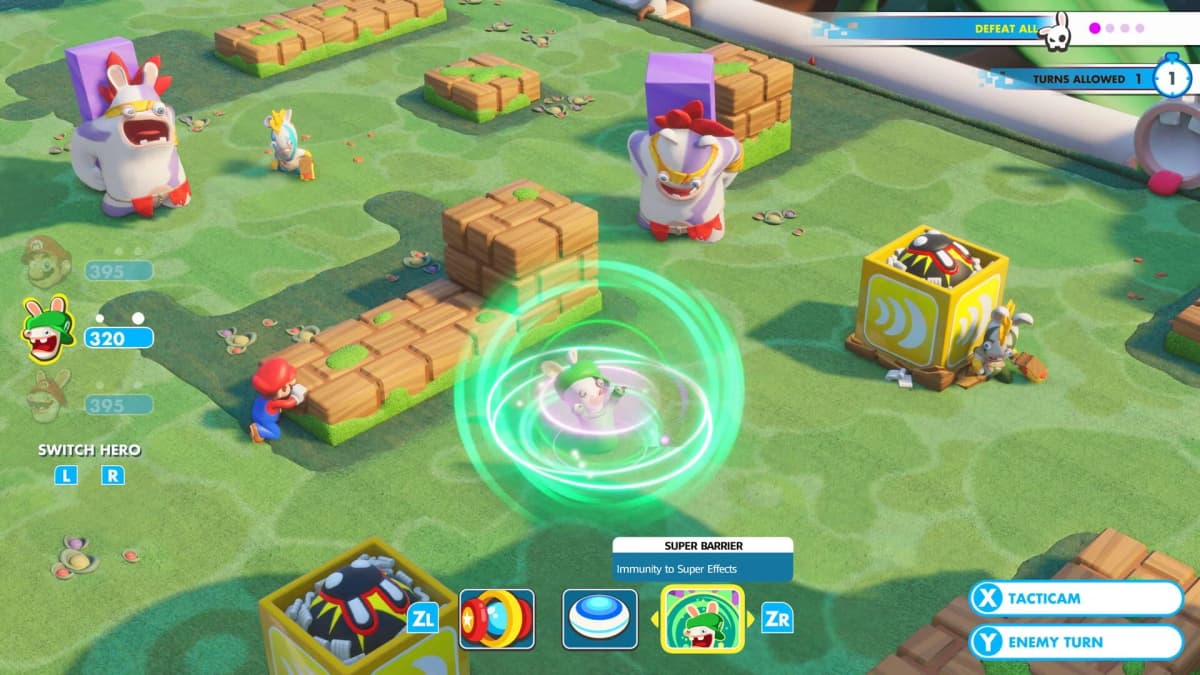
Then we saw it properly. Behind the leaked slides was a tactical RPG in the lineage of XCOM: Enemy Unknown, reimagined for a wider audience. Cover systems, movement ranges, flanking, overwatch-style reactions – all the stuff I love in hardcore tactics games, but wrapped in something bright enough that my non-gamer cousin could pick it up. Suddenly, this wasn’t a meme; it was a wild, actually daring idea.
Playing Kingdom Battle for the first time, I kept waiting for the compromise. Okay, here’s where they’ll make it trivial. Here’s where they’ll drown everything in cutscenes. Here’s where the Rabbids will turn into a constant, grating sideshow. Instead, the opposite happened: Nintendo’s presence forced Ubisoft to refine the Rabbids’ humour, not tone it down, and the tactics were deeper than they had any right to be in a crossover starring homicidal bunnies.
Rabbid Peach is the perfect example. On paper, “Rabbid dressed like Peach taking selfies” sounds like lowest-common-denominator internet humour. In practice, she steals every scene she’s in. The exaggerated poses, the petty jealousy, the way her animations contrast with Peach’s more composed vibe – it becomes this running gag that actually tells you something about both characters. It’s parody with affection, not cheap mockery.
Rabbid Peach is the perfect example. On paper, “Rabbid dressed like Peach taking selfies” sounds like lowest-common-denominator internet humour. In practice, she steals every scene she’s in. The exaggerated poses, the petty jealousy, the way her animations contrast with Peach’s more composed vibe – it becomes this running gag that actually tells you something about both characters. It’s parody with affection, not cheap mockery.
🎮 Get This Game at the Best Price
Compare prices instantly and save up to 80% on Steam keys with Kinguin — trusted by 15+ million gamers worldwide.
*Affiliate link — supports our independent coverage at no extra cost to you
And that balance runs through the whole game. The Rabbids aren’t there to drag Mario into the mud; they’re there to poke holes in how squeaky-clean his world has always been. That opera boss battle? It’s a ridiculous, over-the-top setpiece that still asks you to think carefully about positioning and timing under pressure. You’re laughing, but you’re also sweating the turn order. That’s not an accident; that’s good design.
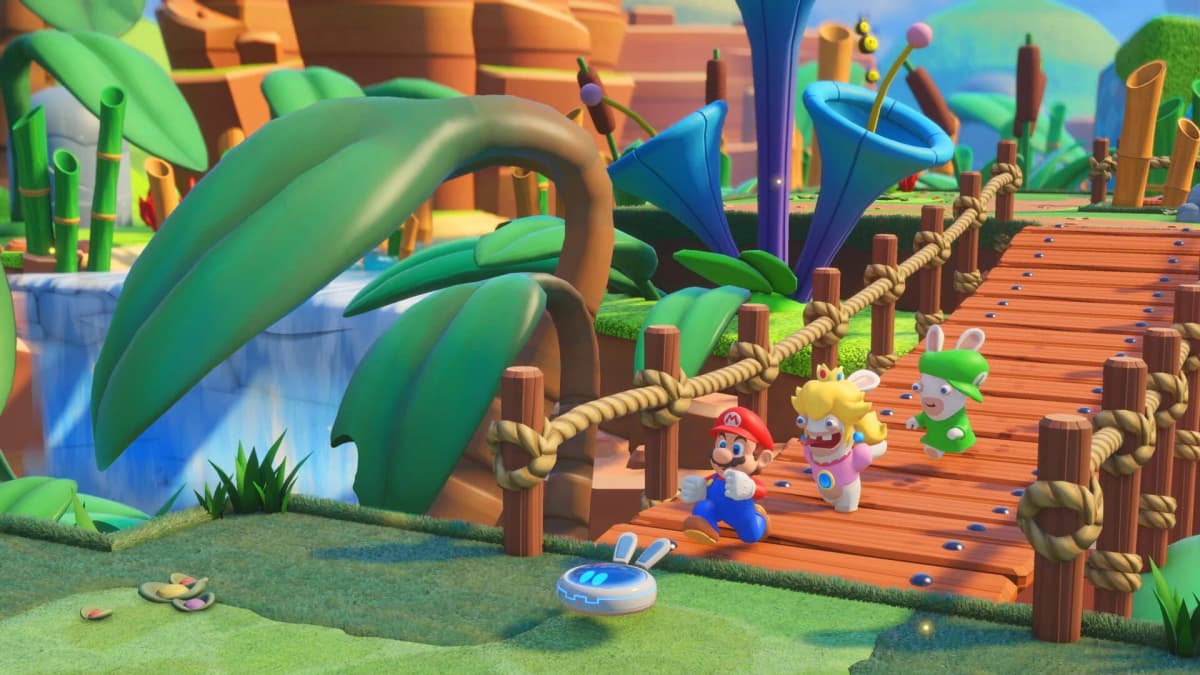
The difficulty curve is another place where the game surprised me. It’s incredibly welcoming – you can brute-force the early fights even if you’ve never touched a tactics game – but later challenges absolutely demand proper planning. Optimising skill trees, synergising abilities, abusing movement options like team jumps and dashes: by the end, Kingdom Battle is quietly teaching players fundamentals that wouldn’t feel out of place in a much more “serious” strategy title.
Combine that with a fantastic soundtrack – from heroic Mario arrangements to more unhinged Rabbids-flavoured tracks – and you get something that, on paper, should have been pure corporate crossover slop but instead feels like a passion project. Nintendo trusted Ubisoft with Mario; Ubisoft, in turn, used the Rabbids to inject a chaotic, self-aware energy that Nintendo themselves would never dare to pull off in a mainline Mario.
That collaboration is exactly why I say the Rabbids matured. They didn’t just crash Mario’s party; they elevated him. And in the process, they proved they could carry a genuinely ambitious game instead of just shrieking in minigames.
Sparks of Hope, free movement, and Rayman’s bittersweet comeback
Then came Mario + Rabbids Sparks of Hope in 2022, and this is where a lot of people I know tapped out. “More of the same,” they said. I call bullshit. Sparks of Hope is the kind of sequel that actually tries to rethink its core systems instead of just adding content bloat.
The grid-based movement is gone, replaced with free movement zones. On the surface, that sounds like a simplification. In practice, it opens up a completely different style of play: more dynamic, more improvisational, less about counting exact squares and more about using space intuitively. Chaining dashes, team jumps, and ability combos becomes this kinetic puzzle every turn. It’s not “better” in some absolute sense than the first game, but it’s bolder – and that counts for a lot in an industry that often treats successful formulas like sacred relics.
The tone shifts a bit too. The humour is still there, but there’s a slightly more adventurous, space-operatic vibe. The Sparks themselves – fusions of Lumas and Rabbids – are a visual metaphor for what this entire crossover has been about: mashing two tones together and seeing what unsettling, strangely charming creature crawls out.
And then there’s the Rayman DLC. For the first time in more than a decade, Rayman steps back into the spotlight… as a guest star in a Rabbids game. If you’d told 12-year-old me that in 2003, I would have been furious. In 2023, when the DLC dropped, I felt something closer to closure.
Rayman returning through Sparks of Hope is poetic in a way Ubisoft probably didn’t even intend. The character who originally spawned the Rabbids comes back not as their boss, but as their collaborator. He drops into their world, plays by their rules, and the whole thing feels like a quiet admission: the torch has been passed. These days, it’s Rayman visiting the Rabbids universe, not the other way around.
As a Rayman fan, does that sting a little? Of course it does. I still want a full-fat Rayman 4 that isn’t a trivia answer or a rebooted subtitle. But I can’t deny the symbolism: if any Ubisoft IP was going to be strong enough to “host” Rayman, it had to be the Rabbids. And the DLC itself is fun, inventive, and respectful. It doesn’t feel like a hostage situation; it feels like a reunion.
Why Rabbids, not Rayman, are Ubisoft’s true mascot now
When I say the Rabbids have replaced Rayman as Ubisoft’s mascot, I’m not talking about sales charts or which character shifts more plushies at Christmas. I’m talking about which character best represents what the company is still capable of when it remembers how to be creative.
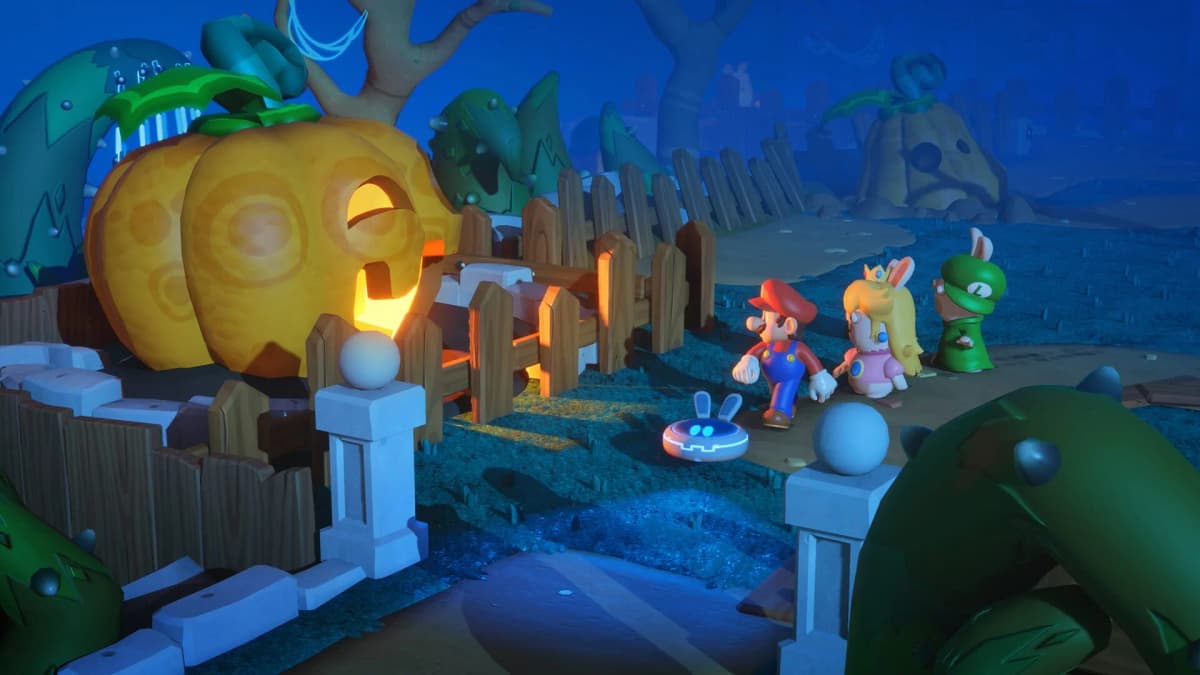
The Rabbids can do slapstick kids’ TV, cynical social satire, experimental party games, and now surprisingly sharp tactical RPGs. They can share the screen with Mario and not feel like impostors. They can poke fun at Ubisoft’s own design habits without saying a single intelligible word. That flexibility is insane.
Meanwhile, most of Ubisoft’s other flagship brands are locked into expectation prisons. Assassin’s Creed has to be sprawling and historical. Far Cry has to be open-world and edgy. The Tom Clancy label is buried under a mountain of half-baked online shooters and “shared worlds.” Those series can absolutely produce great games – and sometimes still do – but they rarely surprise me anymore.
The Rabbids do. For all their screaming and toilet jokes, they’re the one Ubisoft IP that consistently feels like it’s allowed to be genuinely weird. Rabbids Go Home smuggled satire into what looked like a kids’ game. Kingdom Battle tricked a whole generation into enjoying turn-based tactics. Sparks of Hope dared to throw out the grid in a genre that lives and dies on grids.
Are there mediocre Rabbids games? Absolutely. This isn’t some unbroken streak of genius. But when the series is firing, it represents a side of Ubisoft that I desperately don’t want to lose: the side that takes a stupid idea seriously enough to make it brilliant.
What I want from Ubisoft now: keep the Rabbids weird, or don’t bother
Looking at Ubisoft’s current corporate contortions – cancellations, studio closures, an obsession with “live services” – it’d be easy to assume the Rabbids are doomed to become another content mill. A cheap endless-runner here, a mobile gacha there, a cynical tie-in show. And maybe that future is already written somewhere in a PowerPoint deck.
But if there’s one thing the Mario + Rabbids saga proved, it’s that there’s still a version of Ubisoft that can work with constraints and come out stronger. Nintendo didn’t let them be lazy with Mario; in return, Ubisoft let the Rabbids amplify the parts of the Mario universe that usually stay in the background: the absurdity, the theatricality, the slapstick.
I want more of that. Not necessarily more Mario crossovers – honestly, I’d be happy if Sparks of Hope is where that particular arc ends, on a high. I want Ubisoft to take the confidence it gained from pulling off that impossible crossover and apply it elsewhere. Give the Rabbids another satirical adventure that goes as hard on the social commentary as La Grosse Aventure did. Let them crash other genres that “shouldn’t” fit them – a smaller-budget immersive sim, a co-op puzzler that actually makes use of their chaotic energy, anything that isn’t just another by-the-numbers party game.
Most of all, don’t sand them down. The yelling, the stupidity, the borderline-annoying energy – that’s the point. What made Kingdom Battle and Sparks of Hope special wasn’t that the Rabbids suddenly became respectable; it’s that their ridiculousness was finally wielded with precision instead of thrown at the wall.
I’ll always have a soft spot for Rayman. I still hum the Rayman Origins tunes sometimes when I’m doing dishes. But if Ubisoft announced tomorrow that they were putting all their character-mascot chips on the Rabbids for the next decade, I wouldn’t even be mad anymore. They’ve earned it.
Because after twenty years of watching this company chase trends, bungle live-service launches, and bury experimental projects, the thing that’s consistently made me sit up, take notice, and actually smile has been a bunch of screaming rabbits who think they can build a tower of trash to the Moon. And somehow, against all odds, they’ve been right.
FinalBoss // Gear
Level up your setup
01Top-rated gaming headsetson Amazon→02High-refresh gaming monitorson Amazon→03Gaming chairson Amazon→04Discounted game keyson Kinguin→Affiliate links · As an Amazon Associate, FinalBoss earns from qualifying purchases.
Want to Level Up Your Gaming?
Get access to exclusive strategies, hidden tips, and pro-level insights that we don't share publicly.
Ultimate Gaming Strategy Guide + Weekly Pro Tips