
An Ultima Online-inspired private shard should make early effort feel worth investing in: a durable world, useful player roles and progression that fits different playstyles. That is the foundation I would build before expanding the feature list.
Stop treating freedom as an onboarding plan. Giving a new character permission to wander, fight, gather and build leaves the hardest design work unfinished: making those activities worth choosing.
For an Ultima Online-inspired private shard—an independently operated server—I would put that work ahead of another impressive system on the feature list. A character needs somewhere to establish themselves, something they can become unusually good at, and a reason to believe that effort will still matter later. Otherwise, the opening fortnight becomes an audition for a future the game never makes tangible.
I treat day 14 as a design checkpoint, not a magic retention threshold. By then, a player should have experienced enough of the world to imagine a place in it. More powerful equipment can help. So can a dangerous discovery, a repeat customer or a contribution to a shared project. My test is whether the next session has a reason to exist.
Table of Contents (7)
A starter town should have a future
The first place a character calls home deserves more consideration than a tutorial exit. It should offer a legible foothold: somewhere to learn the local rules, understand storage and services, and recover from an early mistake without losing the entire attempt to get established.
That does not require making the whole shard safe. I want danger in a sandbox. But a newcomer needs to understand where danger begins and what failure costs. A protected starting area surrounded by poorly explained risks still leaves the player guessing about the rules that govern their investment.
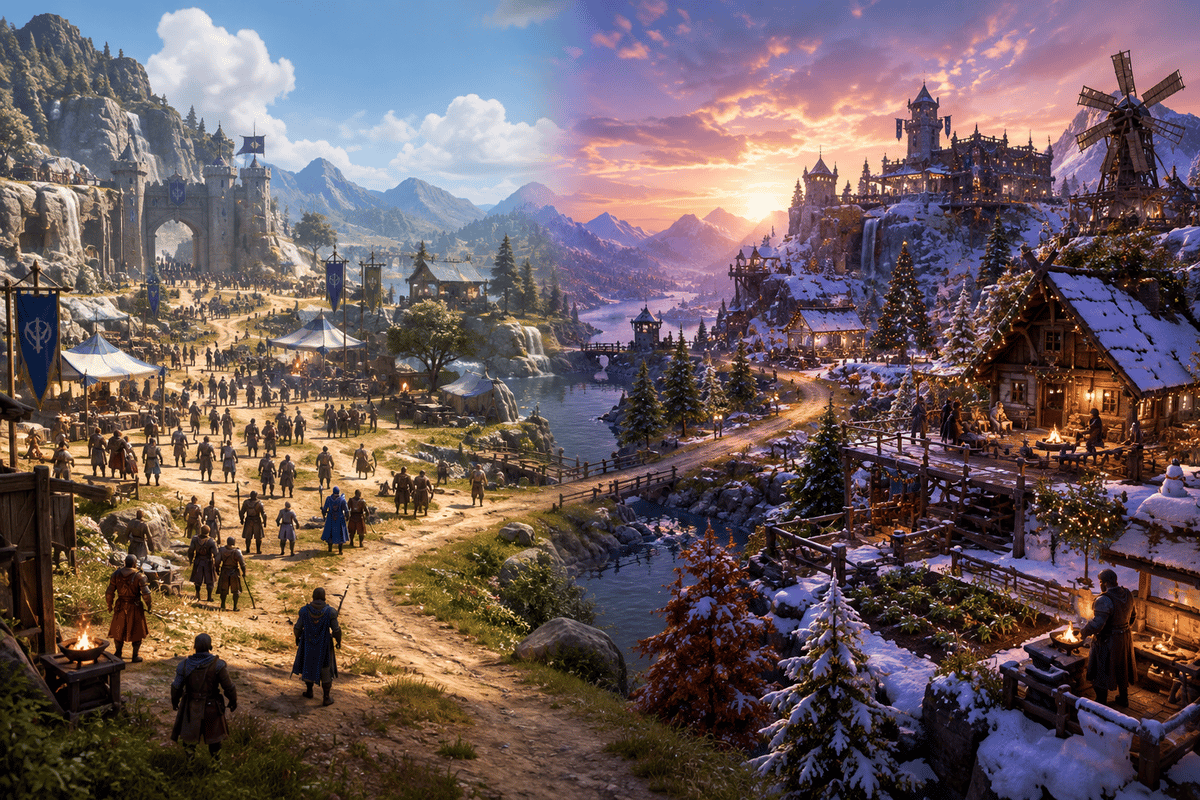
The stronger move is to keep that starting region useful after its introductory encounters stop being challenging. Ultima Online lets players choose a starting city and connects towns through permanent moongates. A shard could give that choice a longer future: a mining town with nearby ore, a farming settlement with agricultural resources, or a trading town with a visible player market. Clear travel connections would let characters pursue those opportunities without making their first choice a permanent trap.
Town-centered housing and recurring supply contracts could reinforce those identities. Reserve homes or housing plots near the market, make ownership limits clear, and give experienced characters business in the same streets newcomers use. I like this approach because it creates contact without requiring a forced introduction. Newcomers can see what being established looks like. The town gets a life beyond processing fresh characters.
Make mastery visible before the grind takes over
A sandbox should offer a short route to basic competence and a much longer route to expertise. Confusing those two stages produces an opening where players perform chores for hours before discovering whether their chosen activity is enjoyable.
My standard for progression is straightforward: improvement should change decisions. A developing crafter should gain useful capabilities or distinct specializations. A scout should become better at judging routes and threats. A combat specialist should have more to learn than the number required for the next equipment upgrade.

Stats can support that learning. They become hollow when advancement consists entirely of repeating an action until the game permits another one. I value the moment a player understands why a tactic works, where a material is worth seeking, or which service their community needs. Those discoveries give progression an identity.
This also sets a sensible boundary for catch-up systems, which help newcomers close the progression gap. Newcomers need access to useful participation before they match veteran capability. Veterans can retain expertise, relationships and specialized knowledge without every meaningful activity requiring months of preliminary work.
The economy needs a place for its newest character
A player-driven economy is a weak retention pitch if its newest participants have nothing anyone wants. I would give a first modest sale more weight than another tutorial reward: someone needed what the character produced.
That is where the starter region’s distinctive resource earns its keep. In Ultima Online, miners supply ore that becomes ingots for blacksmiths and tinkers; lumberjacks supply wood for carpenters and bowcrafters. A shard could build an introductory contract around one of those production chains, connecting a beginner’s gathering to an established crafter’s order. The reward would demonstrate a role in the economy rather than merely pay for completing a tutorial.
The resource rules should be understandable enough to plan around. Give a mining region a recognizable ore profile and explain whether deposits deplete and replenish. Keep those rules consistent so learning where to gather remains useful knowledge. Likewise, crafted goods should serve distinct purposes rather than funnel every producer toward a single best item that crowds everything else out.
Consumables and repairs are possible sources of recurring demand. Neither deserves a free pass. Maintenance that consumes a player’s whole session becomes drudgery; goods that never leave circulation can make new production pointless. The design needs room for ongoing work without making that work feel like a tax on playing.
I would judge the economy by whether a modest gatherer, crafter or trader can establish repeat business. An enormous catalogue of recipes means little if useful participation is locked behind veteran wealth or a long stretch of unrelated combat.
Guidance should respect the player who wants to fight
The strongest objection to structured onboarding is that sandbox players came for self-direction. Fair enough. A mandatory tour through every system would undermine that freedom. Optional guidance can show a destination while leaving the route open.
A combat-focused player should be able to find combat worth learning without first building a house or securing a permanent group. A prospective crafter should discover whether crafting has a viable future before spending hours on unrelated fights. These are different appetites, and the shard should take them seriously.
Local contracts, starter professions and guided expeditions could demonstrate those futures in small doses. A combat contract could point toward an encounter with clearly signposted risks; a crafting order could identify a material, its supplier and the customer who needs it. The useful demonstration lets someone practise a role and see its value. It does not dump the entire rulebook on them or pretend that every profession follows the same progression path.
Exploration needs the same care. Points of interest should offer opportunities to investigate and interact, while giving players enough information to judge danger themselves. Let a newcomer approach a ruin, observe its threats and decide whether to press on. A threatening location can be exciting. An encounter whose rules become legible only after a ruinous loss discourages the curiosity the world depends on.
I would rather preserve uncertainty about what lies beyond a ruin than uncertainty about whether approaching it triggers a punishment the player had no reasonable way to anticipate.
A shared goal should leave something behind
Personal upgrades provide momentum, but I want a persistent world to offer consequences beyond character sheets. A settlement supplied through a siege, a faction changing access to regional materials, or a construction project opening a route can give individual effort a larger purpose.
Those are design possibilities for a shard, not requirements for expensive spectacle. Their value comes from what remains afterward. If supplying a town affects its condition or access to services, the work becomes part of that town’s history. If everything instantly returns to its previous state, the activity has less weight.
Participation also needs a manageable scale. A player with 45 minutes should be able to complete a delivery, fulfil a crafting order or advance a visible project milestone. Long ambitions become easier to care about when individual sessions make a discernible contribution.
This is where social design can help without demanding guild membership. Public contracts and shared orders let strangers become useful to one another. A mentor could help a new miner complete that first supply order, with both receiving credit for the contribution. I want relationships to grow from doing worthwhile things together, rather than having group membership serve as an entry fee to the worthwhile things.
Administration is part of the progression system
An Ultima Online-inspired private shard asks players to invest in its operators as well as its mechanics. A house, a trade reputation or a specialized character depends on the world supporting it remaining available and its rules remaining credible.
That makes published rules, consistent moderation and a clear approach to wipes or resets central to my retention argument. Staff favoritism can undermine earned status. An arbitrary reset can erase the reason someone specialized. Unexplained balance changes can leave a player unable to plan around the role they chose.
Before committing to a shard, I would read its reset policy, look through its development updates and visit its community channels. For a gatherer, I would check how changes to resource availability are communicated; for someone pursuing housing, I would check ownership limits and what a reset would remove. I would also pay attention to activity in the places a newcomer actually uses. A population total offers less practical reassurance than finding trade, assistance and recurring activity around the starting region.
No operator can promise that a world will thrive for years. They can explain how they maintain it, how decisions get made and what circumstances could invalidate progress. That is a more useful basis for trust than an ambitious roadmap alone.
Keep the conflict; protect the reasons to participate
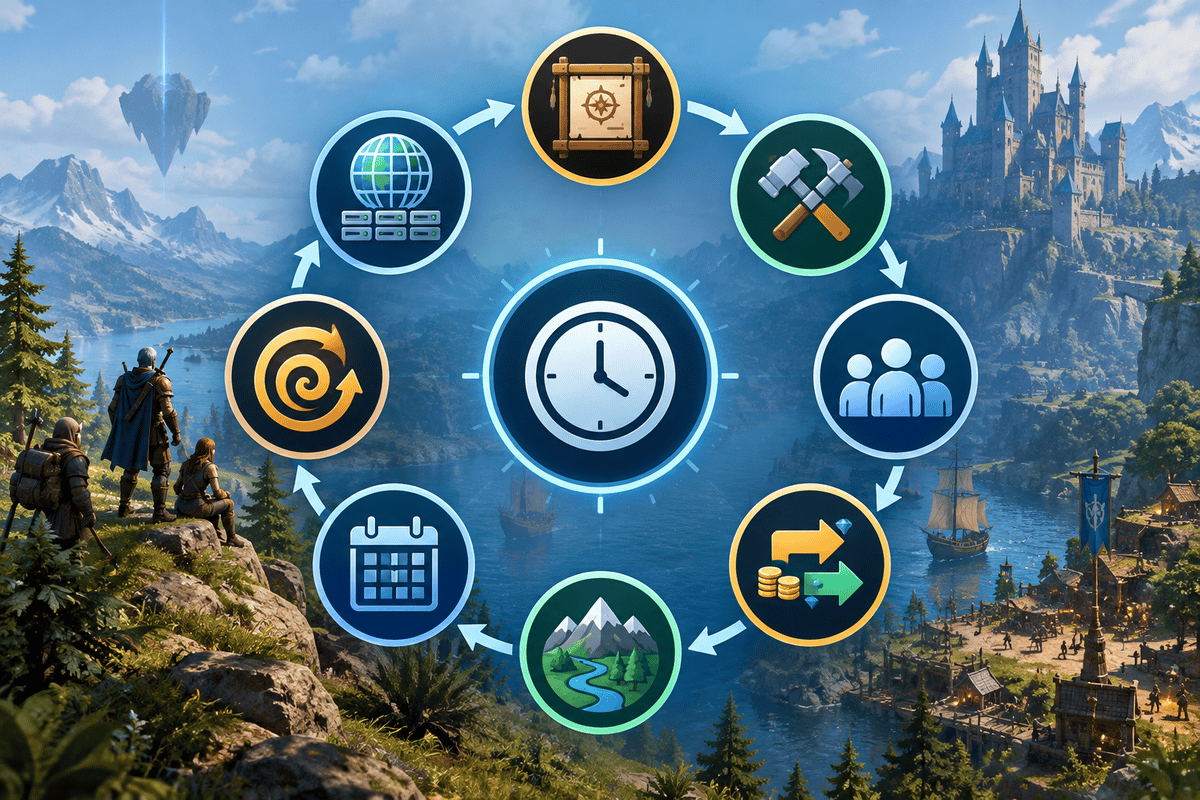
My argument for staying power rests on connected systems. Early competence should enable useful work. Useful work should create relationships and opportunities. Greater mastery should open ambitions that still have a place in the world. Adding another isolated activity does little to repair a broken connection between those stages.
I want an Ultima Online-inspired shard where exploration matters, non-combat work has customers, and fighting can have consequences worth caring about. I also want a new character to see a credible route into that life during the first fortnight. Expecting players to invent every reason to stay is an abdication of design.
The difficult tension is how far established players should be allowed to disrupt that life. Rivalries, competition and changing control can give a world its history; entrenched groups can also choke off the opportunities newcomers need. I would protect access to meaningful participation while leaving outcomes open to conflict. Let a powerful guild contest a valuable supply route. Do not let it close every route by which a newcomer can become useful. A successful community’s freedom should not consume everyone else’s future.
FinalBoss // Gear
Level up your setup
01Top-rated gaming headsetson Amazon→02High-refresh gaming monitorson Amazon→03Gaming chairson Amazon→04Discounted game keyson Kinguin→Affiliate links · As an Amazon Associate, FinalBoss earns from qualifying purchases.
Want to Level Up Your Gaming?
Get access to exclusive strategies, hidden tips, and pro-level insights that we don't share publicly.
Ultimate Gaming Strategy Guide + Weekly Pro Tips