
Urban Cycling: How to Build a Minimalist Winter Commuter Kit – Paris Rain Guide

Urban Cycling: How to Build a Minimalist Winter Commuter Kit – Paris Rain Guide

How I Ended Up Ditching the Three-Layer Rule

After a couple of Paris winters riding every day, I hit a wall. My old setup looked “textbook”: technical base layer, mid-layer, waterproof shell, rain pants, thin gloves, thicker gloves on top. In theory it was the classic three-layer system. In practice, it was a mess.

I was spending 5-10 minutes just getting dressed, constantly losing one glove, forgetting a mid-layer at the office, or skipping the bike entirely because I couldn’t face the whole ritual. Worse: on mild rainy days I’d overheat, and on cold wet days my legs and hands were still miserable.

During winter 2025/2026, after a lot of reader feedback and my own frustration, I decided to reset everything. The breakthrough came when I stopped thinking in “layers” and started thinking in “zones”: upper body, lower body, hands, head. One well-designed piece per zone, no more.

The combo that finally worked for a full Paris winter (roughly 0°C and rain to 12-15°C and showers) was:

  • Urban Circus Iris jacket
  • Urban Circus IYUC rain overpants
  • Van Rysel 900 Winter gloves (Decathlon)
  • Thin merino Ortovox beanie under the helmet

It sounds almost too simple, but this minimalist kit replaced my whole layering system and still kept me dry and comfortable from the périphérique to tiny side streets.

The Core Idea: One Garment per Zone, All Winter

Before getting into the details, here’s the philosophy I ended up with:

  • Upper body: Iris jacket + whatever you’d wear at the office (shirt, light sweater). No dedicated cycling mid-layers.
  • Lower body: Normal jeans or chinos + IYUC overpants only when it’s wet.
  • Hands: One serious pair of winter cycling gloves instead of stacking thin ones.
  • Head: Thin merino beanie that disappears under the helmet.

The big win is mental more than technical: you stop negotiating with yourself every morning. If it’s wet or might be wet, you grab the same four items. That alone made me bike more consistently, even on truly grim days.

Step 1 – Get Your Temperature Range Right

My benchmarks for this kit:

  • Coldest rides: about 0°C with rain and wind (felt like -5°C).
  • Mild & wet: 8–12°C with continuous drizzle or showers.
  • Top end: up to 15°C with light rain before I start feeling a bit warm.

If your winters are much colder than Paris, you may still want a light base layer under your office shirt on freezing mornings. But for a 20–45 minute urban commute, this setup covered my whole season without having to micromanage clothing every week.

Step 2 – The Urban Circus Iris Jacket: Your Upper-Body Workhorse

The Iris is Urban Circus’ “discreet but technical” jacket. That sounded like marketing fluff until I actually lived with it. Black fabric, iridescent reflective panels that light up in headlights but don’t scream hi-vis during the day – more Blade Runner 2049 than highway construction worker.

Key specs and why they matter:

  • 10,000 mm waterproofing (Schmerber) – that’s enough to handle sustained rain on a 1-hour ride without wetting through. It’s not mountaineering-level 20,000 mm, but you don’t need that for crossing Paris.
  • 5,000 g/m²/24h breathability – mid-range, which could feel clammy if the design was lazy. But the Iris compensates with smart vents: pit zips, a back vent, and a double-slider front zip.
  • Helmet-compatible hood – slides over a standard commuter helmet without pulling back your field of view.
  • High collar and zip up over the mouth – I stopped using a scarf entirely; zipping up to the nose is enough wind protection.
  • Thumb loops in the cuffs – instant built-in mittens for shoulder seasons and a neat overlap with your gloves so wrists don’t get exposed.

How I actually use it day to day:

  • Cold & wet (0–5°C): Zip everything up, close the pit zips, hood over the helmet, collar up to the nose. Underneath: just my shirt and maybe a thin sweater. I arrive warm, not sweaty.
  • Mild & wet (8–12°C): Open the back vent and pit zips, keep the front zip partially open from the bottom to let air in while the top stays closed against the rain.
  • Dry but cold: I still use it as a windproof shell; the reflective panels are worth it alone in winter darkness.

Common mistakes I made at first:

  • Wearing too much underneath. With a 10k shell plus windproof design, a thick sweater underneath is overkill most days. I ended up sweating, then blaming the jacket. Once I went back to office clothes only, comfort shot up.
  • Forgetting the vents. The difference between pit zips closed and open is massive. If you run warm, open them before you even start the ride.

At around €190, the Iris is an investment, but for me it replaced a dedicated rain shell, a heavy winter jacket, and a reflective vest. One piece instead of three that I had to juggle.

Step 3 – The IYUC Overpants: Dry Legs in 30 Seconds

Legs are where most cheap solutions fail. Before the IYUC pants, I used a basic Decathlon “garbage bag” rain pant. It worked on paper but was such a pain to put on that I regularly skipped it and just accepted wet jeans.
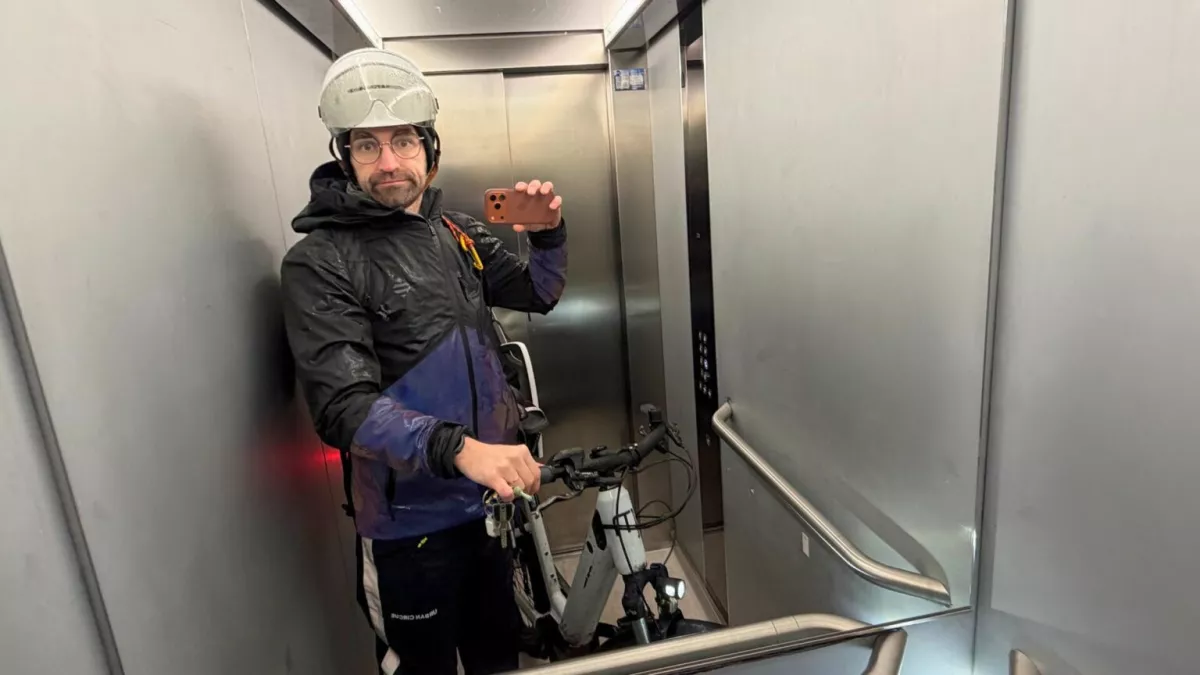
The IYUC overpants fixed that with one simple design choice: long zippers on the lower legs. You can put them on and take them off without removing your shoes. That’s the true game changer.

Features that matter in real commuting:

  • Full-length lower-leg zips – you just step into them at the bike rack, zip up over your shoes, and you’re done. No hopping around the hallway trying to avoid touching the floor with your socks.
  • Integrated elastic shoe covers – fold over your shoes to keep splashes and runoff from soaking your socks.
  • Snap “fake pockets” – holes with snaps that give you direct access to your regular pants pockets under the overpants. Keys, phone, badge: no digging under a plastic shell.
  • Waist drawcord – quick adjustment over bulkier clothes without needing a belt.
  • Reflective details – placed where car lights actually hit when you’re pedaling.
  • Packs into a velcro pouch – small enough to live in a pannier or backpack all winter.

They’re also properly waterproof and breathable. Again, we’re in the same 10,000 mm / 5,000 g/m²/day ballpark: ideal for 30–60 minutes of city riding in real rain, not just drizzle.

How I use them:

  • If the ground is wet or there’s rain in the forecast, I put them on before leaving the office or home. It takes under 30 seconds.
  • At the office, I unclip the shoe covers, open the zips fully, step out, and I’m standing there in dry jeans. The overpants go straight into their pouch.

At about €95 they’re not cheap, but they changed my relationship with rain. I went from “Do I really need rain pants?” to “I’ll just throw them on, it’s so quick anyway.”

Step 4 – Hands and Head: Small Accessories, Big Comfort

After too many failed experiments with glove liners and “water-resistant” fashion gloves, I went back to basics: one good pair built for winter cycling.

Van Rysel 900 Winter gloves (Decathlon) hit the sweet spot for me:

  • Windproof and properly warm for 0–5°C rides.
  • Enough dexterity to handle shifters, brakes, and a phone.
  • Water-resistant enough for typical Paris rain (for absolute downpours, I accept they’ll get damp after 45+ minutes, but my hands still stay warm).
  • Reasonable price (around €30), so I don’t panic if I forget them somewhere.

On the head, the real revelation was the thin merino Ortovox beanie that fits under a helmet without pressure points. It’s just thick enough to block the wind and take the edge off a freezing morning, but thin enough to keep on indoors for a minute while you park and lock your bike without overheating.

My 2-Minute Pre-Ride and Post-Ride Routine

Here’s how a typical rainy commute looks now, timed from my apartment door to being on the bike:

  • At home / office before leaving:
    • Throw on the Iris over my normal clothes.
    • Beanie on, helmet on top.
    • Gloves in the pocket of the jacket.
    • Step into the IYUC overpants, zip up over shoes, flip out the shoe covers.
  • Arrival at work:
    • Lock bike.
    • In the hallway: unzip IYUC legs, step out, fold once, shove in pouch.
    • Take off Iris, hang it up; gloves and beanie into helmet.

Once you’ve done it a week, the whole process takes about as long as unlocking your bike and checking your phone. That was exactly the friction I wanted to remove.

Common Mistakes and How to Avoid Them

Based on my own errors and reader feedback, here are the traps to avoid with this minimalist setup:

  • Overdressing underneath. Trust the outer shell. Start a ride slightly cool; you’ll warm up fast.
  • Not using the vents. On the Iris, treat pit zips and the back vent like gears on your bike. Adjust them as the ride changes.
  • Skipping the overpants “just for a light drizzle”. Wet thighs get cold fast. If the ground is shiny, just put them on; it’s 30 seconds.
  • Storing everything at home. I leave the overpants and gloves at the office during the week. That way, even if the forecast changes, I’m covered for the ride home.

Is This Minimalist Kit for You?

This setup shines if:

  • Your commute is 20–45 minutes each way.
  • You ride in a mild-winter city (Paris-style, not Scandinavian deep freeze).
  • You value arriving dry and office-ready more than shaving watts or looking like a road-racing pro.
  • You’re tired of juggling multiple layers and bits of kit.

If you regularly ride for over an hour in horizontal rain, or in -10°C, you’ll probably want more insulation layers and maybe higher-spec (20,000 mm) shells. But for everyday urban mobility, this 2-piece shell + smart accessories approach has been the most efficient system I’ve tried.

Final Thoughts

Urban Circus impressed me with how obsessively they’ve solved real commuter problems: long zips you can use with shoes on, fake pockets, helmet-ready hood, reflective panels that don’t ruin your outfit. Paired with a solid pair of winter gloves and a thin merino beanie, it let me retire the onion-style layering I’d been told was “the only serious way” to ride in winter.

If you’re stuck in the same loop I was – too many layers, too much time gearing up, and still getting wet – a minimalist, zone-based wardrobe is worth trying. One jacket, one overpant, one good pair of gloves, one beanie. If it carried me through a full Paris winter of rain, there’s a good chance it can simplify your rides too.

F
FinalBoss
Published 2/24/2026
9 min read
Guide
🎮
🚀

Want to Level Up Your Gaming?

Get access to exclusive strategies, hidden tips, and pro-level insights that we don't share publicly.

Exclusive Bonus Content:

Ultimate Guide Strategy Guide + Weekly Pro Tips

Instant deliveryNo spam, unsubscribe anytime