
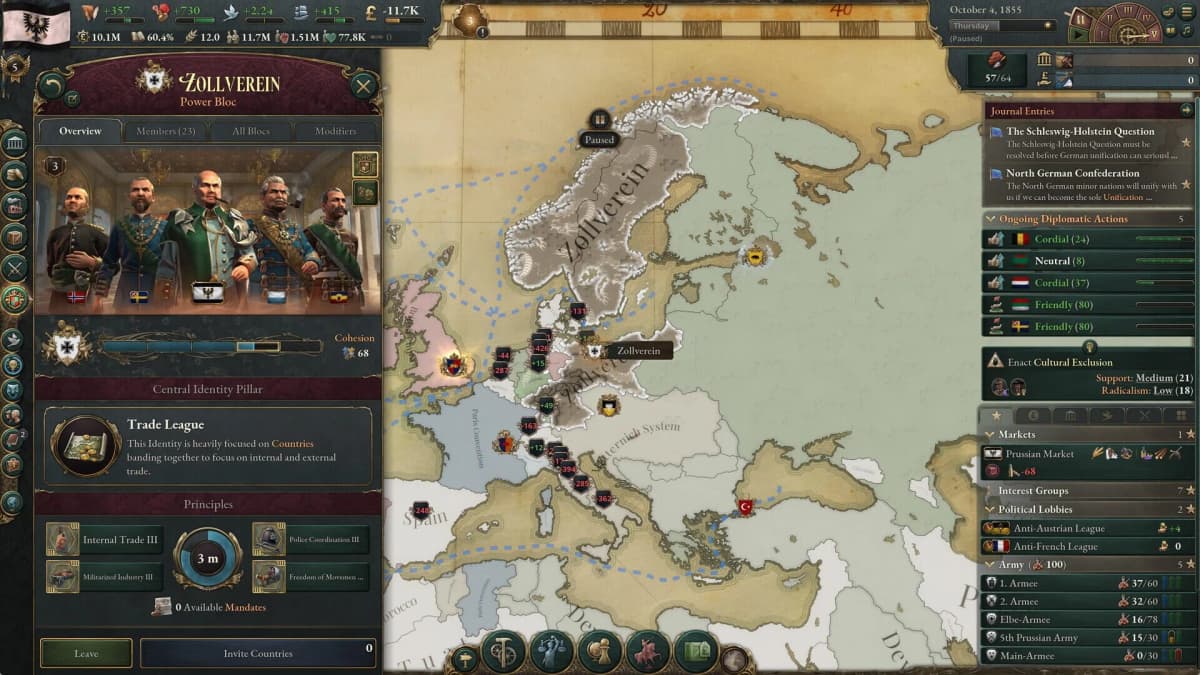
If a coalition is already forming against your Spain, the short answer is: stop expanding, buy one Great Power friend, consolidate your army into a single Iberian front, and take the least-bad peace before your war support collapses. Coalitions in Victoria 3 are not random — they are a bill for infamy you ran up earlier, and the only reliable way to survive them is to have a patron who wants you alive and a homeland front you can actually hold. This guide is an autopsy of a Republican Spain run that died to exactly that mistake, rewritten for the current game: patch 1.13.9, the last hotfix in the 1.13 line, with Update 1.13 “Matcha” and The Great Wave (28 April 2026) now the baseline everyone plays on.
Table of Contents (17)
What changed in 1.13 — and why Spain feels different now
The Great Wave is a naval and diplomacy overhaul, which lands harder on Spain than on almost any other mid-tier Great Power. Spain is a country with a long coastline, overseas holdings in the Caribbean and Pacific, and a Mediterranean chokepoint on its doorstep. Everything 1.13 touched, it touched on your doorstep. The pieces that matter for endgame survival:
- Ships are individual objects now. They are built in Shipyards, they take damage, they sink, they need repair, and they need crews recruited through the new Naval Administration building. You cannot treat your navy as an abstract number that scales with your GDP any more.
- The Ship Designer lets you build to a template across four axes: Armor, Armament, Propulsion and Supply Capacity. For Spain the practical read is that you can build cheap, fast, high-supply hulls for the Atlantic and heavier gun platforms for the Western Mediterranean, instead of one generic fleet that is mediocre in both.
- Convoys are gone. Civilian shipping is handled by the Merchant Marine; military logistics run on dedicated Supply Ships. If you do not build supply capacity, your overseas armies starve — and Spain is an overseas-army country by default.
- Armies embark now. Moving troops across water requires a fleet with enough transport capacity; they embark, sail, and disembark. Redeploying from Cuba to Iberia mid-crisis is no longer instant.
- Marines were added as a special unit type built for naval invasions.
- Gunboat diplomacy is the big one for this guide: during treaty negotiation you can threaten naval aggression, and if the other side refuses, you get 180 days of hostile naval action without a formal declaration of war.
Paradox has also confirmed that the next major release is 1.14, a free “AI Update” targeted at late August or early September 2026, with no attached DLC. Nothing in the announced scope suggests a coalition or infamy rework, so the advice below should hold through that patch — but expect the AI to be sharper about piling on a weakened target once it lands.
Step 1 — Put Spain in “war mode” before the world does
My structural mistake in the run that died was treating Spain as a peaceful industrial sandbox until the 20th century, then trying to fight three Great Powers at once. By the time the Free States of America, Russia and Austria came for me, they had deep battalion pools and I was mobilizing undermanned HQs.
What I do by roughly 1880 now:
- Standardize the army. Do not leave half your barracks on outdated production methods. Push modern small arms and artillery in a focused line rather than researching a bit of everything.
- Concentrate barracks in one or two HQs. Stack combat power in Iberia, with at most one secondary HQ (North Africa). Since 1.13 made sea movement an embarkation problem, scattered barracks are worse than they used to be — those battalions are not coming home quickly.
- Build the arms industry to match. Arms Industries and Motor Industries backed by Tooling and Steel. Ramping military consumption faster than your industry can supply is how a war-time economy implodes.
- Stabilize your laws early, then stop. Constant coup attempts wreck legitimacy exactly when you need war support. Get to a stable government and stop fiddling with laws before a crisis window.
Step 2 — Build an economy that survives total war
In the collapse run my economy looked fine on paper. The cracks only showed once the big war dragged: grain shortages, negative authority events, and a panicked attempt to subsidize farms in Asturias while people starved.
- Secure food domestically. Wheat and maize in safe core states, upgraded ahead of time. Imports are a buffer, not a plan. When enemies embargoed me, the cereal shortage did more damage than any battle.
- Tax deliberately. Moderate taxes in peace; one step up plus consumption taxes on luxuries in war. Maxing everything crashes standard of living and hands the opposition your war support.
- Diversify trade routes early. Coal, iron, small arms and artillery from multiple partners. You will still take a hit from an embargo — you just will not be cut off.
- Stop construction before tensions spike. Cash reserves pay for mobilization and subsidies. Cancelling building queues mid-war is a sign you planned badly.
If GDP falls and your instinct is to slam taxes to max, check the root cause first. It is usually an input shortage from war or embargo, and fixing that with trade or a new mine does more than another tax step ever will.
Step 3 — Colonize with a plan, not vibes
In the doomed run I was proud of the flag being everywhere: chunks of Africa, the Philippines, Cuba, a slice of Borneo, a liberated Yugoslavia, a Corsica. It looked impressive and it was a diplomatic and logistical liability. Every acquisition is a future front, a future infamy tick, and — since 1.13 — a future supply-ship bill.
Three questions before any colonial play:
- Does this create a front I can actually reach? North Africa and Morocco tie into Iberia across a short sea hop. India and scattered Pacific islands do not, and with embarkation and Supply Capacity now modelled, “does not” is a much harsher answer than it was pre-1.13.
- Is the infamy worth it? Late game, each aggressive move makes the next dogpile easier to justify. My colonial bullying is precisely what made the Free States, Russia and Austria comfortable piling on together.
- Can my navy hold it? Taking Corsica is fine until Germany decides it is theirs and you discover your fleet cannot contest the Mediterranean for a month.
A cleaner Spanish plan: prioritize North and West Africa, integrate and improve Cuba and the Philippines rather than pushing further into the Pacific, and skip roleplay plays like freeing Yugoslavia that just create an unstable client next to hostile powers.
Step 4 — Coalition logic: do not end up alone
By the time Germany was issuing ultimatums over Corsica, I had no friends. I had spammed “Humiliate” as a war goal in earlier wars, annoyed half the continent, and then wondered why nobody would back me against the largest army in the world.
- Keep at least one Great Power sweet, permanently. Pick Britain or France, run Improve Relations continuously, send trade their way, and never add humiliating war goals against them or their friends. A defensive pact or customs union is worth more than two extra army divisions.
- Stop taking “Humiliate.” It generates long-term hatred and gives you nothing material. Reparations or a carefully chosen state leaves you stronger and the other side less permanently hostile.
- Treat infamy as a budget. Endless colonial wars push you toward pariah status, which is the precondition for a coalition rather than a coincidence.
- Bank obligations. Do not spend them on trivia while you are strong. Save them so you can pull a patron into a defensive play when the ultimatums start.
- Use gunboat diplomacy carefully. 1.13’s 180-day window of undeclared naval hostility is a genuinely useful lever against a smaller coastal rival — and a genuinely fast way to convince three Great Powers you are the problem. Use it on isolated targets, not on anyone with a patron.
The difference between my lost run and the stable ones was never raw military strength. It was having one or two Great Powers who actively wanted me alive.
Step 5 — Fighting a multi-front Great War as Spain
Prioritize and simplify fronts
- Defend Iberia at all costs. Best generals, most modern barracks. Losing colonies hurts; losing the homeland ends the run.
- Pick one active offensive front. Crush Austria while holding Russia, or the reverse. In my failed war I technically beat Austria and it changed nothing, because I had already bled out elsewhere.
- Accept that some colonies are expendable. Temporary occupation of a remote holding is cheaper than feeding battalions into an unwinnable jungle front — and now also cheaper than the supply ships needed to sustain them there.
Use the navy as a force multiplier — the 1.13 version
The old advice was “establish naval supremacy.” That is still right, but the implementation changed. Concretely:
- Own one sea region properly. For Spain that is the Strait of Gibraltar and the Western Mediterranean. Design a heavy Armament/Armor template for it and keep those hulls repaired — ships sink permanently now, and a fleet you never repair is a fleet you are slowly deleting.
- Build Supply Capacity deliberately. Every overseas front you intend to hold needs supply ships behind it. This is the single most common way players lose colonial wars on the current patch without ever losing a battle.
- Plan one decisive naval invasion with Marines. Marines exist for this. Stack them with your best general and admiral, and commit the transport capacity to land in one place rather than scattering three half-strength landings.
- Raid the enemy economy. Piracy, Privateering and Port Bombardment are now explicit missions. Against an overseas empire like the Free States or Britain, sustained commerce pressure drains war support faster than a front ever will.
Mobilize once, properly
Repeatedly mobilizing and demobilizing to save money destroys general organization right when you need it. I watched battles collapse because units had zero org despite decent numbers. Mobilize fully when war is inevitable, keep it stable through the campaign, and station generals in the correct HQs before the war — because with embarkation, a general in the Caribbean HQ is now genuinely stranded there for weeks.
Step 6 — Make smarter peace deals
- Value core security over prestige. If giving up Corsica or a remote African state prevents a catastrophic defeat, take it. Prestige rebuilds; half of Iberia does not.
- Always add a material war goal. Reparations, a strategic state, or a subject release that weakens a rival. If you are risking a Great War, come out of it with something that changes the balance.
- Read war support trends, not the current number. If enemy war support is falling from blockade and attrition, you can afford to be stubborn. If yours is, start drafting concessions.
- Offer white peace before you are desperate. Early offers succeed far more often than the ones you make when your fronts are already caving.
The timeline that works
- 1836–1870: stabilize politics, industrialize cores, secure grain, limited low-infamy expansion into Morocco and West Africa.
- 1870–1900: modernize army and navy, design and build proper fleet templates plus Naval Administration, cultivate one Great Power patron, build arms and shipyard capacity.
- 1900+: assume a Great War is coming. No needless humiliations, no new fronts you cannot supply, and a standing willingness to trade peripheral land for core security.
FAQ
What is the current Victoria 3 patch?
1.13.9, the final hotfix in the 1.13 line. Paradox has said no further 1.13 hotfixes are planned barring urgent issues. The next release is 1.14, a free AI-focused update targeted at late August or early September 2026.
Did The Great Wave change coalitions or infamy directly?
No. Nothing in the 1.13 material points to a rework of infamy, containment or coalition formation. What changed is the naval and treaty layer — gunboat diplomacy, ship transfer treaty articles, and the ship/supply overhaul — which changes how you respond to a coalition rather than how one forms.
Is the old advice about splitting my navy still valid?
Less than it was. With ships as persistent objects that sink and need repair, and with Supply Capacity now a real constraint, a split fleet loses two engagements instead of winning one. Concentrate.
Can Spain survive a three-power dogpile at all?
Yes, but usually not by winning. Hold Iberia, close Gibraltar, raid enemy trade, and negotiate. Survival as a Great Power with a smaller empire is a win; a heroic last stand over Corsica is not.
Practical takeaway
Coalitions kill Spain because of decisions made forty years earlier. Build for war before you need it, colonize only what your navy and supply ships can reach, keep one Great Power invested in your survival, and treat the peace deal — not the battle — as the thing you are actually playing for. Do that and Spain enters the 20th century as a power other nations think twice about, rather than the obvious target.
More from FinalBoss: our Victoria 3 hub collects every guide and update we cover for the game. If you play the wider Paradox catalogue, Europa Universalis 5’s Rossbach patch overhaul of AI aggression and diplomacy is worth a read for how Paradox is currently thinking about AI hostility, and Crusader Kings 3’s subscription model covers the other side of the DLC question. For something lighter, 15 strategy games that actually keep you playing is our wider genre list.
FinalBoss // Gear
Level up your setup
01Top-rated gaming headsetson Amazon→02High-refresh gaming monitorson Amazon→03Gaming chairson Amazon→04Discounted game keyson Kinguin→Affiliate links · As an Amazon Associate, FinalBoss earns from qualifying purchases.
Want to Level Up Your Gaming?
Get access to exclusive strategies, hidden tips, and pro-level insights that we don't share publicly.
Ultimate Guide Strategy Guide + Weekly Pro Tips