
Table of Contents (8)
Virtua Fighter coming to Switch 2 feels weirdly perfect
The funny thing about Virtua Fighter 5 R.E.V.O. World Stage landing on Switch 2 is that it’s technically a game from 2006, but it slotted into my launch-week library like a brand-new release. While everyone else was downloading flashy tech demos, I spent most of my first weekend on Switch 2 getting repeatedly elbowed in the jaw by Akira Yuki.
I’ve dipped in and out of Virtua Fighter over the years – a bit of Final Showdown on Xbox, a brief fling with Ultimate Showdown on PS4 – but I’ve never really lived with it. On Switch 2, priced at $19.99 / £15.99 and sitting right there on my home screen next to Mario and the usual suspects, it finally clicked: this is the “quietly brilliant” fighting game I always knew I was ignoring.
R.E.V.O. World Stage on Switch 2 doesn’t try to sell you on some wild new mechanic. It’s a clean, grounded port of a fiercely confident fighting game that already knew exactly what it wanted to be: simple inputs, ridiculous depth, solid rollback netcode, full cross-play, and a new single-player World Stage mode that gave me a reason to keep booting it up even when my friends weren’t around.
Three buttons, a D-pad, and an endless rabbit hole
The first thing that hit me, back in my very first 30 minutes, was how nakedly simple Virtua Fighter looks on paper. Guard, Punch, Kick – three main buttons. That’s it. No quarter-circle fireworks, no Street Fighter-style specials painted across the screen. On a handheld, it almost feels modest.
But within an hour, that modesty turned into the deepest pit I’ve fallen into in a long time.
I started with Brad Burns because, if there’s a character archetype that owns me every time, it’s the cocky kickboxer. In training mode, I flipped open his move list and instantly remembered what makes VF… VF. Each command is literally just a direction plus a button or two – forward + punch, down-forward + kick, back + punch+kick – but the list just keeps going. Dodges, stance transitions, different moves on sidestep, specific strings that only combo on counter hit; it’s the kind of move list you don’t scroll, you explore.
I spent a good chunk of my first evening just in the training room: recording the dummy to mash jabs, testing which lows Brad can slip under, figuring out what actually punishes a blocked sweep. It’s not some cinematic combo-builder like modern anime fighters; it’s more like studying a martial art manual and then stress-testing it in the ring.
The moment it clicked was in an early World Stage match. I whiffed a big kick, panicked, and mashed out what I thought was just another string. Instead, Brad automatically transitioned into his slip stance, the opponent’s jab sailed over my shoulder, and the follow-up counter hit launched them for a full juggle. None of that was “dial-a-combo” – it was spacing, movement, and the system rewarding me for using the right tool at the right time even when I wasn’t fully conscious of it yet.
That’s Virtua Fighter in a nutshell. The inputs really are approachable – I handed a Joy-Con to a friend who mostly plays Smash and they were pulling off basic strings in seconds – but this is absolutely the kind of game where you either decide “I’m going to learn this properly” or you bounce off once the matchmaking stops feeding you day-one newbies.
Grounded, honest combat in a world of exploding supers
Virtua Fighter 5 has always been the “grown-up in the room” compared to Tekken and Street Fighter, and that’s still true here. There are no cinematic supers, no particle storms, no comeback mechanics that magically flip a round because you pressed both triggers.
What you get instead is: tight rounds (default 45 seconds), fast damage, brutal wall splats, and a constant mid/throw/low mind game. The three-button system feeds into that clarity. Guard stops mids and highs. Crouch stops highs but opens you up to mids. Throw beats guarding. You can sidestep to attack the opponent’s side. Every exchange feels like a tiny rock-paper-scissors tree that you see play out in real time.
By hour 10, I found myself checking my own habits in a way I don’t in flashier fighters. I was getting blown up by people who did nothing fancy: block, wait, jab, throw. No rage arts, no gimmicks – just “you pressed a button here when you shouldn’t have.” When I swapped to Akira and tried to land his famous knee (a just-frame forward, forward + kick that launches), it felt like training a piano piece. Land it once in a match, you feel like a god. Drop it, you get counter-hit into the wall.
The cast helps sell this grounded vibe. Classic VF faces like Akira, Pai, Jacky, Kage, and Sarah are all here, alongside trickier picks like Shun Di with his drunken stance and drink-count gimmick. On Switch 2, I gravitated toward “honest” characters – Jacky’s kick pressure, Lau’s direct aggression, Brad’s slippery movement – because I could actually feel myself improving as I learned when to use each tool, not just which big cinematic move to fish for.
Compared to Tekken 8’s wall of system mechanics and controversy over heat and chip damage, Virtua Fighter 5 R.E.V.O. feels refreshingly straightforward. That doesn’t mean it’s shallow – if anything, the simplicity of its rules means everything matters more. One bad evade, a misjudged low, a greedy throw attempt, and half your life can disappear.
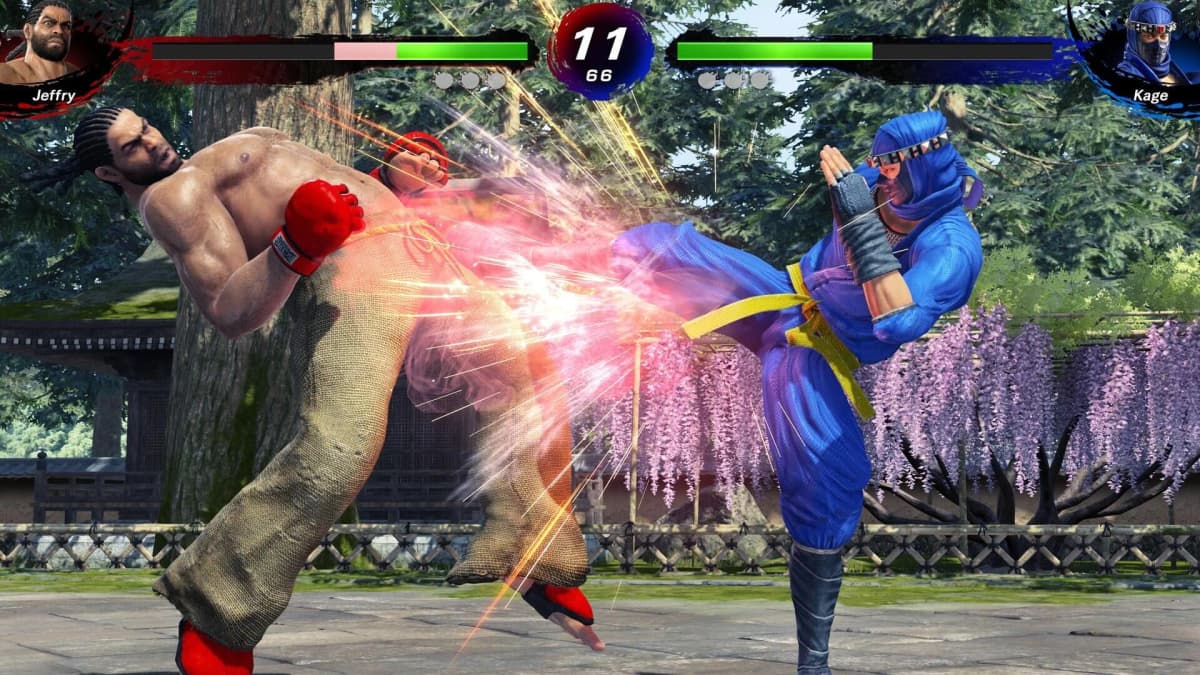
World Stage: a surprisingly compelling solo grind
The big “new” thing for this R.E.V.O. release is the World Stage mode, and this is where I’m glad Sega actually thought about solo players instead of just dumping Arcade Mode on us and calling it a day.
World Stage is basically a long gauntlet of AI opponents framed as traveling the globe through menu locations. Instead of a story with cutscenes, you get a steady drip of fights against CPU fighters modeled on real player data. The game doesn’t loudly advertise which ghosts are which, but it’s obvious as you go: some AIs rush you with unsafe strings like a day-one online warrior, others turtle and sidestep like someone who spent way too long in Dojo mode.
The best compliment I can give World Stage is that I lost track of time in it. I’d jump in thinking, “I’ll clear one more region before bed,” and three hours later I’d be deep into a set against some stubborn AI Lau who kept ducking my throws and blowing me up with mid elbows. Each completed location throws cosmetic unlocks at you – costume pieces, accessories, color variants – which sounds shallow, but the drip-feed of rewards pairs nicely with the slowly rising difficulty curve.
Critically, World Stage is not a brick wall. If a specific opponent bodies you, you can back out and fight someone else instead of smashing your head against them until you magically level up. When I hit a nasty Wolf player who seemed to tech every throw and command grab me on reaction, I bailed, farmed a few more matches in a different location, then came back later with better spacing and a healthier respect for ring-outs.
There are no story scenes, no character arcs, no schmaltzy rival battles. If you’re used to Mortal Kombat’s lavish story campaigns, this will feel spartan. But as someone who mostly wants a “single-player ladder that doesn’t get old in two hours,” World Stage does its job. It kept me playing on nights when I didn’t want to deal with the emotional rollercoaster of ranked online.
Outside of World Stage, you’ve got the traditional Arcade Mode: seven matches and then Dural, the series’ gleaming, T-1000-looking boss. I ran it once with my “main” and then mostly left it alone. You can tweak difficulty, but there’s not much else going on there beyond nostalgia and a quick-hit challenge. Thankfully, the budget price makes that easier to swallow.
Online play: rollback done right, with one odd omission
Let’s be honest: this port would rise or fall on its netcode. R.E.V.O. brings rollback and cross-play to Switch 2, and the good news is that, in practice, it feels completely viable as a main platform for online play.
Over a week of testing – mostly in the evenings, sometimes in handheld mode on the couch – I played ranked sets against PS5 and PC opponents without any real horror stories. The game shows a connection quality indicator before you lock into a ranked match, and on anything green or yellow, the action was smooth enough that I stopped thinking about it and just focused on not getting counter-hit. A couple of red connections felt like underwater sparring, but that’s par for the course and, crucially, avoidable.
Matchmaking at launch has been quick. Ranked matches pop within seconds, and the weekly Tournament mode is a nice spice on top – you can register in advance, then show up and run a mini-bracket that feels more serious than ranked but less commitment than signing up for an actual online event.
The odd design choice is the lack of a clearly labeled casual matchmaking queue. If you want non-ranked games, you’re dealing with player rooms: creating your own lobby with whatever rules you want, or scrolling through a list and hoping someone’s set up a “no ranking, just chill” room. It works, but after years of other fighters having a simple Casual Match button, it feels a bit behind the times.
Spectating in rooms is great, though. One evening I joined a room that already had a little VF ecosystem going – a terrifying Kage, a stoic Goh who seemed determined to break every throw in existence, and a couple of new players cautiously testing waters. Watching how better players handled situations I was struggling with in World Stage was easily as educational as any in-game tutorial.
Local play is nearly flawless. I tried split Joy-Con, Pro Controllers, and a USB arcade stick; the game felt good across the board. Separate Joy-Con are fine for casual messing around, but as soon as you start caring about precise diagonals and quick evades, an actual pad or stick is a huge upgrade.
Switch 2 performance: 60fps first, everything else second
On the technical side, R.E.V.O. is clearly prioritizing one thing above all else on Switch 2: a locked 60 frames per second. And it hits that target. In docked and handheld play, in training, in messy wall-splat scrambles online, the frame rate didn’t waver in my experience. For a fighter this timing-dependent, that’s non-negotiable, and Sega nailed it.
To make that happen, there are some visual compromises compared to the PS5 and PC versions, but they’re subtle. Character models still look sharp, with the Dragon Engine-style touch-ups from the more recent remasters in place – clean facial models, detailed outfits, readable animations. If you stare at edges, you’ll see a bit more aliasing, and the overall resolution is slightly softer, especially in handheld mode. But this is not some muddy, compromised port.
Stages hold up nicely too. The lighting is a little flatter, but the clarity actually helps during heated exchanges: no overblown bloom, no background clutter distracting you when you’re trying to eyeball if that low kick is punishable. Compared to flashier fighters that sometimes drown their own readability in effects, Virtua Fighter’s clean staging feels quietly luxurious.
Audio is better than I expected. The character select theme in particular goes hard – big, high-energy riffs that made me linger on the roster screen longer than I needed to. Impact sounds are crunchy without being obnoxious, and the classic VF voice lines are all here, cheesy win quotes and all.
Learning tools, frustrations, and that “unapproachable” reputation
Virtua Fighter has a reputation as “the hard 3D fighter,” and after a week with R.E.V.O., I think that’s half myth, half self-fulfilling prophecy.
If you only care about mashing and seeing big explosions, yes, this will feel harsh. You don’t get many rounds to figure things out, and an experienced player will tear you apart faster here than in, say, Street Fighter 6, where supers and drive mechanics can rescue a bad decision. Virtua Fighter has no safety net; it’s just you, your reads, and the wall behind you.
But as an “approachable” fighter? It’s a lot friendlier than its legend suggests. The three-button layout, the clearly labeled move lists, the reliable training tools – command training for individual moves, free training with dummy recording, frame info for the diehards – all make it quite welcoming if you’re willing to spend even a little time learning.
Where it can still feel prickly is in teaching why you got hit, not just what you can do. World Stage is great for incremental practice, but there’s not a huge cinematic tutorial holding your hand through “this is advantage, this is punishment, this is a fuzzy guard.” Coming from games that explain every system with diagrams, I had to lean on my prior VF knowledge and some external resources to really understand certain interactions.
If you’re a newer player who wants the game itself to walk you through higher-level concepts, R.E.V.O. doesn’t really go that far. It gives you the tools and a big pile of CPU opponents, then essentially says, “Okay, figure this out.” That can be both exciting and intimidating.
Who Virtua Fighter 5 R.E.V.O. on Switch 2 is actually for
After a solid week bouncing between World Stage, ranked, and offline sets, here’s how I’d break it down.
- If you’re a lapsed Virtua Fighter fan: This is a no-brainer. The core game is intact and sharp, rollback and cross-play finally put online on a modern footing, and the World Stage mode gives you meaningful solo content that wasn’t there back in the PS3/360 days. Having it on a hybrid handheld is just icing.
- If you’re a fighting game regular (Tekken, Street Fighter, Guilty Gear): R.E.V.O. is a fantastic “second game” – something to grind fundamentals in when your main fighter tilts you with balance drama. The grounded systems and honest damage make it incredibly satisfying once you commit to learning at least one character properly.
- If you’re new to fighters: This is trickier. The simple controls and clear rules are genuinely beginner-friendly, and the low price is kind. But Virtua Fighter won’t sugarcoat your mistakes, and it doesn’t have a big cinematic tutorial mode to ease you in. If you like the idea of learning something deep over time and you’re okay getting bodied a bit at the start, it can absolutely be your first “serious” fighter. If you just want immediate fireworks, there are easier entry points elsewhere.
- If you mostly play offline: Between World Stage, Arcade, and local versus, there’s enough meat here to justify the asking price, especially if you have friends over regularly. Just know you’re getting a focused, repeatable fighting experience, not a huge cinematic single-player campaign.
FinalBoss // Gear
Level up your setup
01Best-selling Switch 2 gameson Amazon→02Switch 2 accessorieson Amazon→038BitDo controllerson Amazon→04Discounted game keyson Kinguin→Affiliate links · As an Amazon Associate, FinalBoss earns from qualifying purchases.
Want to Level Up Your Gaming?
Get access to exclusive strategies, hidden tips, and pro-level insights that we don't share publicly.
Ultimate Reviews Strategy Guide + Weekly Pro Tips