
Table of Contents (9)
The 3D fighter I wrote off on Switch 2… until I actually played it
I went into Virtua Fighter 5 R.E.V.O. World Stage on Switch 2 with two clashing thoughts in my head. First: Virtua Fighter 5 is one of the purest 3D fighters ever made. Second: Switch hardware has never been my happy place for serious fighting games. So when SEGA announced a fully featured port with rollback netcode, cross-platform play, and a new single-player mode, I was excited and suspicious in equal measure.
Over the last week, I put in a little over 20 hours between docked and handheld, splitting my time mostly between Lion, Lau, and Akira. I cleared the bulk of World Stage, spent far too long in training mode grinding hit-confirms, and ran a couple dozen online ranked sets against PlayStation and Xbox players. Along the way, this port did two things: it reminded me why Virtua Fighter still feels different from every other fighter, and it confirmed that the Switch 2 is finally a believable home for a “real” 3D fighter – with one glaring hardware caveat.
First night impressions: fast, clean, and shockingly familiar
The first thirty minutes were just me and the training dummy. No story intro, no flashy tutorial cutscenes. You hit the title screen, pick a character, and you’re in. It felt like booting up an arcade board in 2006, in the best possible way.
What hit me immediately was how clean everything felt on Switch 2. Animations are razor-sharp, and that crucial 60fps target is solid in both docked and handheld play. I spent a while just sidestepping around the CPU with Akira, tapping guard, dashing in and out of range, testing if there was any weird frame pacing or stutter. Nothing. Movement is crisp, hit sparks read clearly, and there’s no sense that the port is cutting corners on responsiveness to fit on Nintendo’s hardware.
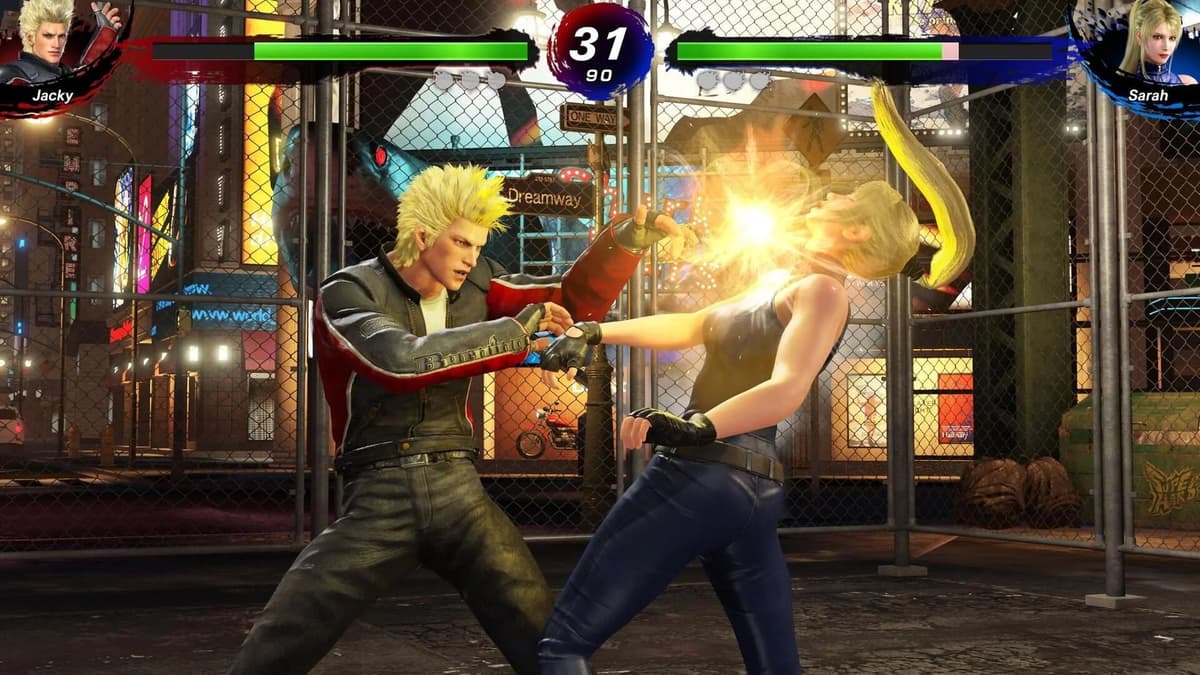
This isn’t a “wow, next-gen spectacle” game – the Dragon Engine facelift makes models and lighting look much nicer than the old PS3/360 versions, but up against the PS5 edition you can see softer textures and simpler background detail on Switch 2. Still, when you’re actually playing, the consistent frame rate matters far more than whether there’s an extra light bounce in Jacky’s jacket. And here, VF5 R.E.V.O. holds the line where it counts.
World Stage: VF4 Quest’s spirit, rebuilt for 2026
The big new Switch-era feature is World Stage, a single-player mode that quietly became my main time sink. If you remember Virtua Fighter 4’s legendary Quest mode, this is very much in that tradition: you’re not following a cinematic story, you’re climbing a weirdly believable meta-ladder of fictional players, arcades, and events.
You start at humble, almost dingy “booths” – essentially themed hubs filled with CPU-controlled “player avatars” that simulate actual online players. They have goofy names, custom costumes, and distinct tendencies. One Lau I fought kept low-sweeping me on wake-up like a human player who found one reliable trick and refused to let go. Another Wolf just wouldn’t stop going for giant swing, and I started fuzzy guarding out of pure spite.
Each booth has a boss-like opponent, and clearing a booth unlocks the next arena on the “world” map. The loop is simple: fight sets, earn in-game currency and unlocks, scoop up cosmetic gear, and push toward a big tournament finale. It’s not trying to be Street Fighter 6’s World Tour with open-world exploration and side quests. Instead, it plays to Virtua Fighter’s strengths: short, focused matches that actually feel like you’re grinding in a local arcade scene.
What I didn’t expect was how sticky this mode would become offline. On the second night, I sat down intending to clear just one booth before bed. Ninety minutes later I was still chasing a specific headgear piece to complete an absurdly overdressed Lion build. World Stage gives VF5 something it’s always slightly lacked on consoles: a reason for solo players to keep playing that isn’t just “get better for online or nothing.”
Combat: still the cleanest, meanest 3D fighter in the room
If you’ve never touched Virtua Fighter before, the control scheme looks almost suspiciously basic. Three buttons: Punch, Kick, Guard. That’s it. No dedicated throw button, no special attack macro. But once you start combining those three buttons with directional inputs — especially the diagonals — you realize how much is hiding under the surface.
VF5’s magic is how it turns simple inputs into complex decision-making. A single step at the wrong angle gets you launched. A lazy mid punch into a seasoned opponent’s evasion turns into a full combo punish. The game asks you to actually think about timing and spacing instead of mashing flashy strings.
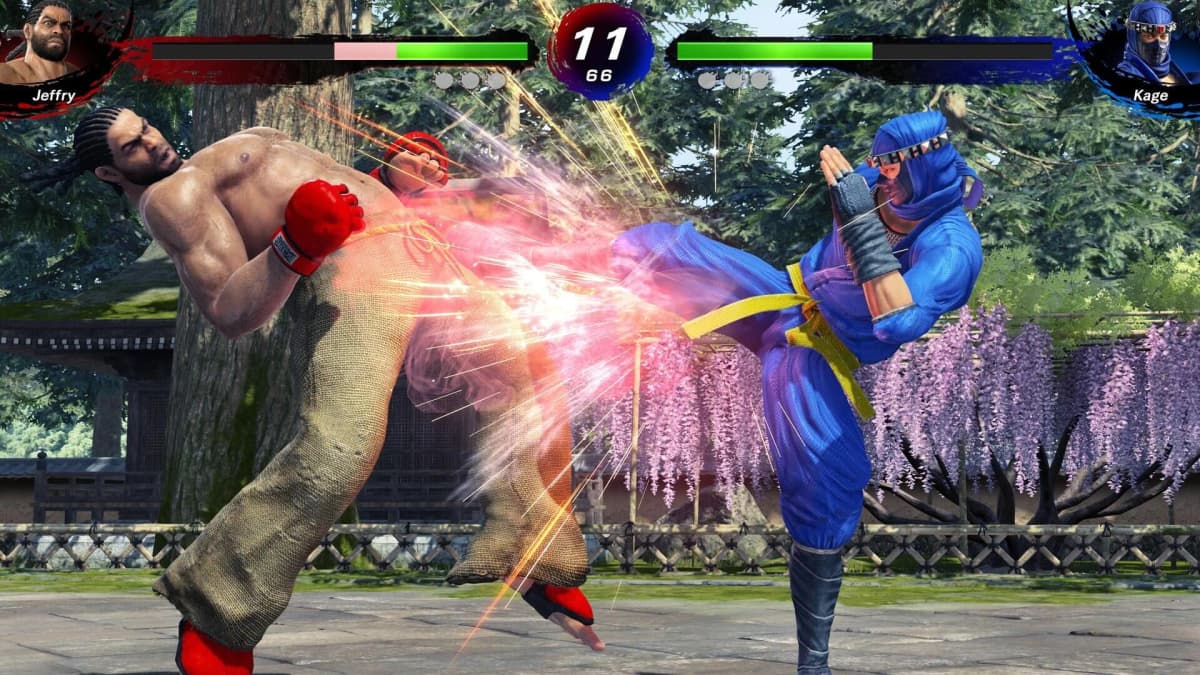
Coming back to Lion after a long break was humbling. I went in trying to play him like a Tekken character, throwing out strings just to see what stuck. The CPU at higher ranks and online players punished that instantly. My “aha” moment came in a ranked set against a Sarah player from PlayStation: I lost the first game because I wouldn’t stop pressing buttons on defense. In the second game, I forced myself to just stand there, guard, and sidestep at disadvantage. Suddenly, all the little Lion stance transitions and pokes started opening up. I took the set 2-1 and immediately jumped into training mode to lab the situations that felt fuzzy.
That’s how Virtua Fighter gets under your skin. The system is brutally honest. You don’t win because your character has an insane super, or because your jump-in has a silly hitbox. You win because you controlled your nerves, picked the right defensive options, and spaced your mids and lows better than the other person. In 2026, that still feels incredibly refreshing next to the busier, flashier chaos of Tekken 8 or the drive system of Street Fighter 6.
On Switch 2 specifically, the most important thing is that there’s no sense of input “mush.” With a good controller (we’ll get to that), sidesteps, fuzzy guard, and tight hit-confirms feel as doable here as they do on other platforms. I was landing Akira’s knee and just-frame-heavy stuff consistently once muscle memory came back, which I honestly didn’t expect from a Nintendo handheld hybrid.
Online play, rollback netcode, and cross-platform reality
For a game that lives and dies by precise timing, the netcode situation matters almost as much as the local performance. The good news: R.E.V.O. World Stage on Switch 2 uses rollback netcode and supports full cross-platform play with other current versions. In practice, that meant my ranked and casual matches were against a mix of Switch 2, PlayStation, Xbox, and PC players, all sharing the same pool.
Most of my matches felt shockingly close to offline. Against opponents in my own region, inputs came out exactly when I expected, and sensitive stuff like throw escapes and evades felt reliable. The few rough spots I hit were long-distance connections at odd hours — a couple of games had slight hitching during stage intros or very occasional rollback spikes mid-round. They were the exception rather than the rule, and I never had a match drop outright.
The online suite itself is refreshingly straightforward. You’ve got Ranked for the long grind, plus a weekly tournament that kicks in on weekends. There’s a simple replay feed in the menus that quietly became one of my favorite features: if you idle in the lobby, you get a ticker of ongoing matches, and you can grab replays from interesting-looking players or check out their profile. I stole an entire okizeme sequence from a Japanese Akira that popped up while I was making coffee.
One caveat: there’s no cross-save. If you’ve already sunk serious time into VF5 R.E.V.O. on another platform, you’re starting from scratch here in terms of rank and unlocks. For a budget-priced port, I can live with that, but it’s worth knowing before you double-dip.
Performance and visuals: the right sacrifices in the right places
SEGA and RGG Studio rebuilt Virtua Fighter 5 in the Dragon Engine a while back, and that’s the version we’re getting here, adapted to Switch 2. Character models benefit the most: faces are less mannequin-like, clothing has believable folds and sheen, and animations have a weight and snap that still holds up against brand-new fighters.
Backgrounds are more of a mixed bag. Some stages — especially the more grounded, urban ones — look great on Switch 2, with strong lighting and a good sense of depth. Others, particularly those with distant crowds or complex geometry, give away the lower power target more clearly: flattened details, simpler shadows, occasionally a slightly sterile look. In motion and at 60fps, you stop caring quickly, but if you bounce between a PS5 and Switch 2 copy, you’ll notice the downgrade.
Docked or handheld, though, the image clarity is good and performance is king. I never hit a single noticeable frame drop, even in busy stages or during chaotic wall combos. Load times are also pleasantly short. Jumping from character select into a match is quick enough that rematching online doesn’t feel like a chore.
Controllers: Joy-Con 2 vs Pro Controller 2 vs reality
This is where the Switch 2 port goes from “damn, this is legit” to “please, just don’t do this to yourself.” The Joy-Con 2 D-pad is still that separated four-button layout, and it is simply not built for Virtua Fighter’s demands. The game leans heavily on diagonals for movement and specific inputs. Trying to consistently pull off Lion’s diagonal-influenced strings or Akira’s directional specials on Joy-Con 2 was an exercise in frustration.
During my first couple of handheld sessions, I kept dropping simple evade-punish sequences because my thumb rolled between left and down-left just enough to confuse the input. It doesn’t matter how good the netcode is if your own hardware is eating your diagonals.
Swap to a Pro Controller 2, and the story completely changes. The traditional D-pad is much more forgiving, and my consistency jumped immediately. Fuzzy guard, instant side steps, tight hit-confirms — all of it felt “right” within a match or two. If you’re even slightly serious about playing VF5 on Switch 2, I’d call a Pro Controller 2 non-negotiable.
I also tried a third-party stick via USB in docked mode, and unsurprisingly that’s the ideal experience if you’re a stick player already. But the key point is this: the port is good enough that the only real input problem is Nintendo’s own default hardware. The moment you fix that, Switch 2 stops feeling like a “compromise” platform for Virtua Fighter.
Customization, DLC, and that pleasantly low asking price
Virtua Fighter has always had a quietly obsessive customization scene, and R.E.V.O. World Stage brings that over wholesale. As you grind World Stage and play matches, you unlock costume pieces, accessories, and visual tweaks. It ranges from subtle (color variations, belts, gloves) to full-on clown costumes that make your stoic martial artist look like they wandered in from a very different game.
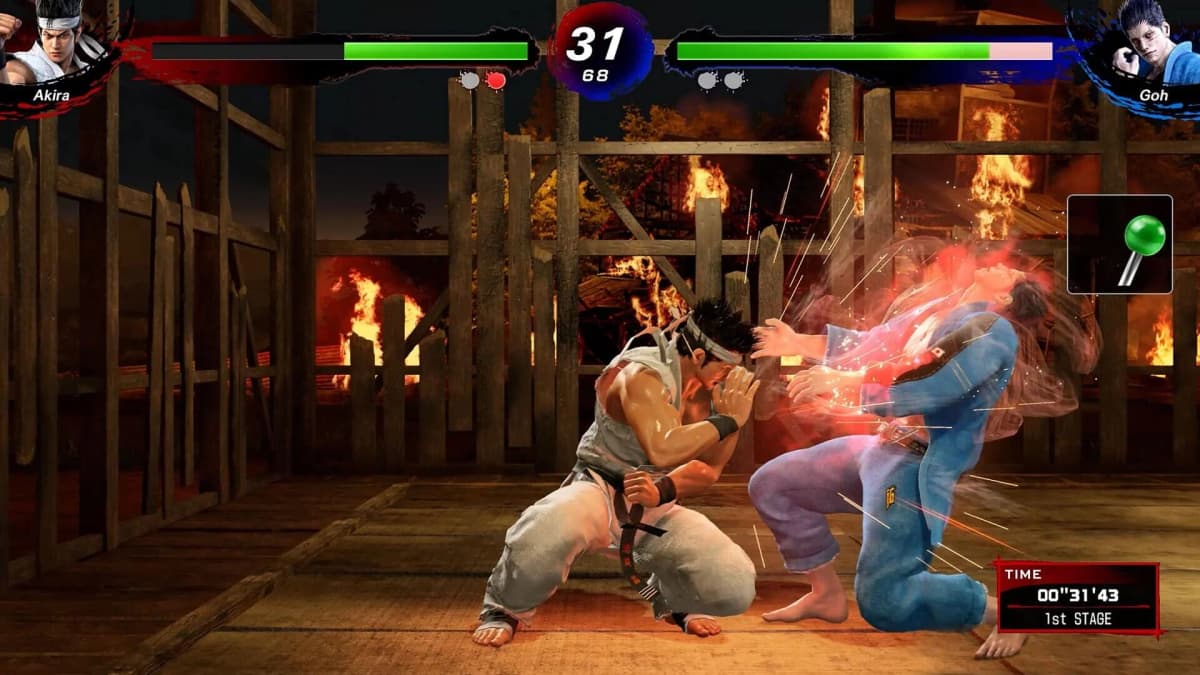
The Switch 2 version ships with a bunch of DLC packs available, including those polygonal retro costumes that make the cast look like they stepped out of the original 1993 Virtua Fighter. They’re not cheap for what they are, but I can’t pretend my low-poly Akira mirror matches weren’t hilarious.
Crucially, the base game itself is budget-priced (around £15.99 at launch). For that, you’re getting the full roster, World Stage, comprehensive training options, rollback netcode, cross-play, ranked modes, local versus — the works. Considering how often fighting games launch as $70 “platforms” and then nickel-and-dime you for seasons of content, having this much game at this price feels almost old-fashioned in the best way.
Who this port is actually for
On paper, Virtua Fighter 5 R.E.V.O. World Stage on Switch 2 is for everyone. In practice, it’s going to resonate the most with a few specific groups.
- VF diehards who want a portable version without sacrificing serious play. If you already love this system, this is an easy double-dip, as long as you’re okay starting fresh on progression.
- 3D fighter fans bouncing between Tekken, DOA, and Soulcalibur who’ve always heard VF is “the deep one” but never had easy access. This is the most convenient, low-cost entry point right now.
- Switch-only players who were locked out of the series entirely until now. With proper controllers, this port doesn’t feel like a second-class citizen — it’s a legitimate way to learn Virtua Fighter.
If you’re purely a casual party-game fighter fan and you want supers, crazy comeback mechanics, and constant particle explosions, VF5 might feel almost too restrained. There’s no World Tour story mode, no crossover characters, no meme-fodder special moves. It’s just you, your opponent, and a system that doesn’t care how flashy you look if your fundamentals are weak.
FinalBoss // Gear
Level up your setup
01Best-selling Switch 2 gameson Amazon→02Switch 2 accessorieson Amazon→038BitDo controllerson Amazon→04Discounted game keyson Kinguin→Affiliate links · As an Amazon Associate, FinalBoss earns from qualifying purchases.
Want to Level Up Your Gaming?
Get access to exclusive strategies, hidden tips, and pro-level insights that we don't share publicly.
Ultimate Reviews Strategy Guide + Weekly Pro Tips