

Game intel
Hollow Knight: Silksong
Hollow Knight: Silksong is the epic sequel to Hollow Knight, the epic action-adventure of bugs and heroes. As the lethal hunter Hornet, journey to all-new land…
I booted up Silksong on my PC with an Xbox pad and a pretentious cup of oolong, fully ready to nitpick after seven years of waiting. That lasted all of five minutes. The opening drops Hornet into Pharloom mid-crisis and, before I had time to calibrate, the game grabbed me by the collar. I ate dirt in the first proper encounter because my Hollow Knight muscle memory told me to hang back and poke. Silksong doesn’t want you to poke. It wants you to cut a ribbon through the air. The first “aha” was slamming the heal mid-dash-the bind animation is snappy, a tug of thread and she’s back in the fray. That single change foreshadowed the entire arc of my 55 hours: this is a metroidvania that rewards momentum and punishes hesitation.
By the end of my first session (about 6 hours), I’d seen two distinct biomes, a handful of side-quest breadcrumbs, and a map that looked like a torn spiderweb I was slowly knitting back together. I felt the old Hollow Knight itch-the kind that turns “one more bench” into bedtime treason. Silksong is that itch, distilled and sharpened.
Background check: I 112%-ed Hollow Knight back in 2018 with a beloved save file named “GeoDaddy” (don’t ask). I prefer exploratory builds and lean into platforming challenges even when they make my knuckles go white. I played Silksong primarily on PC at 1440p with a controller, often with headphones because this series deserves your ears. I’m not a speedrunner, but once a game clicks I tend to mainline it hard. Silksong clicked early, then clawed deeper every hour after.
Hornet talks. That alone shifts the tone. She’s not soliloquizing every ten steps-a relief—but her exchanges give scene-by-scene texture the original didn’t always manage. Pharloom’s residents are a grab bag of haunted artisans, zealots, and strays who’ve learned to live under something bad and growing worse. Conversations have bite. I had one early chat with a weary craftsperson who sized me up in a sentence and sent me chasing a rumor that spiraled into a region I wouldn’t have found for another 10 hours. It’s still cryptic—names, inscriptions, implications—but now it nudges more often, like a friend tapping the map with a gloved finger rather than drawing you a route.
Across the ~55 hours it took me to the credits (and then some), I watched NPCs move homes, change their tone, or vanish in ways that made the world feel unstable in the best way. One mid-game sequence ends with a resident’s fate playing out while you’re forced to keep climbing. I was annoyed in the moment—let me help!—and then it landed: this kingdom doesn’t wait for you to be ready. If the original borrowed some of its storytelling DNA from dusty epigraphs, Silksong spikes in more live, reactive scenes.
Silksong’s big magic trick is how it gets you to care about the space between dots on the map. Mapping is a ritual again—there’s a cartographer to find, his presence telegraphed by distant hums and telltale scribbles. The moment you sit a bench and ink fills the parchment, it hits: there’s the spine of the place, but not the secret veins. I obsessed over those gray pockets and hair-thin lines. By hour 20, I had a backlog of “come back with X” mental sticky notes. By hour 35, I started keeping a literal notepad.
One night around 1 a.m., I noticed a suspicious gap between a ladder well and a wall of decorative wooden beams. It felt like bad set dressing. I threaded a leap, stabbed downward to buy a little hang time, and fell straight through a rotten slat into a pitch-dark attic. It wasn’t just a secret room; it was the mouth of an entire sub-area. The run ended two hours later with new materials, a haunting boss tease, and a sidequest I didn’t resolve until act three. Silksong thrives on that particular “wait, this is bigger than I thought” feeling. Even after the credits, I opened the map, zoomed in on a whisper of empty space, and found another route. That old Elden Ring sensation of being rewarded for curiosity? It’s here, in 2D, in spades.
It helps that levels are built to be incompletable on first pass. Doors ask for tools you haven’t earned; an angry wind says “come back stronger.” In Discord chats with two friends playing alongside me, our routes diverged constantly. They met a late-game vendor before I did and bought an upgrade that trivialized a mid-boss I was stuck on. I’d already solved a quest they didn’t even know existed. The game doesn’t just accommodate different orders—it invites them.
If there’s a bruise, it’s that some secrets are invisible for the wrong reasons. A couple entrances are camouflaged past teasing into “okay, that’s just mean.” I like to feel smart, not lucky. Also, bench scarcity varies wildly. One region made every death a three-minute runback through spike-draped corridors that stopped being educational after the seventh time. Challenge is good. Cardio for cardio’s sake, less so.
Hornet is a different beast than the Knight. Faster. Meaner. Her needle has reach, and her aerial options are the point, not a garnish. The combat finally clicked for me during an early dual miniboss in a bell tower. I died five times treating it like Hollow Knight—tap in, tap out. On attempt six I stayed in their faces, threading jumps between their arcs, cashing my thread meter to bind on the fly, and using the air dash not to retreat, but to reposition just past danger. The fight turned from attrition to choreography and I stopped getting clipped by the world’s most passive-aggressive bell ropes.
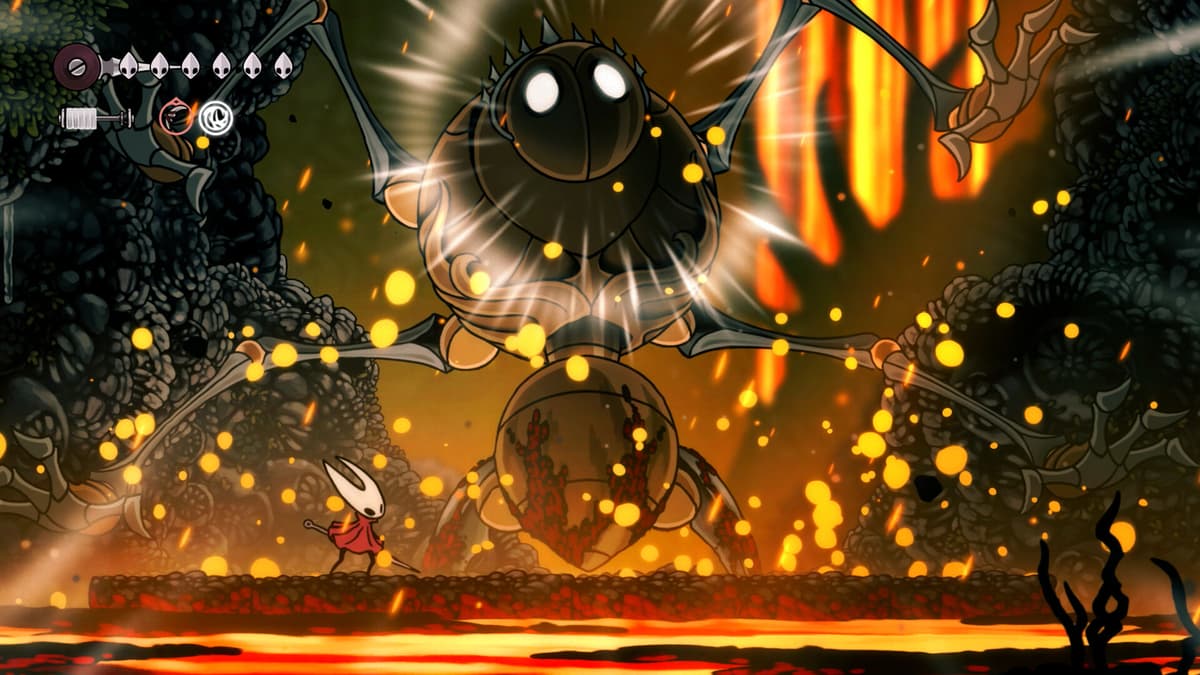
Bosses are where Silksong insists you learn the language. There’s a volcanic trio where the second phase flips the floor plan and demands a new approach mid-yell. There’s a later duel that’s basically a mirror held up to your impatience; two mistakes and you’re silk-confetti. My favorite was an optional guardian tucked three layers under a mausoleum—its final pattern looks impossible until you realize the safe space is above the problem, not beside it. Once you trust Hornet’s verticality, everything unlocks.
The toolset feeds this momentum. Instead of charms that passively do the work, so many of Silksong’s upgrades feel like “permission slips” to play more aggressively: a recovery tweak that lets you act sooner after taking a hit, a technique that turns a downward strike into a brief hover so you can sneak in one more needle flick, a thread art that trades a chunk of silk for an emergency invincible burst through a trap gauntlet. They’re not raw damage crutches so much as new verbs, and when they stack, the game sings.
Platforming gets its own spotlight, repeatedly. I’m not talking full Path of Pain cruelty (though if you go looking, the lineage is honored). It’s more that environmental damage in Silksong adds up fast in the wrong rooms. One late-game descent down a shaft lined with moving thorns had me white-knuckling as I timed bounces, clipped a corner, bled three chunks, and still had to fight a miniboss in a closet. On my third try it flowed and the controller buzzed with that “you did it right this time” hum. I both cursed the room and added it to my personal highlight reel.
Money matters more than I wanted. Prices are spicy, and death taxes are cruel. When you die, you leave a cocoon and your wallet where you fell. Recover it and all’s forgiven; fail before you get there and your savings evaporate. On paper, it’s the same risk-reward tension that keeps you honest in the field. In practice, I spent two separate hours doing “finance runs” because a vendor’s stock refresh threw a must-have upgrade on the shelf and I’d just flubbed a retrieval. Not the end of the world—I like a quiet loop now and then—but the balance sometimes tips from tension into busywork.
There’s a small but significant UX grace note here: banking that first bench in a new zone to auto-update your map also sets a safer respawn loop for recovery runs. When I ignored that, I paid for it. When I respected it, the economy felt like a nudge rather than a slap.
Silksong’s side content is less “checklist to clear” and more “threads that pull on the world.” The wishboard-style requests start simple—deliveries, rescues—and spiral. One I picked up in hour 12 ended in hour 28 with a room I’d walked past three times finally paying off like a magic trick. Another ended badly because I assumed a timer was flavor text. When the credits rolled, I had three unresolved lines gnawing at me, and jumping back in didn’t feel like the usual post-game cleanup. It felt like the story daemon prodding me: finish what you started.
I’m dancing around specifics because the best beats rely on you bumping into them in your own order, but know this: the world changes around you, sometimes because of you and sometimes despite you. It’s charming and cruel in equal measure, and in rare moments it made me swear out loud—in a good way.
On my machine (Ryzen 5, RTX 3070, 32 GB RAM), I ran at 1440p with a high refresh and never saw a hard crash. I hit one softlock in a late-game elevator where a platform didn’t reset; fast travel bailed me out, and it never recurred. Input latency is tight—the kind of tight where you blame yourself, not the game. I toggled V-Sync off to match my monitor, and the motion clarity helped with those thorny gauntlets.
Sound deserves its flowers. The score leans into delicate, insistent strings that fray into percussion as fights escalate, and there’s a motif tied to the cartography ritual that triggered the weirdest Pavlovian urge to find quill and ink. Audio cues pull their weight in boss reads too—a tearing flutter, a throat click, the whisper of thread. I’d tell you to play with headphones, but I already did five paragraphs ago.
After 10 hours: I chased a faint lullaby through a lumberyard and found a survivor behind a barricade. I couldn’t reach them yet. I marked the spot, left, and kept hearing the song in other rooms—fainter, then gone. When I returned, the barricade was open. Inside: not what I expected. That’s Silksong in a nutshell—hints, not instructions, and you have to live with the timing.
At 24 hours: I discovered a fast-travel station wedged under a precarious platforming test I’d avoided. It reframed four regions at once, and suddenly all my half-finished threads connected. That sense of macro-level satisfaction is rare; Silksong earns it repeatedly.
At 41 hours: I finally beat a boss that had my number for two nights. The winning attempt was sloppy until it wasn’t—the last 20 seconds were perfect. I realized, mid-victory, that I’d stopped watching the health pips entirely and was playing by rhythm, not math. The game trains you to do that.
Post-credits: I opened an old door with a new key and found a view that made me screenshot and just sit for a minute. The series’ melancholy beauty is intact, no bloat, no cynicism.
Silksong is bigger without feeling bloated, faster without losing clarity, and harsher without cruelty (most of the time). It strengthens what made Hollow Knight special—the map that breathes, the fights that teach, the world that watches you—as it pivots into a protagonist who moves and speaks with purpose. I had nights where I quit annoyed: at an invisible entrance, a pearl penalty, a runback that overstayed. Then I’d eat breakfast thinking about a corner of the map I hadn’t checked, and the controller would be back in my hands before the kettle boiled.
Seven years of dreaming is unfair pressure for any game. Silksong doesn’t meet every fantasy, but it meets the ones that matter most. It respects your curiosity, it makes you braver, and when it sings, it does so in a voice that belongs to Hornet and nowhere else.
Final score: 9/10
Get access to exclusive strategies, hidden tips, and pro-level insights that we don't share publicly.
Ultimate Reviews Strategy Guide + Weekly Pro Tips