
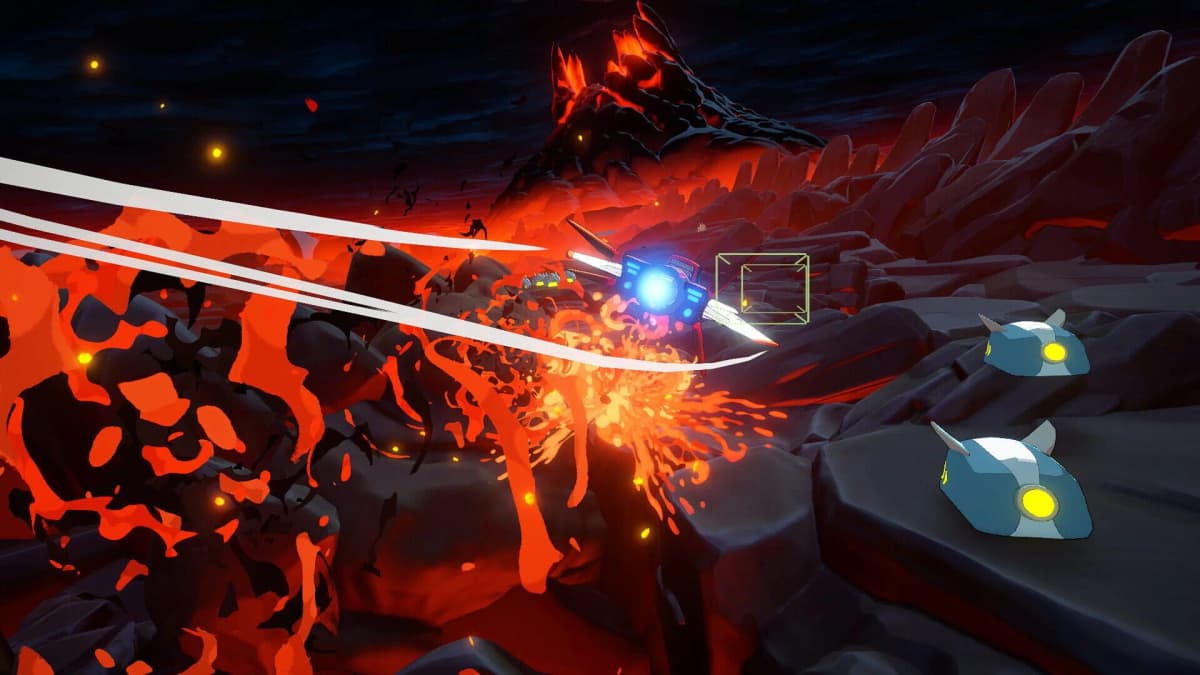
Wild Blue Skies makes the wrong kind of bold move: it copies the shape of a classic arcade flight game so closely that every rough edge feels louder. The on-rails structure is intact. The branching routes are intact. The chatter between squadmates, the score targets, the boss pressure, and the dramatic path splits are all here. What is missing is the effortless confidence that makes that formula sing.
I can respect a focused homage, especially one priced at a reported $14.99. Wild Blue Skies knows exactly what it wants to evoke, and its best moments turn quick target selection, route planning, and medal hunting into a satisfying arcade loop. Yet this is a game that repeatedly asks me to admire the reference instead of the work in front of me. That is a fatal problem for an action game built around split-second feel.
- The best part: branching mission paths, bosses, medals, secrets, and score-chasing give the campaign genuine replay value.
- The biggest problem: standard fire and lock-on charge shots sit on separate buttons, making combat less fluid than it needs to be.
- The difficulty issue: there are no difficulty options at launch, while damage can strip away valuable laser power and recovery remains limited.
- The identity problem: Bowie Stray and the Blue Bombers inhabit a game that too often leans on familiar Star Fox 64-style character roles and mission construction.
- The platform picture: PC, PlayStation 5, and Xbox Series X|S share an August 13, 2026 launch date, with a feature-complete Nintendo Switch version planned for fall 2026.
Table of Contents (7)
The Arcade Framework Still Has Teeth
Wild Blue Skies is an on-rails arcade flight shooter, and its foundational loop remains compelling. Piloting Bowie Stray through branching missions means every run has a reason to be more than a straight march toward the credits. Optional objectives can alter the next stage, while medals, secrets, and high-score targets push the player toward cleaner, more aggressive routes.
That structure gives the game its strongest argument. A good run is about more than surviving a stage. It is about preserving momentum, clearing threats efficiently, finding the valuable line through an encounter, and committing to a route that serves the score. Bomb pickups, laser power-ups, and charge shots aimed at clustered enemies support that rhythm. When a stage feeds targets into the player’s path with enough clarity, Wild Blue Skies has the crisp, old-school urgency it wants.
The score game also gives repeat attempts a purpose. Learning where secrets sit and how objectives influence branching paths creates a tangible mastery curve. The problem is that Wild Blue Skies sometimes mistakes memorization for expression. Once the preferred route is known, the hunt can collapse into executing a prescribed sequence rather than adapting to danger with style.
That limitation would be easier to forgive if the flight model consistently made execution feel exhilarating. It does not. The game can produce sharp arcade tension, but it too often turns a clever route into an argument with its own controls.
Combat Has Too Much Friction for a Flight Shooter
The central control problem is simple: Wild Blue Skies separates standard laser fire from the lock-on charge shot. Those actions belong together in the player’s hands because the game constantly asks for fast transitions between immediate pressure and stronger targeted damage. Splitting them turns a natural combat rhythm into an awkward choice. Fire normally, or shift attention toward locking on. The result is clunkier than an arcade shooter of this speed can afford.
The short range of the stronger homing shot makes that separation sting even more. A lock-on tool should create confidence when enemies crowd the screen or when a larger target demands priority. Here, the player can lose that confidence simply because the target sits outside a restrictive range. Combat becomes more about managing interface limitations than expressing aggression.
Timed dodge rolls have a useful defensive purpose because they can deflect enemy fire, and free-flight missions let the player brake into a 180-degree turn to get behind opponents. Those mechanics show that Chuhai Labs and VITEI Backroom understand the ingredients of a lively aerial combat system. The issue is integration. In 360-degree encounters, threats from behind can become irritating because the available evasive language remains limited. A barrel roll can save a run, but it cannot solve every positioning problem.

Handling also lacks the instant readability that this kind of game needs. The Cloud Cutter requires directional tilting to turn effectively, and its response can feel resistant when a sharp correction matters. Add a reticle perspective that makes targets harder to parse, plus the absence of a first-person view option, and certain encounters become harder for reasons that have little to do with enemy design.
Bombs underline the same frustration. Their large circular blast zones lack the satisfying precision of a tool built for sweeping formations. A bomb should feel like a decisive punctuation mark in a crowded battle. Wild Blue Skies makes it feel more like a rough estimate.
Punishment Outruns Progression
Challenge is welcome in an arcade shooter. Wild Blue Skies is clearly built for players who want to replay missions, learn routes, improve their scores, and chase a more controlled performance. The game has no difficulty options at launch, so its difficulty curve needs to earn that rigidity through reliable systems. Too often, it does not.
Damage carries an outsized cost because taking enough hits can remove laser power, leaving later encounters with weaker damage output. Recovery is limited, extra lives are placed in fixed locations, and healing between missions follows a fixed pattern. That stack of restrictions can turn a single messy stretch into a long, slow decline. By the time a boss arrives, the player may be fighting both the encounter and the consequences of an earlier mistake.
Restarting or replaying a level costs a life, which makes the pursuit of mastery feel more punitive than motivating. A score-driven game should encourage experimentation: test a route, chase a medal, abandon a poor line, and run it back smarter. Wild Blue Skies places a cost on that learning process. The pressure is real, but it is not always productive.
There is a difference between a game demanding discipline and a game making recovery feel joyless. Wild Blue Skies crosses that line often enough to weaken its own replay loop. The player should leave a failed run hungry to improve. Here, a failed run can leave the player annoyed at the state of the ship rather than excited by the next attempt.
Its Homage Becomes a Creative Ceiling
The Blue Bombers give Wild Blue Skies a cast of its own: Bowie Stray, Chuck Barbakoa, Thorne, and Ro Whitetail. The trouble is not that these characters occupy recognizable squad roles. The trouble is how often the game’s character functions, plot beats, and level layouts feel designed to recreate a remembered cadence rather than establish a new one.
That makes the better ideas feel trapped. Some stages introduce novelty into the familiar flight-shooter frame, and those moments matter because they show what Wild Blue Skies could have been with more nerve. The game does not need to reject its inspiration. It needs to stop treating that inspiration as a blueprint that cannot be altered.
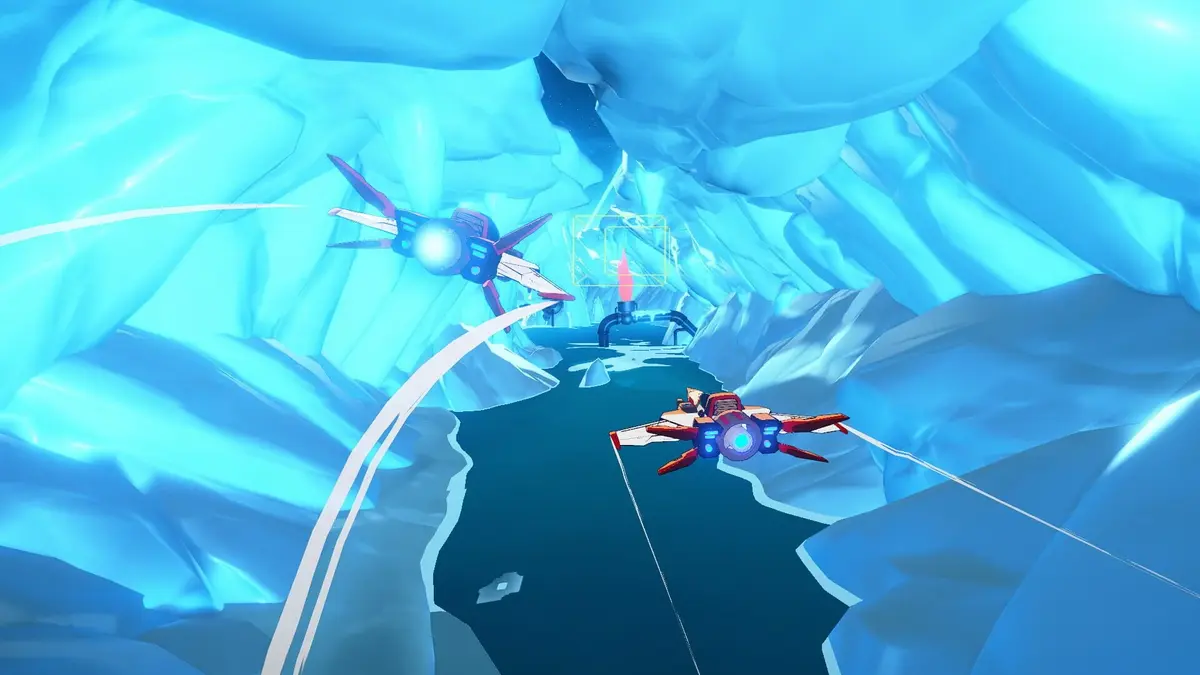
Its strongest visual choices point toward a more individual direction. The outlined cel-shaded presentation and the dithering used on the plane during on-rails missions create a distinct retro texture. There is a lively animated quality to the presentation that suits the arcade intent. Those touches prove that imitation was never inevitable.
Unfortunately, the open-ended combat missions expose the design’s uncertainty. They lack the clean momentum of the guided on-rails stages, and the less controlled spaces make targeting, collisions, and enemy pursuit more frustrating. Wild Blue Skies is at its best when it directs the player’s attention with purpose. It gets weaker when it mistakes a wider arena for greater freedom.
Platform Availability and Technical Caveats
Wild Blue Skies has an August 13, 2026 release date on PC via Steam, PlayStation 5, and Xbox Series X|S. A Nintendo Switch edition is planned for fall 2026 and is described as feature-complete. The reported launch price is $14.99, which is fair for a compact arcade-focused game with branching paths and replay-oriented goals.
Chuhai Labs and VITEI Backroom Inc. are credited as developers. Balor Games is listed as the Steam publisher, while Good Games Group, Inc. is listed on the PlayStation Store. Occasional crashes have been documented on PC, a limited but unwelcome technical blemish in a game where missed opportunities and broken momentum already carry such a heavy cost.
Who Should Play Wild Blue Skies
I recommend Wild Blue Skies to players who specifically want a short, replay-driven arcade flight game with branching routes, medal hunting, and a familiar Star Fox 64-style mission structure. The $14.99 price gives its best qualities room to breathe, especially for players who value score optimization more than fresh ideas.
Players who want immaculate controls, flexible difficulty settings, a generous recovery system, or a thoroughly original squad adventure should skip it. The game asks for tolerance in too many crucial places: awkward targeting, uneven challenge, strict progression penalties, weaker free-flight missions, and a design identity that never escapes its reference point.
Bottom Line
Wild Blue Skies earns a 6/10. Its branching routes, score-chasing structure, bosses, secrets, and retro presentation make for an enjoyable arcade package in flashes. The problem is that those flashes never form a fully confident game. Combat inputs lack smoothness, damage penalties can turn challenge into attrition, and the strongest stages still struggle to establish a personality beyond their inspiration.
Wild Blue Skies proves that the old arcade-flight formula still has power. The unresolved question is whether a tribute can become essential when it preserves so much of the past while leaving too little room for itself.
FinalBoss // Gear
Level up your setup
01Top-rated gaming headsetson Amazon→02High-refresh gaming monitorson Amazon→03Gaming chairson Amazon→04Discounted game keyson Kinguin→Affiliate links · As an Amazon Associate, FinalBoss earns from qualifying purchases.
Want to Level Up Your Gaming?
Get access to exclusive strategies, hidden tips, and pro-level insights that we don't share publicly.
Ultimate Reviews Strategy Guide + Weekly Pro Tips