
Table of Contents (15)
How Midnight’s First Raids Actually Work
World of Warcraft: Midnight launches its endgame around a three-raid setup, and understanding that structure is the foundation of a smooth first season.
Here’s the key layout for Season 1:
- Voidspire – Core “flagship” raid (released March 17, 2026).
- Dreamrift – Shorter companion raid (also March 17, 2026).
- March on Quel’Danas – Follow-up raid (week of March 31, 2026).
Important timing details I had to plan around as a raid leader:
- Mythic difficulty unlocks one week after each raid’s Normal/Heroic release.
- The Cutting Edge window for all three raids is tight: roughly 8–9 weeks of serious progression.
- Raid drops range from about item level 246–282, with Great Vault raid rewards sitting at 256 ilvl early on.
- All three raids drop Tier 35 tokens, so cross-raid progression is baked in from the start.
Practically, that means you are not just “choosing a raid.” You are planning how to weave Voidspire, Dreamrift, and later Quel’Danas together so your group gets tier bonuses, boss kills, and item level in the right order.
Which Raid to Do First: Voidspire vs Dreamrift
When my guild first zoned in, the big question was simple: do we slam all our time into Voidspire, or detour into Dreamrift early?
Based on actually running both in the same reset, here’s how I’d frame it if you’re aiming for efficient progression.
Why I Recommend Starting in Voidspire
Voidspire feels clearly tuned as the “main” Midnight raid. Early bosses are designed to be accessible on Normal while still punishing sloppy play. The loot table also lines up better with what you want on everyone’s first tier set.
- Entry difficulty: More forgiving mechanics per boss, but with tighter execution checks later in the instance.
- Loot profile: Strong spread of tier tokens and core weapons/trinkets.
- Learning value: Mechanics teach the expansion’s general design language (overlaps, movement, add control) that then carries into Dreamrift and Quel’Danas.
What worked well for us was using Voidspire as our Normal “farm spine” in week one: we got people used to Midnight’s visual clutter, new ground effects, and healing profiles without repeatedly slamming into a wall.
Where Dreamrift Fits In
Dreamrift is shorter, but it spikes harder on certain bosses, especially once you move beyond Normal. One early boss in particular is tuned like a mini Mythic+ keystone: burst windows, add waves, and healing CDs all need coordination.
I learned quickly that treating Dreamrift as a “casual side raid” was a mistake. On Heroic, the tuning is closer to the back half of Voidspire, not the front. The upside is that Dreamrift’s loot helps plug gaps on people who had bad luck in Voidspire, and it adds more Tier 35 token chances.
In practice, a solid first-week path for an organized guild looked like this for us:
- Night 1–2: Voidspire Normal full clear, funneling tier and weapons.
- Night 3: Dreamrift Normal clear as far as your group can go smoothly.
- Any remaining time: Heroic front half of Voidspire, even if you only kill 2–3 bosses.
This gave everyone a baseline of gear and let us step into Mythic the following week without feeling underprepared.

Recommended Item Level & Prep Before You Zone In
The game doesn’t spell out clearly what item level actually feels comfortable for each difficulty, so here’s what lined up with our experience:
- Raid Finder (LFR): 240+ is fine. This is mostly for alts and story.
- Normal: Aim for 245–250 ilvl average. Below 240, mistakes start becoming lethal even on early bosses.
- Heroic: 255+ ilvl is where pulls start to feel fair rather than punishing. The 256 Vault rewards line up nicely here.
- Early Mythic: Plan around 265+ ilvl for your main roster when you step into the first Mythic week, assuming you’re pushing Cutting Edge.
To hit these breakpoints quickly, this prep routine helped us:
- Run all available Mythic 0 dungeons in week one for guaranteed 246+ drops.
- Target a few Mythic+ keystones as soon as they open to seed Vault options.
- Use crafted gear or catch-up tokens to fill obvious low slots before raid night.
- Check the
Adventure Guide → Raids → Voidspirepanel in-game to identify target bosses for trinkets and tier.
I also made sure every raider walked into Night 1 with:
- Current consumables (phials, food, weapon oils/imbues).
- Two enchantments minimum on their weakest pieces (rings and weapon if nothing else).
- Basic WeakAuras for boss timers and defensive tracking. Even simple timers made a huge difference in early pulls.
First-Week Plan for Raid Leaders
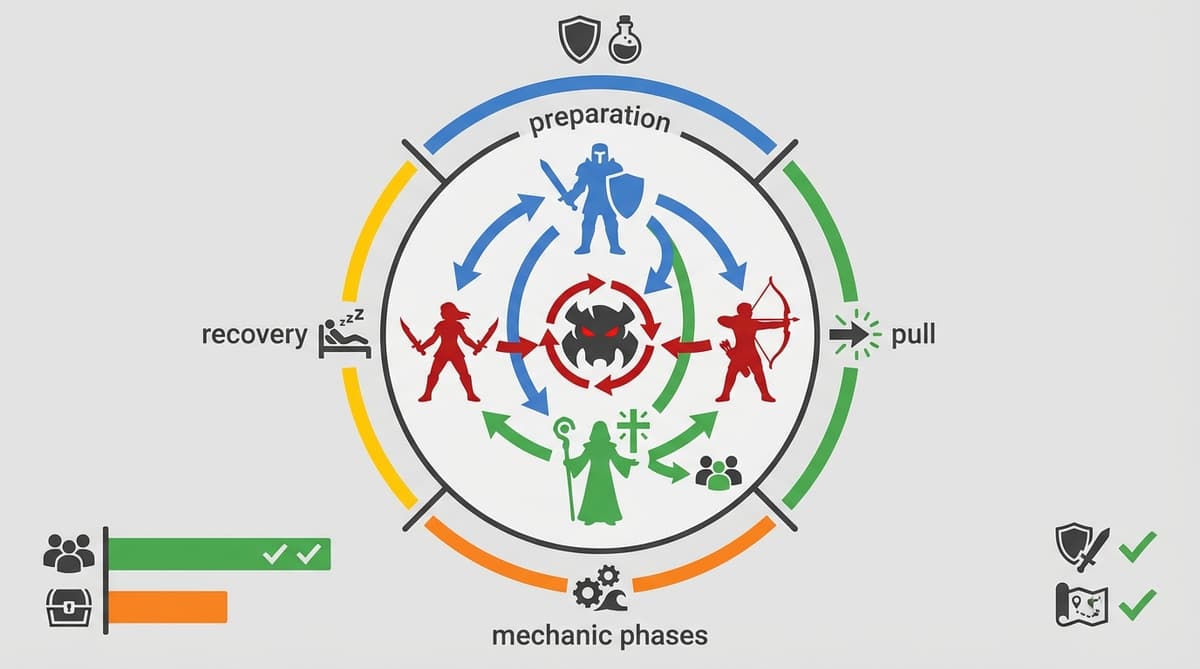
Raids in Midnight aren’t just about clearing bosses; with three raids and a compressed Cutting Edge window, your calendar becomes part of your strategy. Here’s the structure that gave my group a strong start without burning people out.
Step 1: Lock In Attendance & Roster Roles
Before our first pull, I made sure of three things:
- We had two solid tanks with past raid experience.
- We locked at least 4–5 healers for a 20–25 person group, and identified a flex DPS who could swap to healing.
- We understood our cooldown coverage: external tank CDs, raid CDs, and defensive personals.
This let us assign responsibilities early instead of mid-wipe, which is a trap I fell into at first.
Step 2: Use Normal for Wide Loot, Not Ego Metrics
The temptation on week one is to rush Heroic to “keep up” with other guilds. When we tried that in previous tiers, we ended up with undergeared bench players and lopsided loot.
For Midnight, we deliberately used Normal Voidspire and Normal Dreamrift for broad gearing:
- Everyone who intended to raid Heroic or early Mythic got into at least one full Normal clear.
- Tier 35 tokens from early bosses were prioritized on mains who play high-impact specs (tanks, top healers, and key utility DPS).
- We benched meter-chasing ego and focused on mechanics execution and survival.
Once we had a spread of 2-piece tier bonuses on core players, Heroic progression became far more stable.
Step 3: Probe Heroic, Don’t Marry It
On the back half of the first reset, we moved into Heroic Voidspire. What finally worked was treating the first Heroic lockout as information gathering rather than a make-or-break push.
- Kill the first 1–3 bosses that fall over with minimal wipes.
- Spend a handful of pulls on the next progression wall to learn patterns.
- Stop for the week when mistakes turn into frustration instead of progress.
This kept morale high and let us go into week two with specific notes like “Boss X needs another healing CD in phase 2” instead of just “Heroic is hard.”
Composition Tips for Early Midnight Raiding
Class balance always shifts, so I avoid hard “bring X, bench Y” rules. What Midnight’s first raids really reward is toolkit coverage. Here’s the pattern I noticed across both Voidspire and Dreamrift.
- 2 Tanks: One sturdy, one mobile. Bosses often punish slow repositioning, so having at least one tank comfortable with kiting and movement is huge.
- 4–5 Healers: Bring a mix of burst cooldowns (big 3-minute raid CDs) and sustained throughput. Several fights spike damage in overlapping windows.
- DPS with interrupts and stops: You want multiple reliable kicks, a few stuns, and soft CCs. Dreamrift in particular leans into add waves and cast control.
- Utility tools: At least one battle resurrection, a few externals (e.g., damage-reduction buffs on others), and two or three group defensives.
When we struggled on early bosses, it almost always came down to missing a key category (no reliable knockbacks, or not enough raid CDs) instead of “not enough raw DPS.” Once we adjusted comp, the same mechanics suddenly felt manageable.
Managing the Aggressive Cutting Edge Timeline
The biggest difference I felt in Midnight compared to older expansions is how compressed the Cutting Edge window is. With Mythic unlocking one week after each raid releases and all three raids dropped into an 8–9 week competitive window, you cannot treat this like a slow farm tier.
- By mid-June you are expected to have two Mythic raids cleared if you’re chasing Cutting Edge.
- The third raid comes in soon after, with relatively little breathing room.
The adjustment that kept our team sane:
- Set explicit goals per week (“This reset we kill Heroic Boss 5 and see Mythic Boss 1 at 30%.”) rather than vague “let’s push Mythic.”
- Protect one night each week as a consistent farm night for tier tokens and key trinkets, even while progressing.
- Rotate benches fairly so you always have geared backups without burning out a tiny core.
- Accept that you won’t full-clear everything instantly; the schedule is built for focused, not frantic, progression.
Once we treated the season like a time-limited project instead of a bottomless grind, planning became much easier.
Common Early Mistakes in Midnight’s First Raids
A lot of our wipes weren’t because the bosses were impossible; they came from a few predictable errors that you can dodge entirely.

- Ignoring Dreamrift on week one: Skipping it completely left some groups short on tier tokens and specific item slots. Even a partial clear is valuable.
- Overcommitting to Heroic too early: Banging your head against a Heroic wall while half the raid sits at low item level kills momentum and morale.
- Poor tier distribution: Handing first tier pieces to side alts or low-impact specs instead of tanks/healers and high-output mains slows everyone down.
- No cooldown plan: Relying on “use CDs when you feel like it” turns manageable damage patterns into chaos. Even a simple “CD1 at 60%, CD2 at 30%” plan works wonders.
- Skipping basic addons: Running without timers and warnings is asking for avoidable deaths, especially in movement-heavy fights.
A quick cooldown spreadsheet and tier priority list before your first pull saves more time than any single gear upgrade.
Efficient Tier & Loot Planning Across All Three Raids
Because Tier 35 tokens drop in all three raids, the smartest guilds I’ve watched (and tried to emulate) treat tier as a cross-raid puzzle, not a per-instance concern.
- Track who has 2-piece and 4-piece bonuses across your entire roster.
- Use early bosses in Voidspire and Dreamrift as “tier factories” every week.
- Once March on Quel’Danas opens, fold its early bosses into your farm rotation to top off missing 4-piece sets.
- Align high-value Vault choices (256 ilvl) with worst-equipped slots rather than chasing ilvl for its own sake.
In our case, as soon as both tanks and two key healers hit 4-piece tier, the difficulty jump moving from Heroic into early Mythic was dramatically smaller than it looked on paper.
What to Focus on Each Reset: Quick Checklist
If you want a simple structure to follow without overthinking every choice, this is the loop that has kept our progression steady:
- Early season (weeks 1–2):
- Full clear Normal Voidspire.
- Full or near-full clear Normal Dreamrift.
- Probe Heroic Voidspire front half.
- Max out Mythic 0s and a few low Mythic+ keys for Vault.
- Mid season (weeks 3–5):
- Farm early bosses on Heroic in both raids for tier and key trinkets.
- Start Mythic on the first 1–2 bosses of Voidspire once your core is 260+ ilvl with some 4-piece sets.
- Fold March on Quel’Danas into the rotation once it opens, at least on Normal/Heroic.
- Late season (weeks 6–9):
- Lock one night for pure farm across all three raids (tier, trinkets, weapons).
- Use remaining nights for targeted Mythic progression bosses.
- Trim low-impact alts from progression runs to keep pulls consistent.
Wrap-Up: The Smart Way Into Midnight’s Raids
Midnight’s first raids are tuned to reward planning more than brute force. If you understand the three-raid schedule, respect the shorter Cutting Edge window, and treat Voidspire and Dreamrift as parts of one gearing ecosystem, your first weeks will feel structured instead of overwhelming.
The practical path is straightforward: build a balanced roster, use Normal to spread gear and tier, fold in Dreamrift and later Quel’Danas for extra tokens, and only push Heroic and Mythic once your core is ready. Do that consistently for the first few resets and you set your team up not just to clear Midnight’s first raid, but to stay competitive all season.
FinalBoss // Gear
Level up your setup
01Top-rated gaming headsetson Amazon→02High-refresh gaming monitorson Amazon→03Gaming chairson Amazon→04Discounted game keyson Kinguin→
Affiliate links · As an Amazon Associate, FinalBoss earns from qualifying purchases.
Want to Level Up Your Gaming?
Get access to exclusive strategies, hidden tips, and pro-level insights that we don't share publicly.
Ultimate Guide Strategy Guide + Weekly Pro Tips