
Table of Contents (9)
Booting Up WWE 2K26: Comfort Food Wrestling After A 9-Month Crunch
The first night I loaded up WWE 2K26 on PS5, I had that weird double feeling you only get with annual sports games. On one hand, I instantly felt at home. The menus, the vibe, the camera, even the way the opening video slams from hype package to main menu… it all screamed “Yep, you know this.” On the other, I couldn’t shake the thought in the back of my mind: this thing was apparently built in roughly nine months. How much could really have changed since WWE 2K25?
After about 30 hours of bouncing between Showcase, MyRise, The Island and a disgusting number of I Quit matches with friends, the answer is pretty clear: 2K26 doesn’t try to reinvent anything. What it does is double down on content and small details in a way that makes it the most gigantic wrestling toy box ever, even if returning players might sometimes feel like they paid full price for a deluxe patch.
On paper, it’s absurd: more than 400 wrestlers, 33 match types, a refreshed single-player set (Showcase, MyRise, The Island) and all the usual time-sink modes like MyGM, Universe and MyFaction. It’s also sprinkled with new systems like deeper stamina and updated physics that give matches more weight and drama. Layer on the new Ringside Pass battle pass replacing the old DLC packs and you’ve got a game that’s massive, confident… and also a bit too comfortable with itself.
The CM Punk Showcase: A Love Letter With A Few Smudged Pages
I started, predictably, with Showcase. This year it’s all about CM Punk, which is both a smart move and a very on-brand “we’re making a statement” choice. The structure is familiar if you’ve played recent entries: you jump into key moments of Punk’s career, hit a checklist of objectives that recreate spots, and watch game-engine recreations blend into real footage and commentary.
The magic here isn’t the objectives themselves – those are standard “hit a diving attack,” “Irish whip him into the corner” stuff – it’s Punk’s narration. Hearing him introduce each match, poke fun at himself, or quietly underline how painful certain losses were gives the mode personality. There’s also a neat “what if” angle where some matches bend history a bit, letting you live out alternate outcomes instead of being locked to the true result every time.
My favorite night with Showcase was when I decided to try the survival variant: a gauntlet where you attempt to beat twenty opponents in a row to unlock everything at once. I made it to twelve before collapsing in a heap of missed reversals and bad stamina management. It’s silly, it’s stressful, and it’s the kind of challenge that makes you respect speedrunners in advance. I do wish the matches themselves leaned harder into bespoke scripting – more one-off camera cuts, unique commentary lines, or wild mid-match events – but as a focused tour through Punk’s career, it’s an easy, fun binge.
MyRise & The Island: One Strong Return Story, One Weird Detour
Once I’d had my fill of nostalgia, I jumped into MyRise, which the Spanish build calls “MiLeyenda.” This year’s hook is that you’re not a wide-eyed rookie; you’re a wrestler coming back to WWE after a couple of years out. You pick why you left, tweak your alignment (cheered hero or absolute menace), and then work your way back into the spotlight.
It’s still very much the classic loop: match, cutscene, backstage chat, repeat. But the “fallen star returning” angle gives conversations a different vibe. You’re not begging for chances; you’re negotiating for them. I liked how other superstars acknowledged my past, threw little jabs about “ring rust,” or questioned whether the fans would still care. The writing isn’t Oscar-level, but it’s just believable enough to keep you clicking through dialogue instead of mashing skip.
Then there’s The Island, the experimental mode that came in hot last year and returns here… still a bit half-baked. Structurally, it’s a kind of faction war set on a ridiculous theme-park island where you run around a hub, visit shops, and jump into matches to help your group take control. This year it leans harder into full-on absurdity, with more cinematic flair and proper voiced cutscenes, which helps a lot. Some of the jokes land, some don’t, but at least it owns its weirdness.
The problem is that once you’re past the novelty, you remember how shallow the “open world” really is. Buildings are still just icons you press on to warp inside, and interaction with other players is limited. It feels like a themed menu rather than a living space. I kept thinking about the potential here – a social hub full of live players, spontaneous brawls, goofy mini-games – and feeling that familiar 2K twinge of “maybe next year.” As a side distraction, it’s fine. As the big evolving mode it could be, it still falls short.
MyGM, Universe & MyFaction: The Time Sinks Are Stronger Than Ever
If Showcase and MyRise are the story appetizers, MyGM, Universe and MyFaction are the giant buffet you drown in. These modes don’t reinvent anything in 2K26, and honestly, they don’t need to. MyGM remains that dangerously compulsive spreadsheet fantasy where you tweak budgets, sign wrestlers, book cards and try to outdo rival shows. Universe is still the sandbox where you script endless feuds and shows, turn everyone heel, and see what madness comes out of the sim.
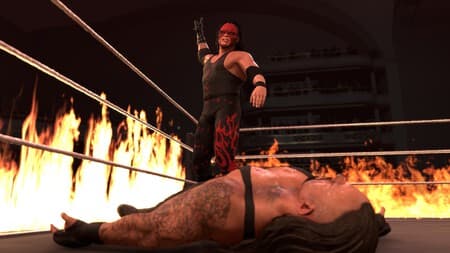
The main “upgrade” across these is just… more. More match types to slot into your shows, more wrestlers to juggle, more tiny options to tweak how often titles are defended or who gets pushed. I lost an hour one night just fine-tuning a custom Universe where NXT was nothing but hardcore matches and Dumpster bouts. It’s still the closest thing in games to running your own fantasy WWE long-term.
MyFaction, meanwhile, quietly becomes more dangerous for your free time – and your wallet. Intergender matches are allowed again, which opens up some fun dream-team combos, and there’s a steady drip of cards and challenges. Pulling packs and building lineups scratches the same itch as FIFA/EA Sports FC’s Ultimate Team, for better and worse. The mode itself is enjoyable, especially if you’re the type who likes grinding objectives, but 2K’s love of microtransactions is very clearly alive here.
Between The Ropes: Stamina, Reversals And Meatier Physics
Moment to moment, WWE 2K26 feels a lot like 2K25 at first. The controls are still built around light/heavy strikes, combos, grapples, and carefully timed reversals that can swing a match in an instant. The optional over-the-shoulder camera from 2K25 is still here and still the best way to play if you like feeling like you’re ringside instead of hovering over a diorama.
What slowly creeps up on you is how much the new stamina system and improved physics change the flow of matches. Stamina isn’t just a bar you ignore anymore. Burn it too early spamming big moves and you’ll notice your wrestler sucking wind, animations getting more labored, and-crucially-your ability to chain reversals and counters dropping. It naturally creates those TV-style phases in a match where one wrestler is on a roll, then has to back off and play defense while they recover.
In one particularly tense Iron Man match, I went 2–0 up early, got greedy, and burned through most of my stamina bar hammering finishers. The last three minutes were pure panic as I desperately tried to block and dodge while my opponent, who’d paced themselves, started punishing every whiffed strike. It’s not a back-to-the-drawing-board combat overhaul, but this “wrestle with some self-control” layer makes even standard matches feel closer to the ebb and flow of the actual show.
The physics upgrade is more subtle but just as important. Bodies fold and crumple in more believable ways, selling suplexes, slams and apron spots with extra impact. Weapons react better to weight and angles – tables don’t always break cleanly, ladders slide and tip over in more chaotic ways, and chairs bounce off ropes more convincingly. And yes, thumbtacks are finally in, and they’re gloriously nasty: watching a wrestler roll over a bed of tacks and then finish the match with them still stuck in their back is exactly the kind of horrible detail wrestling fans have been begging for.
Match Types & Chaos: Inferno, I Quit And All The Toys
WWE 2K26 quotes a huge 33 match types, and while some of those are variants and returns from older games, the slate as a whole is ridiculous. The big “headline” additions/returns this year are Inferno, Three Stages of Hell, Dumpster and I Quit.
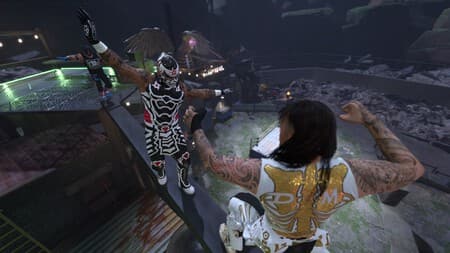
Inferno matches still have that guilty-pleasure spectacle – the ring surrounded by flames that flare up with big moves never really gets old. Three Stages of Hell is a perfect fit for this series: a best-of-three war where each fall can have a different stipulation. I used it to tell a mini-story one evening: first fall as a standard match, second as a Street Fight, and third as a Ladder Match for the title. By the end, the ring looked like a warzone and both wrestlers felt like they’d been through something.
The surprise MVP, though, is I Quit. Instead of going for a pin or a submission, you’re trying to literally make your opponent say “I quit” into a mic. Mechanically, it triggers a little QTE tug-of-war where you and your opponent fight over a bar, and you can even interfere to mess up their inputs. In practice, it leads to some of the tensest late-match moments in the game, especially when both of you are low on stamina and one mistake can flip the whole thing.
The smaller quality-of-life touches add up too. Being able to set up tables on top of other tables, or hit new top-rope finishers to the outside, lets you create those social-media-clippable spots more easily. Pre-match choices are back as well: before the bell you can choose to cheap-shot your opponent, hype up the crowd, or offer a handshake. It doesn’t overhaul the gameplay, but it helps sell the illusion that you’re playing out a TV segment, not just loading into a generic exhibition.
Presentation & Performance: Chasing The TV Show, One Detail At A Time
Visually, if you’ve played 2K25 on current-gen hardware, you’ll feel right at home. On PS5 the game runs at a smooth 60fps in matches, with sharp resolution and quick loading. Entrances are still the star: camera cuts echo the TV direction, lighting and pyro sell the scale of big arenas, and the crowd looks fuller and more reactive than a few years ago. Audio-wise, the mix of crowd chants, commentary and theme songs does a solid job of making even random exhibition bouts feel important.
Character models are in that weird middle tier modern sports games often land in. Some wrestlers look uncannily close to their real selves; others hover in that “you at least know who this is supposed to be” zone. Face animations during matches are still a weak point, and hair can misbehave in certain angles or clipping-heavy situations. It’s not game-breaking, but it reminds you that despite the TV-level presentation, this is still game-engine theatre.
I haven’t had hands-on time with the Switch or “Switch 2” versions, but on PS5 the performance is stable, and reports on PC and Xbox Series X point to smoother performance than some previous entries. The important thing is that matches feel responsive, even in multi-man chaos. When a six-man Ladder Match doesn’t tank your framerate, that’s a quiet victory in itself.
Ringside Pass: A New Grind Replaces Old DLC Packs
The most controversial part of WWE 2K26 isn’t a move or a match type; it’s the new monetization setup. Instead of selling traditional DLC wrestler packs, 2K has moved to a battle pass-style system called the Ringside Pass. Each season (there are six planned) has 60 free tiers and 40 premium tiers of unlocks – wrestlers, cosmetics, arenas, that kind of thing – and you earn progress by playing and gaining XP.
There are two big caveats. First, passes don’t expire, so if you pick up the game late or can’t no-life a given season, you won’t lose access to rewards forever. That’s genuinely consumer-friendly for this kind of system. Second, not every mode feeds XP into the pass equally, and online play doesn’t contribute in the same way as offline grinding. Depending on your habits, that can make progress feel significantly slower than just unlocking everything through old-school DLC or in-game currency.
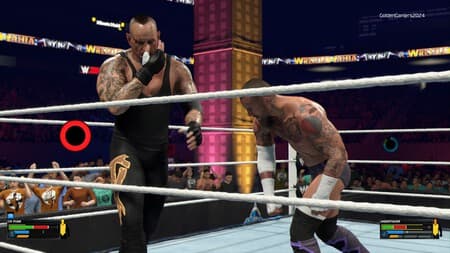
Personally, I’m torn. I like having long-term goals, and seeing the little level bar creep up after a wild Inferno match scratches that live-service itch. But tying roster content to a battle pass – even one that doesn’t expire – risks turning what used to be “buy this pack if you care about these wrestlers” into “always be grinding if you want to keep up.” If you already bounced off MyFaction’s card-based economy, the Ringside Pass won’t change your mind about 2K’s obsession with keeping you on the treadmill.
Who WWE 2K26 Is Really For
After a few weeks with WWE 2K26, the split in its audience feels clearer than ever. If you skipped 2K25 (or even 2K22–24), this is an absurdly good entry point. You’re getting the most refined version of this combat system so far, a frankly ridiculous roster, and more modes than any sane person has time for. You could live in MyGM and Universe alone and still be carving out dream feuds months from now.
If you sunk serious time into 2K25, though? That’s where the conversation changes. The new stamina and physics tweaks absolutely make matches feel better, the added match types are fun, and Punk’s Showcase is a solid ride. But this isn’t a reinvention; it’s an iteration. There were nights where, swapping between 2K25 and 2K26 to compare, I had to pay close attention to really feel the difference.
That doesn’t make 2K26 a bad game – far from it. It just means that, like EA’s football series, it’s settling into that territory where each yearly step is smaller, more about polishing an already-dominant formula than taking wild risks. If you’re a CM Punk superfan, desperate for thumbtacks and Inferno matches, or you crave the more deliberate pacing the new stamina system brings, you’ll probably be happy with the upgrade. If you were hoping for a radical rethink of how WWE games work, this isn’t that year.
FinalBoss // Gear
Level up your setup
01Top-rated gaming headsetson Amazon→02High-refresh gaming monitorson Amazon→03Gaming chairson Amazon→04Discounted game keyson Kinguin→Affiliate links · As an Amazon Associate, FinalBoss earns from qualifying purchases.
Want to Level Up Your Gaming?
Get access to exclusive strategies, hidden tips, and pro-level insights that we don't share publicly.
Ultimate Reviews Strategy Guide + Weekly Pro Tips