
Table of Contents (9)
The Moment I Realised Xbox Wasn’t “Ours” Anymore
The day Microsoft announced Asha Sharma as the new head of Xbox, I didn’t feel excitement. I felt that weird, hollow sensation you get when you walk past your old local arcade and realise it’s become a bank.
For years, everyone and their dog assumed Sarah Bond was the heir apparent. Phil Spencer all but teed it up that way in interviews. She was visible, she was already fighting in the trenches of Xbox messaging, and whatever you thought of her decisions, she at least looked like the continuity pick.
Instead, Satya Nadella reached outside the usual “gamer-adjacent” circle and dropped in Asha Sharma, whose background is deeply rooted in AI and broader Microsoft strategy, not the day-to-day wars of console launches and Game Pass debates. Bond left. Spencer rode off after almost 40 years in Redmond. Overnight, the vibe went from “gamer runs the asylum” to “the adults from corporate just turned up with clipboards.”
I’ve been playing Xbox since the original Duke controller cut literal grooves into my palms. Xbox Live on the OG Halo 2 servers was a second home for me. So when people tell me, “Relax, it’s just business,” I don’t buy it. When leadership changes this drastically, it isn’t “just business”. It’s a signal about what Xbox wants to be in a world where the console war isn’t some scrappy brawl anymore, but a tired, expensive grind in a mature, saturated industry.
Phil Spencer Wasn’t Perfect, But He Was One of Us
I’m not interested in rewriting history to make Phil Spencer a saint. Under his watch we got misfires, delays, overpromises, awkward cross-gen messaging, the works. The Activision Blizzard acquisition dragged on forever. First-party output was wildly inconsistent. He had his share of “we need to do better” apology tours.
But here’s the thing: whenever Spencer talked about games, I believed him. That matters more than people like to admit.
He could rattle off obscure favourites, go deep on design decisions, and name-drop stuff that didn’t make him look cool, just genuine. You can’t fake spending nights grinding through Destiny raids or getting weirdly emotional about a Shenmue remaster. I’ve met plenty of execs in this industry; most of them talk about “content”, not games. Spencer talked about games. You felt the difference.
And that “one of us” factor isn’t just parasocial sugar. It changes how you read every decision. When he botched something, I could at least imagine the internal fight: the guy who loved games wrestling with the guy who had to satisfy quarterly reports. I didn’t always agree with where he landed, but the tension felt real.
Now that he’s gone, and the new face of Xbox is someone whose public relationship with gaming feels… synthetic at best, that tension’s gone. In its place is something colder, more clinical. And that’s exactly why the community latched so hard onto Asha Sharma’s so-called “gamer credentials.”
Asha Sharma’s Awkward “I’m a Gamer Too” Tour
The rollout of Asha Sharma as the new Xbox boss was rough, and that’s putting it kindly. Within days of the announcement, social feeds were full of attempts to paint her as “one of us”. Favourite games lists. Carefully framed anecdotes. The inevitable “please share your gamertag” moment, followed by people combing through her play history like they were auditing tax returns.
Her initial list of favourites – things like GoldenEye, Halo, Valheim – landed with a thud. Not because they’re bad choices (they’re great), but because the answer felt like it had been run through three layers of PR approval. Safe picks. Iconic picks. Nothing that tells you how someone really plays. It had the same energy as those celebrity “Top 10 Games” lists where half the titles are just the big box art from the last E3 sizzle reel.
Then came the gamertag saga. People found a messy, inconsistent profile with scattered achievements, and Sharma eventually explained that it was a shared family account. Completely plausible, honestly. Normal people do share accounts. The problem is, she’s not being introduced to us as a “normal person”. She’s being introduced as the person who’ll decide the fate of Xbox as a gaming brand.
Stack that against her resume – a powerful CV, heavy on AI leadership and corporate transformation – and it was inevitable that some would assume the worst: that Xbox was getting ready to be fully absorbed into Big Microsoft, led by someone whose primary relationship to games is as a line item.
To their credit, her team clearly noticed the backlash and did some damage control, showing her engaging a bit more naturally. The noise has died down for now. But the question underneath all that drama hasn’t gone anywhere:
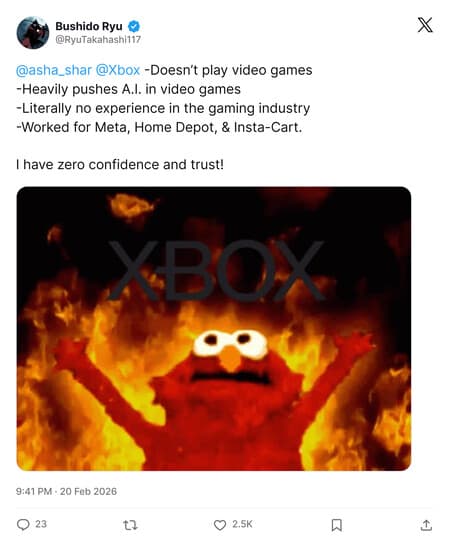
Do the people running gaming companies actually need to be gamers?
“I Could Sell Games or Washing Machines, Doesn’t Matter”
I’ve been around enough publishing and platform people to know the ugly truth: in most entertainment companies, high-level executives don’t care what they’re selling. Games, washing machines, toothpaste – whatever. It’s all funnel charts, KPIs, and PowerPoint decks.
And historically, that’s actually been part of why gaming blew up. When the industry was exploding, the suits who didn’t particularly love games still knew how to squeeze every drop of growth out of them. They shoved consoles into every living room, turned microtransactions into a science, and made live service into a printing press. Were they soulless? Often, yes. Were they effective? Also yes.
Execs like Take-Two’s Strauss Zelnick aren’t outliers – they’re the default. For the last twenty years, the job wasn’t to be a curator of culture; it was to be a killer of markets. Take this quirky, nerdy hobby and strip-mine it until it outgrosses Hollywood, then move on to the next frontier.
As much as that mentality disgusts me when I think about mobile gacha hellscapes or battle passes stapled to single-player games, it undeniably worked. Gaming went from a niche to the dominant form of entertainment on the planet. They won.
But here’s the catch: that era is over. The music has stopped.
Xbox in a Mature Industry: No More Infinite Growth, Just Hard Choices
We’re in a very different phase now. The pandemic boom is long gone. Engagement is softening. Layoffs are tearing through studios and publishers. Investors aren’t salivating over “games as the next big thing” anymore; they’re chasing AI, biotech, whatever promises a new gold rush.
The game industry, for all practical purposes, has hit maturity. There are no massive, uncolonised markets left. The console space is carved up. PC is PC. Mobile is a separate beast. If there’s growth, it’s incremental, hard-won, and often bought with layoffs, consolidation, or gutting weird, experimental stuff that doesn’t have a guaranteed return.
In that context, Xbox isn’t the scrappy underdog trying to break in anymore. It’s a legacy brand living under a tech giant that’s clearly more excited about cloud, AI, and enterprise contracts than whether your Series X has enough compelling exclusives in 2027.
That’s why Seamus Blackley – one of the original Xbox creators – describing Sharma’s role as essentially administering “palliative care” to the brand hit uncomfortably hard. It makes sense. When a division’s hypergrowth days are over, a certain type of leader gets parachuted in: someone who can make the spreadsheets look respectable while slowly shrinking the scope.
And this is where I stop pretending this is just some abstract corporate chess game. Because if Xbox really is in palliative care mode, I don’t want a mercenary “fixer” at the top. I want someone who’s going down with the ship if it sinks. Someone who’ll fight for the parts of Xbox that made it special, even when the boardroom wants to carve it up for parts.
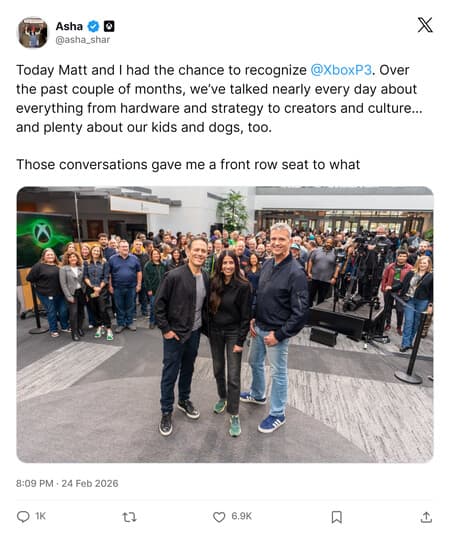
The “This Is an Xbox” Fiasco and the Brand Identity Crisis
Look at what’s already happened under Sharma’s watch: Microsoft pulled the “This is an Xbox” campaign from official channels. That whole push, heavily associated with Sarah Bond, tried to sell the idea that anything could be an Xbox – your TV, your phone, your toaster as long as it could stream Game Pass. It made strategic sense in a boardroom, but it confused the hell out of a lot of players and even some internal staff, if reports are to be believed.
Under the new regime, that messaging is gone or buried behind 404s, replaced by softer lines about “play your way” and renewed hints that the console itself still matters, especially with things like Project Helix hovering on the horizon. On paper, that actually sounds like an improvement to me. I’ve never liked treating hardware as a disposable husk for a subscription funnel.
But the timing makes it crystal clear: this isn’t just about cleaning up a confusing slogan. It’s about Xbox deciding what it wants to be in a world where the old dream – “be everywhere, eat everything” – just isn’t paying out the way the Excel models promised.
Plenty of fans have joked that “xbox pasado estar game” – roughly, “Xbox has moved past being about the games themselves” – and honestly, it hasn’t felt like much of a joke for a while. When your big pitches are cloud trials, cross-device ecosystems, and experimental pricing models, the games start feeling like content widgets, not the main event.
Sharma stepping in, nuking confusing campaigns, and tightening the message could go one of two ways:
- Either it’s a genuine attempt to re-center Xbox around a solid, console-respecting strategy that still embraces PC and cloud in a sane way.
- Or it’s the first step in turning Xbox into a more generic “Microsoft Gaming” service layer where hardware, legacy, and culture slowly fade into the background.
Which way it goes depends a lot on what kind of leader Sharma chooses to be: the cold operator or the unexpected believer.
Growth Needs Killers. Decline Needs True Believers.
Here’s where I land on the whole “do execs need to be gamers?” debate.
When a business is in explosive growth mode, the brutal truth is that you actually want the killers. You want the person who’ll do whatever it takes to capture territory: launch risky services, bet the farm on acquisitions, cut weird corners to get on every device. In that kind of phase, pure love of the product can even be a liability. True believers hesitate where mercenaries don’t.
But when the industry hits maturity and the brand you’re running is no longer sprinting forward, but trying not to lose ground? That’s different. You’re not conquering new territory. You’re defending what’s already there. You’re keeping the lights on in communities and ecosystems that actually mean something to people.
In that phase, I do want a leader who understands what it means when a digital store shuts down, when a matchmaking server gets flipped off, when a beloved series is left to rot because the IP valuation spreadsheet says it isn’t “worth” it. I want someone who gets why backwards compatibility isn’t just a bullet point, why Xbox Live friendships from 2004 still matter to the people who made them.
And that’s my problem with Sharma’s appointment. Not that she’s an outsider in some tribal “she’s not pure enough” way. But that everything about her career screams “scalability, optimisation, transformation” at a time when I think Xbox needs “stewardship, preservation, conviction.”
It’s not that a non-gamer can’t become that kind of steward. It’s that this industry has spent decades rewarding the exact opposite behaviour. People get promoted for eking out extra margin, not for protecting a weird, unprofitable passion project because they know what it means to the players.
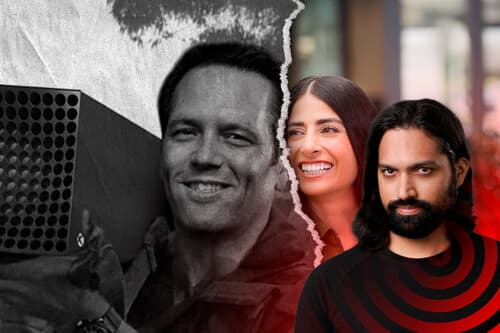
Where I Draw the Line With Asha Sharma
So what would actually make me give up on Xbox? Because despite all this, I haven’t yet.
If Xbox quietly becomes just a “Microsoft Gaming” tab in some generic cloud dashboard, where the hardware is an afterthought and the identity is pure subscription stack? That’s one line.
If we see sustained retreat from taking risks on new, ambitious first-party titles in favour of safer live-service grinds that feed engagement metrics at the cost of variety and weirdness? That’s another.
If AI – Sharma’s old sphere – starts creeping into game strategy in the laziest possible ways: content churn, procedurally padded worlds, writing teams gutted because a model can spit out passable dialogue trees? That’s where my alarm bells go nuclear. Use AI to speed up tools, sure. Use it to justify cutting human creativity out of the loop, and I’m out.
Most of all, if her Xbox starts treating its own legacy as dead weight instead of a living, breathing advantage – if “xbox pasado estar” becomes less a joke and more a mission statement – then yeah, that’ll be the moment I stop pretending this is still the platform I grew up caring about.
Why I’m Still Willing to Give Her a Shot
Here’s the twist: despite all of this, I don’t think Asha Sharma is doomed to be the villain of this story.
She’s stepping into an absolute minefield: a tired console war, a jittery parent company obsessed with AI, an audience burned by years of overpromising, and an industry that’s bleeding talent in every direction. I don’t envy her at all.
She’s also young, ambitious, and clearly sharp. That can cut either way. It could mean she treats Xbox as just another rung on the corporate ladder – come in, do the hard restructuring, keep the numbers tidy, move on. Or it could mean she sees a long-term opportunity to be the person who proves a gaming division can be run sustainably without completely hollowing it out.
As a lifelong player, my stake in this is emotional, not financial. I’m not a shareholder. I don’t care about EPS. I care about whether Xbox, in ten years, is a place where I can still discover something as weird and earnest as Shenmue was for me back in the day, or whether it’s just a pipeline of safe bets, algorithm-friendly grinds, and legacy IP milked dry.
So yeah, I’m wary. I don’t buy the PR fluff about favourite games. I see the AI background and the corporate trajectory and I’m not naïve about what that usually leads to. But I also know that industries evolve, leaders surprise us, and sometimes the person who wasn’t “one of us” at the start actually grows into the role in ways nobody expected.
All I can ask – all any of us on the player side can really ask – is that while Xbox navigates this long, messy middle age, someone in the big chair remembers that there were once people sitting on living room floors in front of CRTs, hands mangled by the Duke, forming friendships and identities around that little green logo.
If Asha Sharma respects that legacy and fights for it when the spreadsheets say “cut”, I’ll happily admit my early scepticism was unfair. If she doesn’t, then Xbox won’t just have changed leaders. It will have finally stopped being ours.
FinalBoss // Gear
Level up your setup
01Best-selling Xbox Series X|S gameson Amazon→02Xbox controllerson Amazon→03Top-rated gaming headsetson Amazon→04Discounted game keyson Kinguin→Affiliate links · As an Amazon Associate, FinalBoss earns from qualifying purchases.
Want to Level Up Your Gaming?
Get access to exclusive strategies, hidden tips, and pro-level insights that we don't share publicly.
Ultimate Gaming Strategy Guide + Weekly Pro Tips