
Table of Contents (11)
Disco Elysium changed my life. ZA/UM’s implosion changed how I trust studios.
When I first finished Disco Elysium, I did something I almost never do: I just sat there at the “Continue” screen and stared at the busted, miserable streets of Martinaise for a few extra minutes. No menu hopping, no New Game Plus run. Just letting the voices in Harry’s head slowly fade from my own.
I remember thinking, completely dead serious: “Whoever made this, I’m riding with them for whatever they do next.” That’s how much faith I had in ZA/UM after that first playthrough. I don’t give that kind of blind loyalty to brands, barely even to people. But Disco Elysium felt like it had come from a specific, stubborn, very human place. It felt earned.
Fast forward a few years, and that same studio is now the poster child for why I’ve stopped trusting names on the splash screen. The forced departure of the key creators, the ugly IP dispute, the sudden cancellation of the sequel, the layoffs, the new “successor” game riding Disco’s reputation while being made without many of the original minds – it’s the perfect case study in how to torch goodwill in record time.
ZA/UM after Disco Elysium isn’t just a studio that “had some drama.” It’s a studio that took one of the most personal, author-driven RPGs ever made and wrapped it in a corporate soap opera so messy that every new announcement now gets side-eyed by the exact fans who should be its core audience. I’m one of them.
I’m not here to relitigate every legal filing or pick a winner in court; that’s for lawyers. I’m here as someone who adored this game, watched the fallout in real time, and now has to decide what to do when ZA/UM shows up with its next big thing and says, “Trust us again.”
Disco Elysium felt like it belonged to its creators, not a holding company
The reason this whole saga hits so hard is that Disco Elysium never felt like a committee project. It felt like one of those rare games where you can feel the arguments that happened at 2am in some freezing office over the wording of a single line of dialogue.
The game is drenched in the sensibilities of lead designer and writer Robert Kurvitz – his novelistic worldbuilding, that heavy, melancholic political history. You’ve got Helen Hindpere’s words and Aleksander Rostov’s art direction making Revachol feel like a place that absolutely exists somewhere just out of reach. It’s not “IP” in the cute marketing sense; it’s a very specific worldview hammered into code.
That’s why when the story broke in late 2022 that Kurvitz, Hindpere, and Rostov had been forced out of ZA/UM the previous year in what they described as an “involuntary manner,” it didn’t feel like normal studio turnover. It felt like somebody had reached into the game, yanked out its soul, and then kept the body.
The picture that emerged was ugly: the original creative core gone, control of the company moving to new leadership, and public accusations from Kurvitz and Rostov that the takeover of ZA/UM (and by extension the Elysium universe) involved fraudulent behavior. One of the businessmen involved, Tõnis Haavel, already had a prior fraud conviction unrelated to ZA/UM, which only made the optics worse.
To be absolutely clear, the legal side of this is still murky. ZA/UM has denied wrongdoing, some claims have been disputed or dropped, and no court has handed down a nice, clean, Reddit-friendly verdict that says “these guys are definitively the villains.” Legally, it’s complicated. Morally, as a fan, it felt pretty simple: the people whose names I associate with Disco Elysium no longer had control over the thing they’d made, and they were clearly furious about how that happened.
That alone is enough to poison the well. But it didn’t stop there.
The IP dispute is the fracture line that never healed
At the heart of all of this is the question: who actually owns Elysium?
According to reports, there’s a dispute over whether Kurvitz knowingly signed away the rights to the Elysium setting to ZA/UM while the game was in development. Kurvitz has publicly denied being aware of such a transfer, while the company maintains that it has the exclusive rights and everything was done correctly.
From the outside, what that leaves us with is a depressing picture: the universe of Disco Elysium – its history, its metaphysics, its whole political horror show – is legally locked inside the same corporate shell that ousted the people who created it. Whatever the exact paper trail says, that’s how it feels. Fans see an IP cage match where the side with the lawyers is sitting on top of the setting, and the side with the ideas is outside, starting over.
This is why so many of us recoil when ZA/UM starts talking about new Elysium projects like the mobile-focused M0 or anything directly tied to that universe. It’s not just skepticism about quality. It feels like we’re being asked to endorse one side of an ethical dispute just by showing up as customers.
And when ownership of a world that personal is contested, it infects every announcement. Every press release reads less like “we’re excited to show you our new game” and more like “we have the keys to this house, and we’re going to keep renting it out whether the architect likes it or not.”
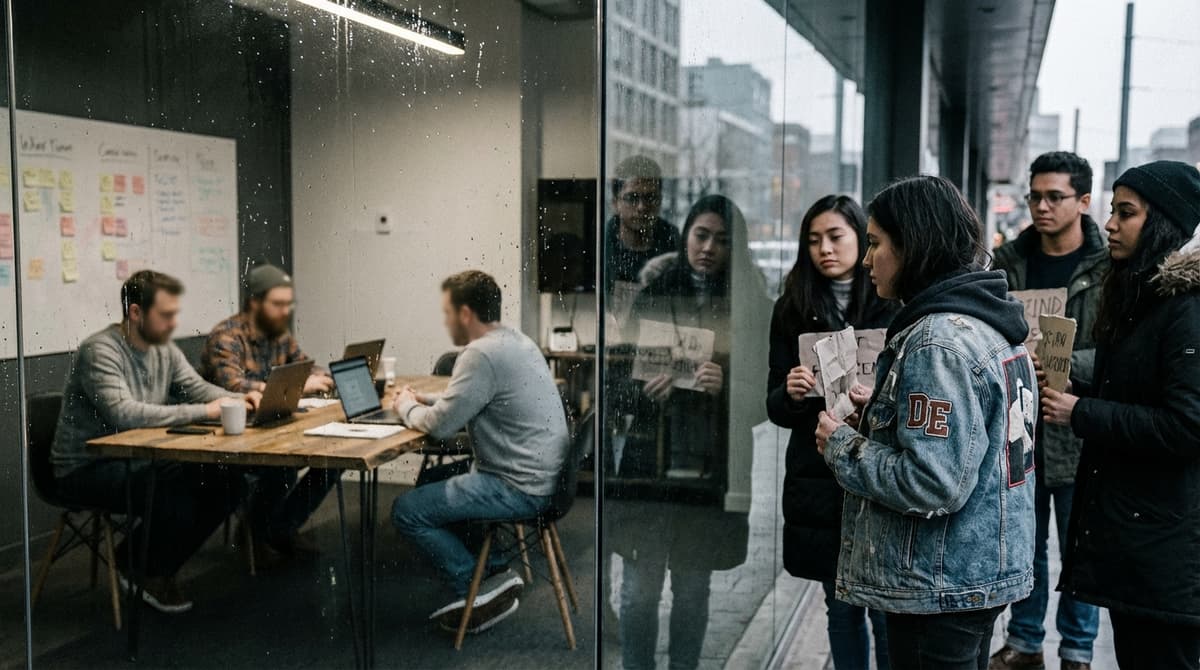
“Forever a one-game studio”: the sequel that died in a meeting room
If the forced departures cracked the trust, the sequel cancellation shattered it.
Internally, ZA/UM had been working on a full-fat follow-up to Disco Elysium, codenamed Y12. By early 2024, that project was abruptly killed. Developers have described a whiplash scenario: script changes given the green light, then suddenly everyone called into a meeting where management announced the entire project was being discontinued. No real explanation, just a guillotine drop.
Alongside that cancellation came layoffs reportedly hitting around 25% of the studio, including key narrative staff like lead writer Argo Tuulik. This is the same studio that, only months earlier, had publicly insisted it was in good financial health. You can call that a sudden downturn or “market realities” if you like. From the outside looking in, it reads like classic corporate doublespeak: “We’re fine – until we’re not, and then it’s your jobs on the altar.”
Tuulik’s post-layoff statement that ZA/UM would “forever stay a one-game studio” hit harder than any sales figure. It captured what a lot of us already suspected: that whatever razor’s-edge combination of personalities and politics birthed Disco Elysium simply does not exist inside that building anymore.
And honestly, how could it? When a studio cuts loose that much of its original creative DNA, cancels the obvious passion project, and then pivots to safer, smaller ideas, it stops looking like an artist-led outfit and starts looking like a brand management office that just happens to employ some developers.
Fans didn’t just walk away – they took their faith elsewhere
Here’s the thing that’s different about ZA/UM versus your average “studio goes corporate” story: the people who made Disco Elysium didn’t vanish. They scattered and started new studios.
Kurvitz and Rostov co-founded Red Info. A group of a dozen former devs spun up Longdue Games. Others ended up at places like Dark Math Games and Summer Eternal. In other words, the talent diaspora formed its own little constellation of “ZA/UMs that could have been.”
The fan reaction was immediate: these offspring studios were christened as the “real” successors, the spiritual heirs. You could see it in community conversations: enthusiasm for whatever those teams do next, and cold suspicion for anything coming out under the actual ZA/UM name.
Meanwhile, the stuff ZA/UM is working on – like the touchscreen-focused M0 project and the larger “C4” RPG – is met with shrugs at best. There isn’t a groundswell of “I can’t wait” around these games, no matter how often the press releases name-check Disco Elysium. They’re associated with the corporate entity fans feel burned them, not the scrappy collective that made their favorite game.
And now we’ve got the next flashpoint: Zero Parades: For Dead Spies, pitched as the controversial successor to Disco Elysium, locked in for a 2026 PC launch with a PS5 version later that year. The marketing is very clearly trading on the legacy – “from the studio behind Disco Elysium,” of course – but that studio is no longer the thing people fell in love with.
I’ve already seen the split forming: some players cautiously curious because they just want more dense, weird RPGs, and a big chunk of the old fanbase basically saying, “You don’t get to wave that name around like nothing happened.” The game itself could be brilliant, but the trust account it’s drawing from is deeply overdrawn.
This isn’t just “devs left” – it’s a textbook case of trust erosion
Plenty of beloved studios have changed lineups. People leave. New teams form. I don’t boycott every game that isn’t made by 100% of the original squad; that would be absurd. So why does ZA/UM’s situation feel different enough that I’ve mentally put them on my personal “wait and see, do not pre-order” list?
Because this isn’t about turnover; it’s about patterns of behavior that all point in the same direction:
- Key creators say they were forced out “involuntarily.”
- They allege the studio’s control and the Elysium IP ended up in new hands through shady means (while the company insists everything is legit).
- A big sequel gets quietly nurtured and then suddenly axed, along with a quarter of the staff, right after leadership has publicly insisted things are fine.
- Current leadership pushes ahead with new projects and a “successor” game while the legal and ethical dust around the old one hasn’t really settled.
That cocktail is what kills trust. It’s the same flavor of rot we’ve seen at other studios when the suits start squeezing: ex-Bethesda devs describing a yes-men culture around Todd Howard, or Remedy bringing in growth-obsessed executives while trying to keep its creative soul intact. The difference is, those studios have a long track record and multiple eras to point to. ZA/UM basically has one masterpiece and then a spectacular implosion.
As a player, trust isn’t just, “Will this game be good?” It’s, “Will my money be used to keep the right people in power?” With ZA/UM right now, that second question is exactly where the unease lives.
What it would actually take to win me back
Here’s the part where people usually say something mushy like, “There are good folks on every side” and “Ultimately, we should just judge the games.” I don’t buy that anymore. Not after Blizzard, not after CDPR, and definitely not after watching ZA/UM go from miracle to mess.
If ZA/UM wants my trust back – not my curiosity, not my doomscrolling, but my actual money on day one – it would take a few very specific things.
1. Radical honesty about what happened
So far, most of what we know has come from public statements by the ousted creators and court-related reporting. ZA/UM’s leadership, by comparison, has largely hidden behind PR-safe language: everything is fine, no wrongdoing, we’re excited about the future, etc.
If they want to rebuild trust, that has to change. I’m talking about a real, detailed accounting of how ownership changed hands, how the sequel died, why so many people left, and what the studio actually learned from that. Not vague “lessons.” Concrete decisions that will not be repeated.
Without that, every new interview and dev diary is just marketing to me. I’m not interested in lore teases if I still feel like the people talking are skipping the chapter that matters most.
2. A fair, transparent resolution to the Elysium IP mess
I don’t need a court transcript framed on my wall. But I do need to know that the people who created Elysium aren’t being frozen out of its future in some technical, morally grey way.
That could look like revenue-sharing agreements, acknowledgements of creative authorship, or even collaboration terms if the relationships aren’t completely nuked. I’m not naïve; maybe that’s impossible now. But if ZA/UM keeps trying to mine Elysium while the original authors are building the “real” successors across the street, it’s going to keep feeling exploitative, regardless of who technically signed what.
If, on the other hand, a clear, fair settlement emerges – one where Kurvitz and co. publicly acknowledge they’re satisfied with the outcome, even if they never work together again – that would go a long way toward making future Elysium projects feel less cursed.
3. Stop leaning on Disco Elysium’s corpse like a crutch
If Zero Parades, M0, C4, or whatever else ZA/UM is cooking keeps being introduced to the world as “from the creators of Disco Elysium” while clearly not involving many of those creators, it’s going to read as cynical brand-hijacking every single time.
You want to convince me you’re still a creative force? Cool. Then stand on your own work. Make a game that’s nothing like Disco Elysium. Drop the winking references. Prove that the current team can define itself without constantly dragging the old banner behind it.
If Zero Parades comes out and it’s sharp, fearless, politically barbed, and unmistakably its own thing – not a hollow cosplay of a better era – I’ll pay attention. But if the entire pitch is “remember that game from 2019? we’re still that, promise,” I’m out.
4. Treat staff like collaborators, not collateral
Any studio can say “people are our greatest asset.” I’m at the point where I only believe it when I see how they handle failure. Cancelling Y12 while telling people everything was fine months prior, all while the leadership structure that caused the chaos stays in place? That’s the opposite of what I want to support.
If ZA/UM starts showing its work on this front – real worker protections, transparent communication about project health, maybe even actual employee representation in governance – that would mean more to me than the shiniest trailer. Disco Elysium was a game obsessed with the dynamics of power; it’s only fitting that the studio that made it be held to the same standard.
FinalBoss // Gear
Level up your setup
01Top-rated gaming headsetson Amazon→02High-refresh gaming monitorson Amazon→03Gaming chairson Amazon→04Discounted game keyson Kinguin→Affiliate links · As an Amazon Associate, FinalBoss earns from qualifying purchases.
Want to Level Up Your Gaming?
Get access to exclusive strategies, hidden tips, and pro-level insights that we don't share publicly.
Ultimate Gaming Strategy Guide + Weekly Pro Tips