
Both games live in the medieval survival-and-building space, so they look almost interchangeable in screenshots. They are not. Bellwright is a settlement builder that turns into a military campaign; Medieval Dynasty is a village-survival life sim where combat is a minor side activity. Pick the wrong one and you will spend hours fighting the loop you actually wanted.
Table of Contents (8)
The short version
- Buy Bellwright if you want skill-based directional combat, NPC squads you command in formations, and settlements that get raided as you grow. It is the more aggressive, expansion-driven game.
- Buy Medieval Dynasty if you want a calmer life sim: real survival pressure (food, water, health, stamina), a full animal-husbandry roster, rideable mounts, and a multi-generation family line.
- Status matters: Bellwright is still in Early Access (launched 23 April 2024). Medieval Dynasty is fully released (out of Early Access since 23 September 2021), so it is the more finished, content-complete package today.
- Price is close: Bellwright is €28.99 and Medieval Dynasty is €29.99 at base price, so the decision is about loop and finish, not cost. Both support solo play and online co-op.
You feel the split in the opening hours, not the late game. Bellwright frames your early progress around recruits, weapons, and the coming liberation of bandit-held towns. Medieval Dynasty frames yours around not starving through winter.
Combat: directional duels and squad command vs an afterthought
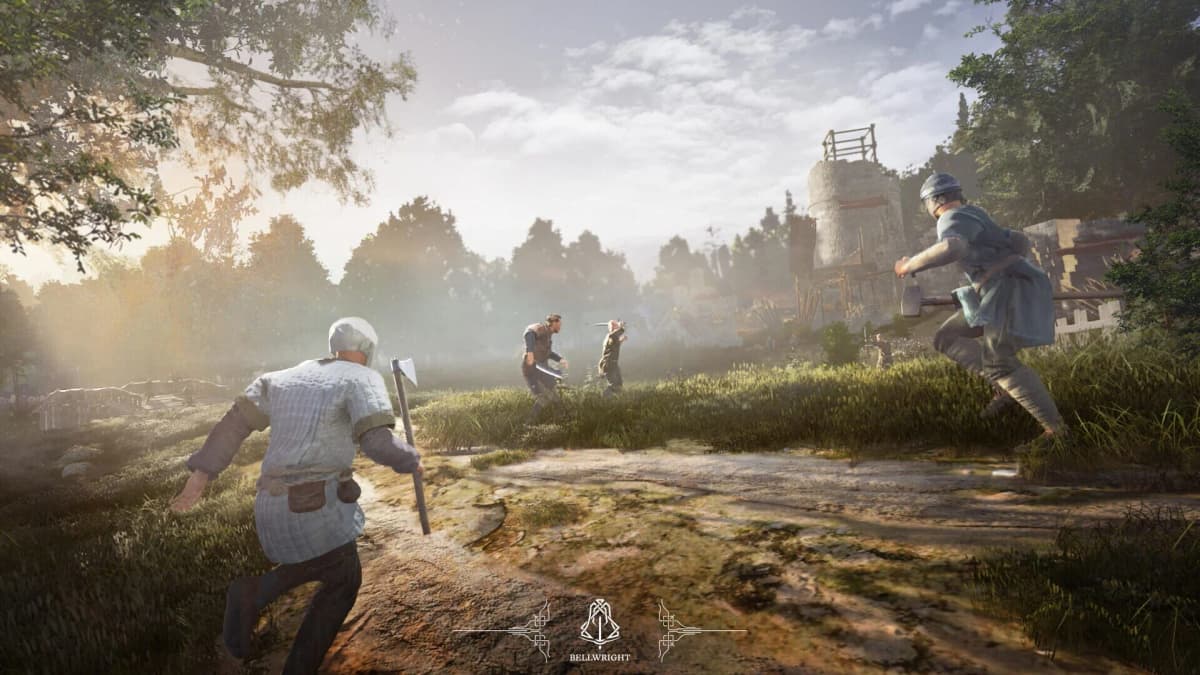
This is the single biggest difference. Bellwright runs a skill-based directional combat system with medieval weapons, and it builds whole layers on top of it: you recruit NPCs, equip them, and command them as squads with formations and tactics in larger fights. Combat is a core pillar, not an interruption.
Medieval Dynasty has weapons too — bows and spears to hunt animals and fend off the occasional bandit — but combat is deliberately minor. The game’s spine is building, town management, and survival. If swinging a sword and ordering troops is the part you came for, Medieval Dynasty will feel thin and Bellwright will feel built for you.
That difference flows into upgrades. In Medieval Dynasty a better tool mostly makes village life smoother. In Bellwright better gear, armor, and food stocks for your followers feed directly into your ability to defend territory and push outward.

Worker management: priority numbers vs building assignment
Both games use villagers, but they organize labor in opposite ways. Bellwright runs a numeric job-priority system. Each worker gets a priority per job type on a 1–9 scale where 1 is highest and 9 is lowest, and any job can be switched off entirely (shown as X, or set to 0). On top of that, each workstation has its own building priority, so when several stations share a job family you decide which one gets worked first. A villager set to Crafting 1 will clear every open crafting order before moving down their list to the next job.
Medieval Dynasty instead has you assign villagers directly to specific production buildings and tasks. It is more compartmentalized: this person works this hut. Bellwright’s system feels more like running a living operation with shifting needs; Medieval Dynasty’s feels more like a stable roster. Neither is strictly better — it depends on whether you want flexible reallocation or fixed roles.
Bellwright also lets recruited NPCs double as battle companions and guards, not just labor. So settlement management there is partly a defense question: who makes planks, who holds the line, and how much of your economy is paying for your fighting force.
Survival pressure: serious in Medieval Dynasty, lighter in Bellwright
Medieval Dynasty makes staying alive a real job: you monitor food, water, health, and stamina, and your villagers can literally starve or die of thirst if you neglect supply. Surviving the seasons is the day-to-day tension. Bellwright keeps survival upkeep present but lighter, spending its tension budget on combat readiness and raids instead. If you want the grind of keeping a body and a village fed to be the main loop, Medieval Dynasty does more with it.
Raids: Bellwright’s sharpest differentiator
Bellwright settlements and outposts are raid targets, and the threat scales as you grow — the more towns you liberate and camps you clear, the heavier the pressure. You can tune that in settings (low, medium, or high) or turn raids off entirely, but left on it reshapes the whole building loop: every expansion also makes you more exposed, so guards, companion roles, gear quality, and base layout all start to matter strategically.
Medieval Dynasty has no equivalent escalating-raid system; it preserves a calmer maintenance rhythm. If you like the feeling that success attracts new problems, Bellwright is the one with the hook. If you want a base that stays a base, Medieval Dynasty leaves you alone.
Where Medieval Dynasty wins: animals, mounts, and finish
Medieval Dynasty has a far deeper animal layer. It supports a full farm roster — chickens, pigs, goats, sheep, cows, geese — plus rideable mounts (donkeys and horses) that you buy after building a stable and use for faster travel and extra carry capacity. Bellwright has livestock and farming, but rideable mounts and large-scale mounted play are on its Early Access roadmap rather than shipped today. If husbandry, breeding, and getting around on horseback are central to your fantasy, Medieval Dynasty is the clear pick.
Finish is the other edge. Medieval Dynasty is a released, content-complete game; Bellwright is still being built in Early Access, with the studio planning further additions over its development window. That cuts both ways: Bellwright may grow significantly, but you are buying it mid-build.
Common mistakes
- Treating Bellwright like “Medieval Dynasty with combat.” It is the reverse priority: a combat-and-expansion game with a village attached, not a village sim with fights bolted on.
- Ignoring combat readiness in Bellwright. Raids scale with your progress. If you play it as a pure builder and never gear your NPCs, you are underinvesting in a system the game expects you to respect.
- Leaving Bellwright workers at the default priority 5. If nobody is doing a job, set at least one villager’s job priority to 1 and check the station has fuel, tools, inputs, and somewhere to put outputs — “broken” automation is almost always priorities and logistics, not a bug.
- Buying Medieval Dynasty for the combat. Combat is intentionally light. You came for survival, building, and animals; the fighting is filler.
- Forgetting Bellwright is Early Access. Expect rough edges and ongoing changes; if you want a finished game today, Medieval Dynasty is the safer buy.
Practical takeaway
Stop asking which game is “better” and ask which friction you want. Bellwright gives you directional combat, commandable NPC squads, numeric worker priorities, and raids that escalate as you expand — a settlement builder pointed at conquest, still growing in Early Access. Medieval Dynasty gives you real survival pressure, a deep animal-and-mount economy, and a finished, multi-generation village life. Match the loop to what you actually enjoy and neither one will disappoint you.
New to Bellwright and still finding your feet? Get your settlement self-sufficient with our guides on liberating your first village and using console commands and cheats to tweak your run.
FinalBoss // Gear
Level up your setup
01Graphics cardson Amazon→02Gaming laptopson Amazon→03High-refresh gaming monitorson Amazon→04Discounted game keyson Kinguin→Affiliate links · As an Amazon Associate, FinalBoss earns from qualifying purchases.
Want to Level Up Your Gaming?
Get access to exclusive strategies, hidden tips, and pro-level insights that we don't share publicly.
Ultimate Guide Strategy Guide + Weekly Pro Tips