
If you searched for “the Streamer” in Mullet MadJack expecting a weapon, a perk, or a real-life broadcasting feature, you went the wrong way. The Streamer is a character: she is the Chapter 1 boss, and she is the unhinged Peace Corp operative who puts Jack live in front of an audience. This guide tells you exactly who she is, where you fight her, and how her broadcast ties into the timer that keeps you moving.
Table of Contents (8)
The short version
- The Streamer is the Chapter 1 boss. You do not unlock her or earn her as a collectible — you fight and defeat her at the end of Chapter 1, the same way you defeat the game’s other bosses.
- She is a Peace Corp operative. She runs Jack’s live broadcast, tells him the stream is live, and eggs him on through the dopamine-and-reward framing the whole game is built around.
- The dopamine timer is the real pressure. Jack’s run is governed by a roughly 10-second kill-or-die clock driven by the bloodthirsty live audience — every kill resets it, every pause drains it.
- Treat her like any boss floor. Arrive with momentum, a weapon you trust, and a plan — not a half-built run.
Who the Streamer is
The Streamer is an unhinged Peace Corp operative who monitors and encourages Jack throughout his ascent of the tower. She is the in-world host who informs Jack that the stream is live and frames his slaughter as entertainment for a paying audience. That is not flavor text bolted onto a shooter — it is the narrative engine behind why the game pushes you so hard. The audience wants spectacle on demand, and the Streamer is the face of that demand.
She sits inside the same dystopian setup as the rest of the cast: a future where humans have merged with technology, robots have rebelled, and a corporate broadcast turns one moderator’s rescue mission into a livestreamed bloodsport. Knowing she is a Peace Corp character, and not a menu feature or a Twitch integration, is the single fact that clears up most of the confusion around the term.
Where you fight her: the Chapter 1 boss
Here is the part the vague write-ups miss: the Streamer is a boss, and she is the boss of Chapter 1. You do not obtain her, unlock her, or find her as a side reward — you face her at the end of the first chapter and defeat her exactly as you defeat the game’s later bosses. So if you came looking for a route like “beat chapter X to get the Streamer,” reframe it: you beat the Streamer to clear Chapter 1.
She is not the only named boss you will plan around. Mr. Bullet, the Chapter 3 boss and the game’s main antagonist, anchors the back half of the campaign, and the Punished V2 fight in Boss Rush Mode waits beyond the main story. Treating the Streamer as a boss from the start — rather than a fuzzy “system role” — puts you in the right mindset for all of them.
The dopamine timer she broadcasts
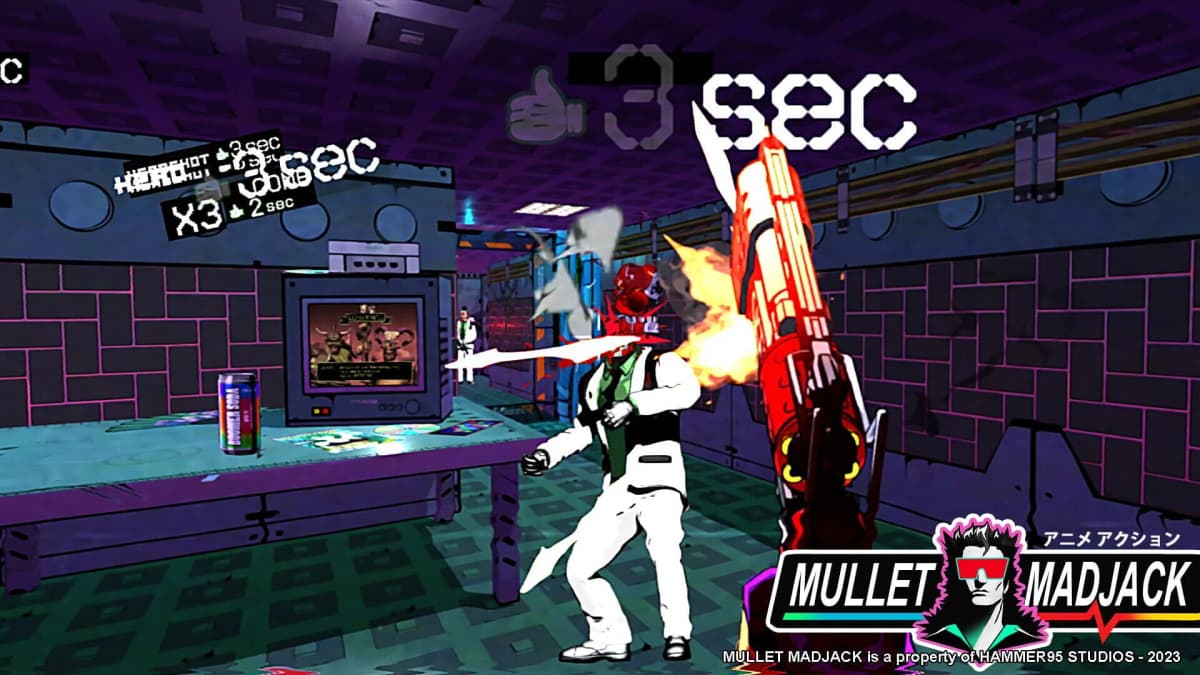
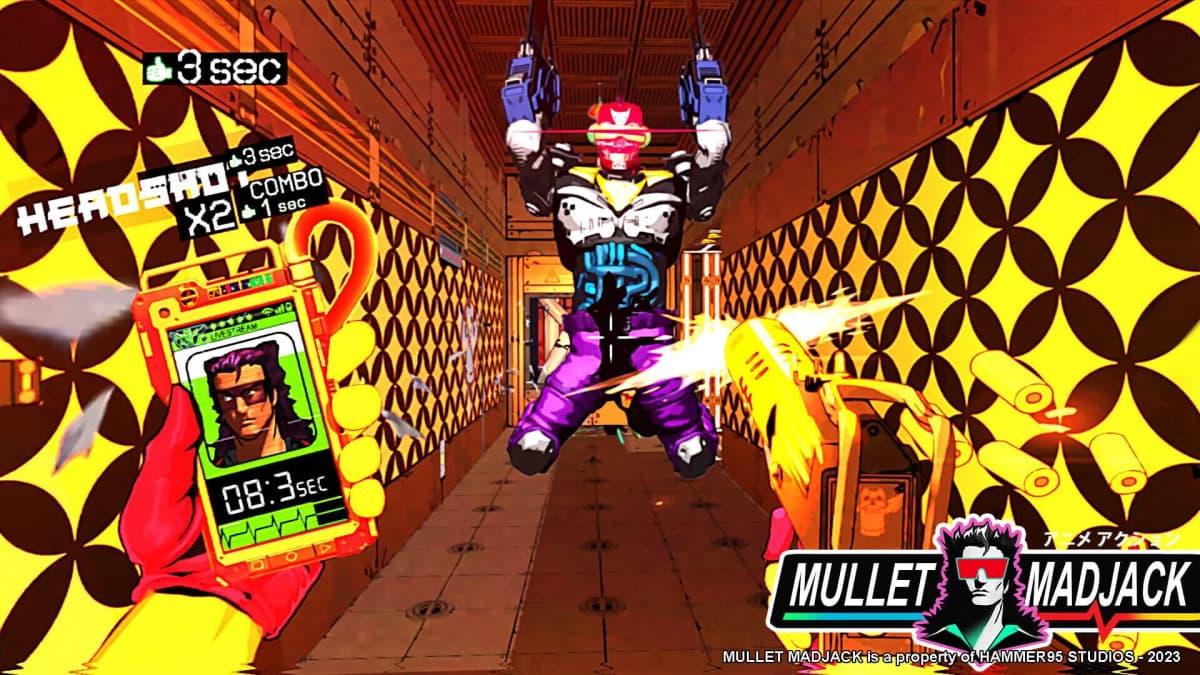
The reason the Streamer matters mechanically is the clock she is broadcasting. Mullet MadJack runs on a brutal rule: Jack has roughly 10 seconds to land a kill, or he dies. The bloodthirsty live audience needs its dopamine hit on a constant interval, and your only source of more time is more violence. Every robot you destroy resets the timer; every second you hesitate burns it down.
This is a world-level mechanic driven by the audience, not a personal attack from the Streamer — but she is the one selling it to you as a show. That distinction is why the game plays the way it does. A normal corridor shooter lets you peek, loot slowly, and reset between fights. Mullet MadJack inverts that: hesitation is not a pacing problem, it is a death sentence. Speed, kill chains, and clean routing beat cautious room-by-room clearing every single time.
- Downtime kills you literally. A stalled run is not just slow — it runs out the clock.
- Clean routes beat messy exploration. A detour only earns its place if it produces an immediate kill or an immediate advantage.
- Keep killing through the boss floor. The timer does not politely pause because you reached the Streamer; carry your momentum straight into the fight.
How to beat the Streamer floor
Because the Streamer caps Chapter 1, you want to arrive with a run that is already working rather than one you are still assembling. The general principle holds for every boss in the game: a strong climb feeds a strong boss fight, and a bad loadout at the end of a chapter wastes all the momentum that got you there.
Treat each floor on the way up as a routing problem. The question is never just “can this enemy die?” — it is “how fast can this room turn into more time and a safer position for the next one?” That mindset matters more against a boss than chasing stylish executions for their own sake. For weapon and perk specifics, our builds and loadouts guide for fast runs breaks down what to carry into the later chapters.
Priorities going into the boss
- Carry a weapon you can rely on. A dependable primary that keeps kills coming under timer pressure beats a flashy pickup you cannot sustain.
- Enter with momentum, not a reset. Reaching the boss floor on a kill streak keeps your clock healthy as the fight opens.
- Plan the room before you walk in. Improvising under the dopamine timer is how clean runs collapse at the last step.
Common mistakes
- Thinking the Streamer is a real-world streaming feature. She is not Twitch, YouTube, an overlay, or a creator tool — she is an in-game Peace Corp character.
- Hunting for an “unlock.” There is no side objective or shop route to “get” the Streamer. She is the Chapter 1 boss; you fight her, you do not collect her.
- Believing she cannot be killed. She is a boss and is defeated like the others. The old “not confirmed as a kill target” hedge is simply wrong.
- Playing the boss floor cautiously. Slowing down to “be safe” runs out the dopamine clock. Keep killing.
Practical takeaway
The Streamer is not a mystery and not a menu option — she is the Chapter 1 boss, a Peace Corp operative who broadcasts Jack’s run to a dopamine-hungry audience. The roughly 10-second kill-or-die clock she is selling to that audience is the real engine of the game, so play her floor the way you play the whole game: keep momentum, keep a weapon you trust, route cleanly, and walk into the fight with a plan rather than improvising under pressure.
FinalBoss // Gear
Level up your setup
01Capture cards (Elgato & more)on Amazon→02USB microphoneson Amazon→03Gaming keyboardson Amazon→04Gaming deskson Amazon→
Affiliate links · As an Amazon Associate, FinalBoss earns from qualifying purchases.
Want to Level Up Your Gaming?
Get access to exclusive strategies, hidden tips, and pro-level insights that we don't share publicly.
Ultimate Guide Strategy Guide + Weekly Pro Tips