
Table of Contents (10)
The Exact Moment DLSS 5 Lost Me
I knew something was seriously wrong with DLSS 5 the second I saw a character’s face I recognized… and didn’t recognize at all.
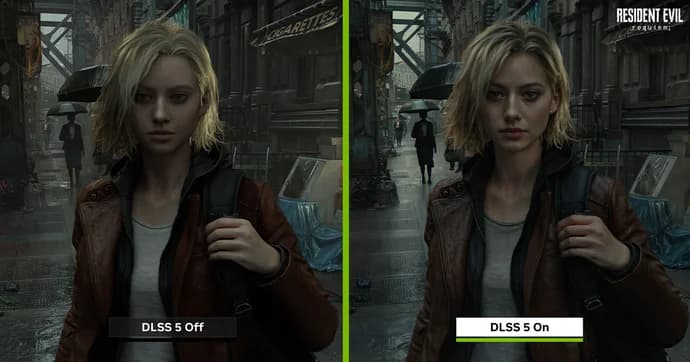
It was one of those comparison shots Nvidia proudly threw up during the GTC presentation. On the left: the original in-game render. Imperfect, sure, but with a clear identity – specific cheekbones, slightly tired eyes, the kind of stylised imperfection that tells you an artist actually made this. On the right: DLSS 5’s “enhanced” version, supposedly the future of real-time graphics.
The “enhanced” face looked like it had just walked out of an AI porn ad. Skin waxy and flattened, eyes glassy, lighting completely different from the rest of the scene. Same character, allegedly. But it felt like Nvidia’s model had decided, “No, actually, I know what a video game face should look like,” and just steamrolled whatever the developers had done.
I’ve been a PC graphics nerd for decades. I’ve spent more time tweaking ini files, toggling anti-aliasing methods, and benchmarking than I’d ever admit in public. I loved what early DLSS did when it stayed in its lane: smart upscaling to squeeze more frames out of my GPU without butchering the art. But DLSS 5 isn’t that. DLSS 5 is Nvidia handing generative AI a paintbrush and letting it redraw the scene on top of the game you actually bought.
And that’s exactly why this backlash isn’t some “gamers overreacting on social media” moment. It’s the first time in a while I’ve looked at a big tech reveal and thought: if this is the direction we’re going, we’re about to do real, lasting damage to how games look and feel.
DLSS Used to Be a Smart Hack. DLSS 5 Is an AI Filter With an Agenda.
Let’s be clear about something: I’m not anti-AI in graphics. DLSS 2’s upscaling and even the early denoising tech for ray tracing were clever, targeted uses of machine learning. You give the model low-res frames, depth, motion vectors, and it predicts a higher-res image. When it works, it’s like free performance. You don’t change the art direction; you just reconstruct it more efficiently.
DLSS 5 is not that. Nvidia pitched it as “content-controlled generative AI” working at the geometry level, not just a post-process filter. Translation: it doesn’t just guess pixels, it actively changes how the frame is rendered – faces, materials, lighting. It’s a neural renderer baked into the pipeline.
If you watched the same demos I did, you saw what that actually means in practice. Character faces in Resident Evil-style scenes losing their grit and horror vibe, smoothed into an AI-approved mannequin look. Hogwarts-like interiors with lighting that suddenly ignored the mood the original artists were going for. Starfield-esque vistas that looked like someone had cranked a “cinematic AI grading” slider up to 11 without asking why the scene was lit that way in the first place.
This is the key shift: DLSS used to be a “how can we draw this faster?” trick. DLSS 5 is a “how can AI redraw this in a way it thinks looks better?” system. That’s a philosophical difference, not just a technical one. And it’s exactly why so many devs have been openly side-eyeing it.
“Completely Wrong” – Nvidia vs. My Eyes
Instead of listening to the criticism, Nvidia’s response so far has basically been: don’t trust your lying eyes.
CEO Jensen Huang reportedly told press that gamers are “completely wrong” about DLSS 5 and that the tech is being misunderstood. The company line is that developers have fine-grained control, that the neural renderer doesn’t just slap a generic filter on everything, and that what we saw in the demos was all under dev control.
Here’s the problem: I don’t care how pretty the words are if the pictures on screen look like this.
Across multiple showcased titles, the DLSS 5 comparison shots had the same telltale qualities: a weirdly homogenised “house style” where every face looks slightly more generic, every surface a bit more polished, and every shadow a bit less threatening. It’s that uncanny AI look we’ve all learned to recognize – technically detailed, emotionally dead.
And then there’s the lighting. Nvidia keeps talking up improved, more “naturalistic” lighting as one of DLSS 5’s big wins. What I see in their own examples is scenes that get brighter and flatter. Contrast vanishes. Atmosphere drains away. Characters end up lit like they’re on a different planet to their background.
This isn’t some abstract art-school complaint. Game lighting is one of the most hard-earned, painfully tuned parts of modern development. Studios have spent decades getting good at it. The entire feeling of a scene – tension, comfort, danger, mystery – lives and dies on how light and shadow are handled.

So when an AI model comes in and says, “Cool story, but my training data thinks faces should look like this, and interiors should be this bright,” it’s not assisting the art direction. It’s overwriting it.
Why the Lighting Looks Wrong (and Why That’s Not an Easy Fix)
The creepy part is that DLSS 5’s issues don’t just look like bad tuning. They look like exactly what you’d expect from a generative model trained on mountains of “nice-looking” images.
Neural networks like this work by learning patterns from lots of examples, then averaging towards what they consider plausible, typical results. That’s great for upscaling: you show it tons of high-res/low-res pairs, and it learns to reconstruct sharp edges and details that match what it’s seen before.
But the second you give that same system permission to adjust things like lighting and material response, you’ve basically told it: “Make this scene look more like the generic concept of a good-looking game.” And generic is the enemy of style.
Of course it brightens things. Of course it softens shadows. Of course it pushes skin and metal and cloth towards the same kind of Instagram-ready sheen. That’s what happens when you optimize for “average good” instead of “specific intentional.”
Could Nvidia give developers more dials and flags to try to rein that in? Probably. They claim those controls already exist. But the underlying bias is baked into the training data. You’re fighting the gravity of the model’s idea of what a game should look like. That’s not a bug; it’s the entire premise.
And the worst part? We didn’t need this. We already have physically based rendering, ray tracing, and decades of know-how about how to light a scene. Artists have tools. They need more performance and flexibility, not a neural auteur barging into the pipeline and “fixing” their work.
The Myth of “Don’t Worry, Devs Control It”
Nvidia’s big defence has been that DLSS 5 is “content-controlled” – that developers decide how far the AI goes, what it touches, what it leaves alone. In theory, that sounds reassuring. In practice, I don’t buy it for a second.
First, let’s talk about power dynamics. Nvidia is the 800-pound gorilla of PC graphics. Their GPUs dominate the market. Their tech features become bullet points on Steam pages and in marketing decks. When Nvidia says “Hey, integrate this, we’ll promote your game and give you engineering support,” studios listen – especially those under pressure to ship on brutal timelines.
First, let’s talk about power dynamics. Nvidia is the 800-pound gorilla of PC graphics. Their GPUs dominate the market. Their tech features become bullet points on Steam pages and in marketing decks. When Nvidia says “Hey, integrate this, we’ll promote your game and give you engineering support,” studios listen – especially those under pressure to ship on brutal timelines.
🎮 Get This Game at the Best Price
Compare prices instantly and save up to 80% on Steam keys with Kinguin — trusted by 15+ million gamers worldwide.
*Affiliate link — supports our independent coverage at no extra cost to you
Now imagine you’re a graphics programmer being told, “We’ve got this AI renderer; it’s a huge selling point; just make it work.” Are you really going to spend months fighting the model’s biases because some shadows look off and a character’s face lost 10% of its personality? Or are you going to shrug and ship because the frame times look good and marketing is happy?
Then there’s the player side. Frame generation, another AI-powered feature, at least has a clear toggle. A lot of us turn it off because we hate the input lag and interpolation weirdness – and that’s fine, it’s optional. With DLSS 5, Jensen keeps stressing that it’s integrated at a much deeper level than just post-processing.
That should scare you, not reassure you.
When a feature is that deep in the rendering path, there’s every incentive to lock it in, or at best offer a neutered “off” mode that tanks performance so hard most people won’t touch it. It’s the TV motion smoothing fiasco all over again: the dreaded “soap opera effect” turned on by default, hated by directors, loathed by people who know what they’re looking at – and yet it keeps shipping enabled, because it demos well in showrooms.
DLSS 5 feels like motion smoothing for games, except instead of just messing with frame cadence, it’s repainting your entire image according to what an AI thinks “good graphics” look like.
Nvidia Isn’t a Gaming Company Anymore – and It Shows
Part of why this whole thing stings is because I remember when Nvidia actually felt like a gaming-first company. Their big reveals were about pushing polygons, new shader tricks, raw raster horsepower. GPUs were for games first; everything else was extra.
That Nvidia is gone. The modern Nvidia is an AI titan. The real money is in data centres buying Blackwell-class chips by the thousands. Gaming revenue is a side hustle that just happens to be extremely visible to consumers.
Seen through that lens, DLSS 5 suddenly makes a grotesque kind of sense. It lets Nvidia parade their AI muscles in a flashy, consumer-friendly way: “Look, the GPU doesn’t just render; it creates.” It’s a marketing story for investors as much as for gamers.
So when gamers and developers look at DLSS 5 and go, “This actually makes our art worse,” Jensen can afford to say they’re “completely wrong.” Because for Nvidia, the most dangerous narrative isn’t “this looks bad in my game,” it’s “people are starting to hate generative AI in their media.” That threatens the whole AI-first dream.
From where I’m sitting, DLSS 5 feels less like a solution to problems developers actually have and more like Nvidia trying to shove generative AI into every possible context to justify its own corporate strategy. And if that means bulldozing decades of hard-won art direction, well, too bad – the neural net thinks it looks nice.
Homogenised “AI Slop” Isn’t an Accident, It’s the Endgame
The most depressing thing about those DLSS 5 demos wasn’t just the individual bad shots. It was the sameness creeping across completely different games.
Horror, sci-fi, fantasy – different art teams, different engines, different tones. Yet once DLSS 5 got involved, they all started to share that eerie “AI slop” gloss: glossy skin, over-sanitized lighting, smoothed textures that look like they’ve gone through a content farm pipeline.
Styles that should clash in interesting ways instead collapsed towards a single, bland median. And this is before the tech has even shipped widely. Imagine what happens if this becomes default on high-end PC builds for the next five years. You get a generation of games quietly nudged into looking more alike, not because artists changed their vision, but because the renderer did.

We’ve been here before in other media. Photography went through the same phase with phone cameras and auto-HDR. Suddenly everything was oversharpened, oversaturated, eye-searingly “vivid” – because the algorithms decided that’s what pops on a tiny screen. Social media filters did it next: skin smoothing, generic bokeh, faces reshaped into the same market-tested, algorithm-approved template.
DLSS 5 is that same mentality, but baked into the rendering pipeline of the games we play. And I’m not okay with that.
Yes, AI Can Help Games – Just Not Like This
Here’s where I part ways with some of the loudest anti-AI voices: I actually think machine learning has a huge role to play in game development. But it should be serving the people making the art, not quietly rewriting the art after they’re done.
Use ML to speed up iteration: smart baking tools, denoisers for path tracing, better compression, animation cleanup, smarter LOD systems. Use it to solve the annoying, unglamorous problems that eat up dev time and budget. Let artists direct it, constrain it, and throw it away when it doesn’t match the vision.
What DLSS 5 is doing instead is treating generative AI as a shortcut to “better” graphics – where “better” is defined by whatever the model’s training data thinks is photoreal, cinematic, or impressive in a side-by-side gif. It’s the exact opposite of what made video game visuals interesting in the first place: teams picking a look, leaning into it, and owning the imperfections.
The more I play, the more I value games that don’t chase some generic realism benchmark. Give me strong art direction and stable performance over AI-enhanced wax faces any day.
Where I Draw the Line – and What I’ll Do About It
After seeing those DLSS 5 demos and hearing Nvidia’s dismissive response, I’ve hit my own personal line in the sand.
On my rig, anything that lets a neural net rewrite lighting or character rendering at runtime is getting shut off by default. If a game doesn’t give me that choice – if DLSS 5-style AI rendering is fused so deep into the pipeline that it can’t be disabled without breaking performance – I’m going to think very hard about whether I even want to play it on PC.
More importantly, I’m done giving Nvidia the benefit of the doubt when it comes to “AI breakthroughs” in graphics. Show me tech that empowers artists instead of arguing with them. Show me features that respect the look of a game instead of yassifying it into an AI showreel.
The backlash to DLSS 5 is justified, and it needs to stay loud. Because if we roll over and accept this as “the future,” we’re signing up for a generation of games that look like they’ve been processed through the same neural meat grinder – all in service of a company that’s clearly more interested in selling AI to enterprises than in protecting what makes games visually special.
Nvidia keeps telling us DLSS 5 is a “significant breakthrough.” From where I’m sitting, it looks like a breakthrough in how far you can betray artistic intent while still calling it an upgrade. And I’m not interested in living with that version of the future, no matter how many teraflops are behind it.
FinalBoss // Gear
Level up your setup
01Graphics cardson Amazon→02Gaming laptopson Amazon→03High-refresh gaming monitorson Amazon→04Discounted game keyson Kinguin→Affiliate links · As an Amazon Associate, FinalBoss earns from qualifying purchases.
Want to Level Up Your Gaming?
Get access to exclusive strategies, hidden tips, and pro-level insights that we don't share publicly.
Ultimate Gaming Strategy Guide + Weekly Pro Tips