
Table of Contents (8)
Waking Up As A Lonely Ditto Completely Sold Me On Pokopia
When Pokémon Pokopia was first shown in that September 2025 Direct, I mentally filed it under “cute experiment I’ll try for a weekend.” A blocky Pokémon life sim from Koei Tecmo for Nintendo Switch 2 sounded promising, sure, but after the rushed feeling of Sword, Shield, Scarlet, and Violet, I didn’t exactly trust anything with the Pokémon logo to feel finished at launch.
Fast-forward to release week: I booted it up on a weeknight, expecting to poke around for an hour before bed. Instead, I looked up and it was 2:30 a.m., my Joy-Cons were warm, and my Ditto-built version of Pallet Town actually felt like somewhere I lived. I’ve put a little over 45 hours into Pokopia since, bouncing between handheld and docked play, and it’s the first Pokémon game in years that feels both complete and dangerously hard to put down.
The hook is simple but weirdly affecting: you’re a Ditto in a world where humans are gone. Your Ditto remembers its old trainer, takes on their human form, and then gets asked to rebuild a shattered Kanto by coaxing Pokémon back with carefully crafted habitats. It’s part Animal Crossing: New Horizons, part Minecraft, a little Dragon Quest Builders, and completely its own thing.
What surprised me most is how much heart there is behind that pitch. Pokopia could have been a lifeless “brand mashup sandbox.” Instead, it feels like someone at Koei Tecmo actually sat down and asked, “How do we make living with Pokémon the game?”
A Post-Human Pokémon World That’s Sad, Gentle, And Weirdly Hopeful
The opening hour hit me with a mood I usually associate more with Zelda than Pokémon. You wake up alone in a desolate, overgrown Kanto. Rusted playgrounds, collapsed houses, silent Pokémon wandering with no idea what happened. There are no humans, and the game refuses to immediately explain why.
The soundtrack leans into that uncertainty. Early tracks are soft and a little mournful, more piano and distant pads than cutesy jingles. As you slowly pull a town back from the brink-placing that first working streetlamp, building a tiny wooden bridge, watching a nervous Pikachu move into a starter hut-the music subtly warms up. By the time your first town has a bustling Pokémon Center and a functioning waterwheel, you’ve got something closer to a laid-back, bouncy life-sim vibe.
The story never gets grimdark, and it doesn’t drown you in cutscenes. Instead you find journal scraps in ruined houses, half-finished notes on whiteboards, and old postcards stuffed in drawers. I’d be building a habitat and suddenly stumble across a note from a kid who used to live there, talking about their partner Pokémon and “the sirens in the distance.” Pokopia trusts you to piece together what went wrong and, more importantly, what you’re rebuilding toward.
I appreciated that the game’s tone is hopeful without lapsing into the usual “power of friendship” speeches. The message is quieter: things broke, you can’t fix everything, but you can make this one patch of land safe and warm again-for yourself and for the Pokémon that choose to live with you.
Playing As Ditto Might Be The Smartest Pokémon Twist In Years
Pokopia’s best idea is its protagonist. You’re not a customizable trainer; you’re a Ditto who remembers your old trainer and mimics them. Mechanically, that means you start as a squishy pseudo-human with almost no abilities, and then gradually gain powers by partnering with different Pokémon.
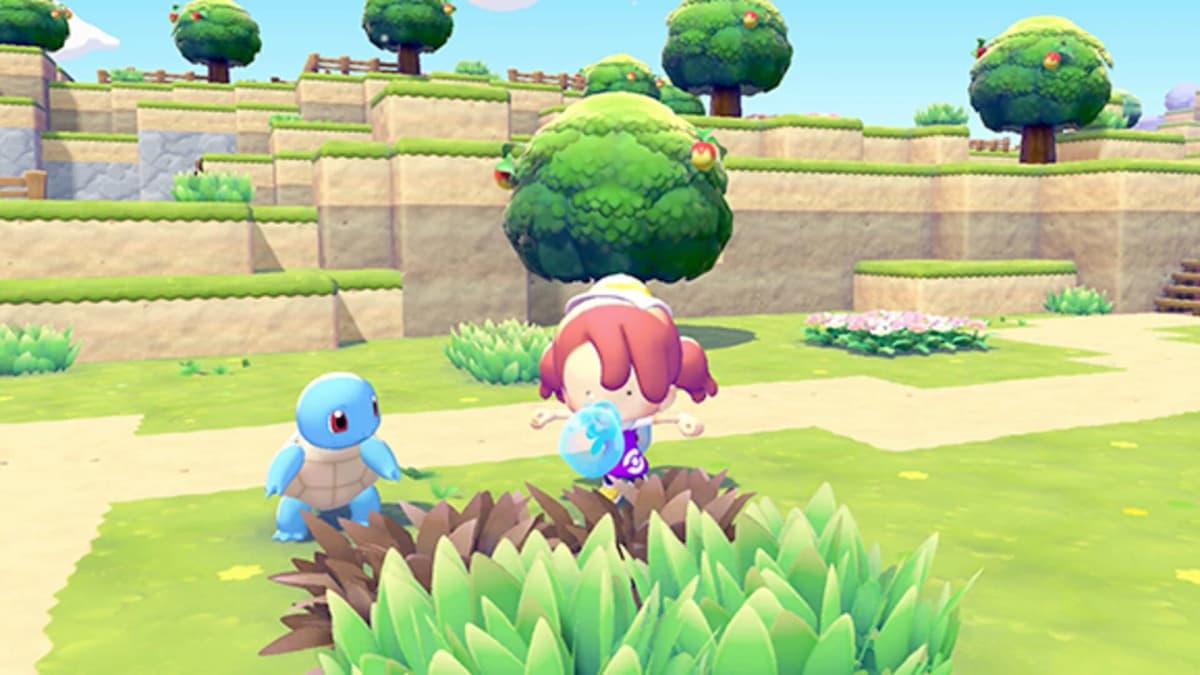
After my first couple of hours, for example, I’d befriended a Squirtle who taught my Ditto how to spray water in a short arc. That sounds minor, but it changes everything: you can water crops, clean off moss-covered machinery, and activate certain ancient devices. A little later, a rowdy Machop gave me the ability to smash tougher blocks, opening up new mining and cave systems. Eventually you’re spitting flames, swinging across vines, zipping up waterfalls—it’s a Metroidvania-style ability drip feed, just framed as Pokémon teaching “their human” new tricks.
What I love about this is how naturally it feeds into the building loop. You don’t just craft a ladder because a menu says so; you figure out that your new vine-swing works perfectly with a certain kind of tree, which then inspires how you design shortcuts in your town. Everything you unlock finds its way into either exploration or construction in a way that feels earned, not tutorial-mandated.
It also makes the relationship with your residents feel a little more mutual. There’s this quiet, ongoing sense that Ditto is learning to be a person again through the Pokémon it helps. The game never monologues about that, but it’s there in the little animation of Ditto hesitating before copying a new move, or in the way other Pokémon talk about “remembering” humans through you.
The Building Loop: Animal Crossing Freedom With Minecraft Brains
Pokopia’s world is built out of chunky square blocks—very Minecraft-coded at a glance—but structuring this around towns instead of pure survival makes a big difference. You’re not punching trees to keep hunger meters full; you’re gathering resources to make habitats and infrastructure that keep Pokémon happy.
Each town has its own “environment level” and Pokémon roster. You raise that level by crafting individual habitats tailored to species’ preferences. A Charizard wants wide-open, grassy space with verticality; a Metang demands a techy corner with a PC setup and a whiteboard; certain Bug-types insist on humidity and lots of low, leafy plants. The game gives you cryptic hint cards—“likes soft light and the sound of water,” that kind of thing—but actually discovering the right combo feels like solving cozy little design puzzles.
The key difference from something like Animal Crossing: New Horizons is how few hard limitations there are. Very early on I was stacking blocks to make multi-story houses, carving out underground bunkers, running minecart rails to a quarry I built in the hill behind town, and experimenting with waterwheels to power lights. The toolset goes far beyond “put furniture here”: elevators, basic electrical circuits, automated farms, conveyor belts, decorative and functional wiring. It’s closer to Dragon Quest Builders in depth, but with better onboarding.
What really impressed me is how gently the game teaches all this. There is a Professor Tangrowth who’ll give you formal tutorials if you ask, but most of the learning happens through exploration. You’ll find the ruins of an old greenhouse, for example, and by studying the layout and the pipes you realize, “Oh, this is how they watered these crops automatically,” and then go home and recreate it. It’s the kind of design that makes you feel clever even when the systems are actually straightforward.
This loop—explore, discover a clever bit of environmental design, copy and iterate it in your own town—kept me in that “just one more in-game day” trance for entire evenings. I’d log on to quickly tweak a Bulbasaur’s garden, then notice my ore stockpile was low, which led to a mining trip, which led to a new ruined factory, which gave me a blueprint for a conveyor system… and suddenly it was midnight.
Pokémon As Residents, Not Just Collectibles
There are over 200 Pokémon in Pokopia, pulled from multiple generations even though the region is a ruined Kanto. On paper that sounds like a checklist, but this is the first time in a long while that I’ve felt like the middle evolutions and oddballs actually got to shine.
Every Pokémon has a little personality profile built from its dialogue, its habitat preferences, and its job assignments. A sleepy Herdier that complains about noise but secretly loves watching the minecarts; a hyperactive Minun that says “yooo” a bit too often while begging for more gadgets in its room; a shy Lampent who only perks up when you add more bookshelves. None of it is complex narrative design, but across a whole town it adds up to something that feels like a genuine community.
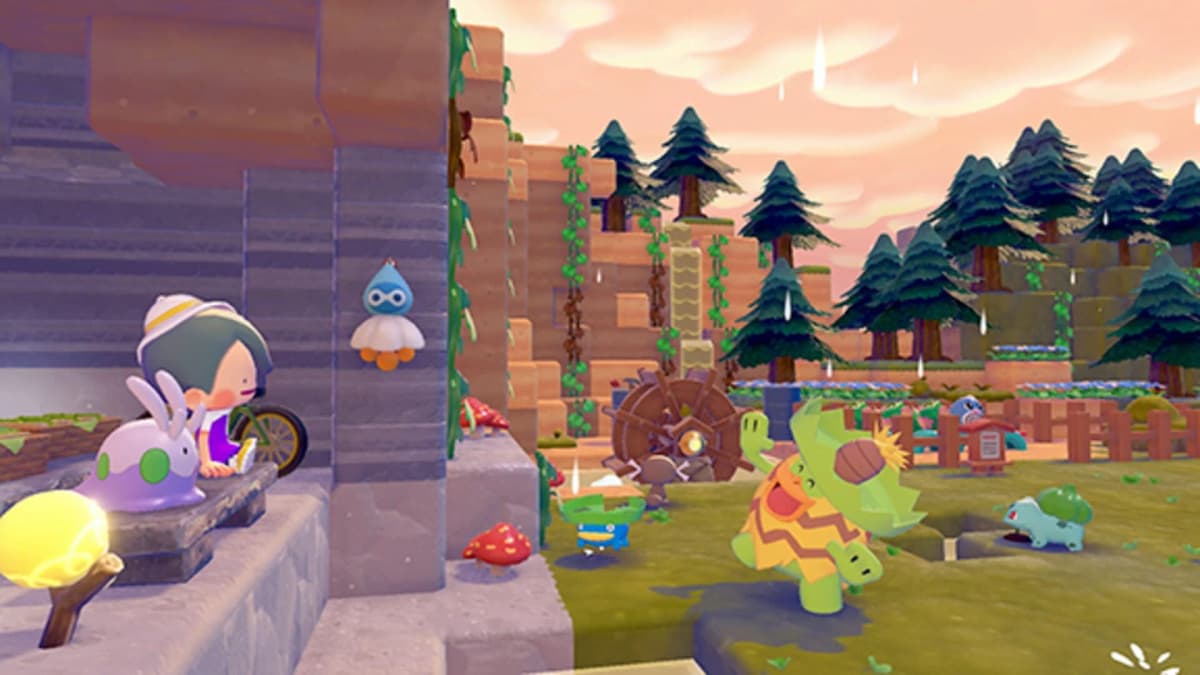
You can assign residents to tasks—running shops, tending crops, handling deliveries—and it’s not just a background system. Walking through town and seeing your Machoke operating the ore processor they nagged you to build three hours ago is weirdly satisfying. The moment I realized my town’s economy was quietly ticking along while I was off in another biome hunting rare wood was when the game fully clicked.
I also have to give credit for how dialogue is handled. Pokémon still mostly say their names, but the localization leans into tone and rhythm to convey character instead of just repeating catchphrases. It’s especially noticeable with species that rarely get attention in the mainline RPGs; I left this game irrationally attached to a Dedenne that constantly complained about my sense of interior design.
Multiplayer That Finally Respects Your Time
I adored Animal Crossing: New Horizons, but its online experience was straight-up painful. Every arrival or departure paused the world for a full cutscene. Trying to host more than a couple friends turned into a night of watching airline animations instead of, you know, playing.
Pokopia treats multiplayer like a background layer instead of the main event, and it’s so much better for it. Friends can drop into your town without stopping your game; you’ll see a little notification and maybe a short visual of them arriving at the station, but you’re free to keep building, mining, or decorating. No forced interruptions, no group-held-hostage by one person’s bad connection.
There are actually reasons to have people over beyond vibes. Visitors can shop at your Pokémon Center’s PC, which has a rotating selection of items that’s different for every player each real-world day. They can also inspect your habitats to unlock the same hint cards you used. I had a friend visit specifically to study how I’d managed to keep a Magmar and a Snover happy on the same street—he borrowed my layout, tweaked it, and then I later visited his town to “steal” his improved version.
The real star, though, is the Cloud Islands system. These are shared, always-on floating islands where you and friends can co-build massive projects completely separate from your personal towns. Think of them as communal servers: your progress persists whether the host is online or not. One weekend, three of us chipped away at turning a Cloud Island into a giant multi-layered safari zone, logging in at different times like we were working shifts. Coming back to see someone else’s half-finished rail line or weird statue became its own little thrill.
It’s not a full-on MMO, and visiting a friend’s main town is still more about hanging out than structured activities, but as a foundation for creative multiplayer it’s miles ahead of what Nintendo usually ships. It feels like they actually looked at how people used Minecraft realms and community servers and borrowed the right lessons.
Performance, Controls, And The Few Things That Bugged Me
On the technical side, Pokopia is one of the more reassuring early Switch 2 games I’ve played. In both handheld and docked modes, my framerate stayed smooth even when my town turned into a spaghetti of lights, crops, rails, and wandering Pokémon. Load times between regions are short, and I never had a crash or major bug across 45+ hours.
The one place where the game stumbles is precision building. Placing and destroying blocks in 3D space with a controller will never feel as exact as a mouse, and Pokopia doesn’t entirely solve that problem. There’s a helpful outline showing which block you’re targeting, and a “mouse mode” for Joy-Con that lets you flick a cursor around, but I still found myself misplacing pieces or accidentally breaking the wrong tile more often than I wanted.
It’s not a deal-breaker; I just learned to build a little slower and rely more on scaffolding. But when I was working on more intricate builds—like a lighthouse with a spiral staircase—I definitely wished for just a bit more snap or constraint options. Late-game, when your projects get bigger and more vertical, the fiddliness becomes more obvious.
The only other rough spot for me was a mild sense of repetition once I’d fully upgraded a couple of towns. The core loop—gather, craft, build habitats, attract new residents—remains satisfying, but after 40 hours I started to feel the patterns behind the habitat puzzles. New biomes and rare materials keep things engaging for a while, yet I did catch myself thinking, “Okay, I know exactly how this line of quests will pan out.” It doesn’t kill the magic, but it’s worth noting if you’re chasing dozens and dozens of hours.
Who Pokémon Pokopia Is Really For
This is not a traditional Pokémon RPG. There’s no combat system, no gyms, no catching in the usual sense. If your ideal Pokémon experience is competitive battling, EV spreads, and min-maxing, Pokopia is basically a different genre that just happens to be set in that universe.
If, however, you’ve ever lost a week to Animal Crossing, spent too long fussing over furniture placement, or fallen deep into a Minecraft/Dragon Quest Builders rabbit hole, Pokopia feels custom-built for you. It’s a builder first, life sim second, and Pokémon game third—meant as a compliment. The Pokémon flavor isn’t a skin; it genuinely changes how you think about residents, how you design spaces, and what goals you chase.
It’s also a perfect “shared console” game. I had a family member start their own save on the same Switch 2, and watching how different our towns evolved from the same starting seeds was fascinating. They focused on making a dense urban hub; I went full cottagecore with elevated walkways and waterfalls. The systems support both without complaining.
FinalBoss // Gear
Level up your setup
01Best-selling Switch 2 gameson Amazon→02Switch 2 accessorieson Amazon→038BitDo controllerson Amazon→04Discounted game keyson Kinguin→
Affiliate links · As an Amazon Associate, FinalBoss earns from qualifying purchases.
Want to Level Up Your Gaming?
Get access to exclusive strategies, hidden tips, and pro-level insights that we don't share publicly.
Ultimate Reviews Strategy Guide + Weekly Pro Tips