
Table of Contents (9)
Booting Up Requiem on Switch 2: My First Night in the Dark
Resident Evil and Nintendo hardware have always felt a bit cursed together. Cloud versions on the first Switch, weird performance compromises, handheld horror that never quite clicked. So when Capcom said Resident Evil Requiem would hit Nintendo Switch 2 day one alongside PS5 and Xbox Series, I honestly expected a downgrade special with a fancy logo.
A week later, I’m sitting here with three games installed on my Switch 2: Resident Evil 7, Village, and Requiem. I’ve finished Requiem once, poked around New Game+, and spent several evenings revisiting key sections of 7 and 8. I played mostly docked with the Pro Controller on a 55″ 4K OLED, but I also burned through a couple of late-night chapters in handheld mode, headphones on, Switch 2 about 10 inches from my terrified face.
The short version? Capcom absolutely pulled off some black magic to make these games run natively on a hybrid console… but with Requiem in particular, you can feel the strain in every open area where the framerate dips and your crosshair starts to feel just that bit too squishy.
Two Horrors in One: How Requiem Actually Plays
Structurally, Requiem is one of the most interesting Resident Evil entries in years. It leans hard into a dual-gameplay idea: tense, first-person infiltration with newcomer Grace, and more traditional over-the-shoulder action with series veteran Leon. It really does feel like Capcom tried to fuse the suffocating dread of RE7 with the punchier spectacle of RE4 and Village.
Grace’s sections are where the game is at its nastiest. You’re creeping through narrow spaces, relying on sound more than sight, with that first-person camera welded right to your skull. Every footstep echoes, every creak in the building makes you stop dead and listen. The game pushes you toward avoidance and patience: peeking around corners, watching patrol routes, holding your nerve instead of your trigger.
Leon’s parts flip the switch. You’re back in classic third-person, managing crowd control, lining up precise headshots and quick melee follow-ups when enemies stagger. Ammo isn’t plentiful, but it’s not as brutally tight as Grace’s runs, and the level design opens up in ways that clearly stress the Switch 2 hardware more than the claustrophobic Grace sequences.
There’s a lot of fan service here. Familiar motifs, sly references to older games, monster designs that clearly wink at long-time fans without turning the whole thing into a meme compilation. I caught myself grinning at a couple of moments that are obviously designed for those of us who’ve been locked in this mansion of a franchise for decades.
Across roughly 15 hours on my first playthrough, the structure in two big halves worked better than I expected. I’d burn through an intense, puzzle-heavy stretch with Grace where I barely fired a shot, then swap to Leon for a chunk of more kinetic, spectacle-heavy horror. If you bounced hard off RE7’s pure first-person anxiety, Requiem is a nicer middle ground. If you loved 7, Grace’s sections feel like a direct, nastier cousin.
So… How Does It Actually Look on Switch 2?
The first thing that hit me, right from the rainy opening, was the atmosphere. Rain hammers down, the lighting bounces off wet surfaces, and the Switch 2’s HD Rumble 2 in the Pro Controller sells each heavy drop. I wasn’t expecting the rumble to be this detailed; that first scene felt uncomfortably close to what the PS5 DualSense does, just a bit less nuanced.
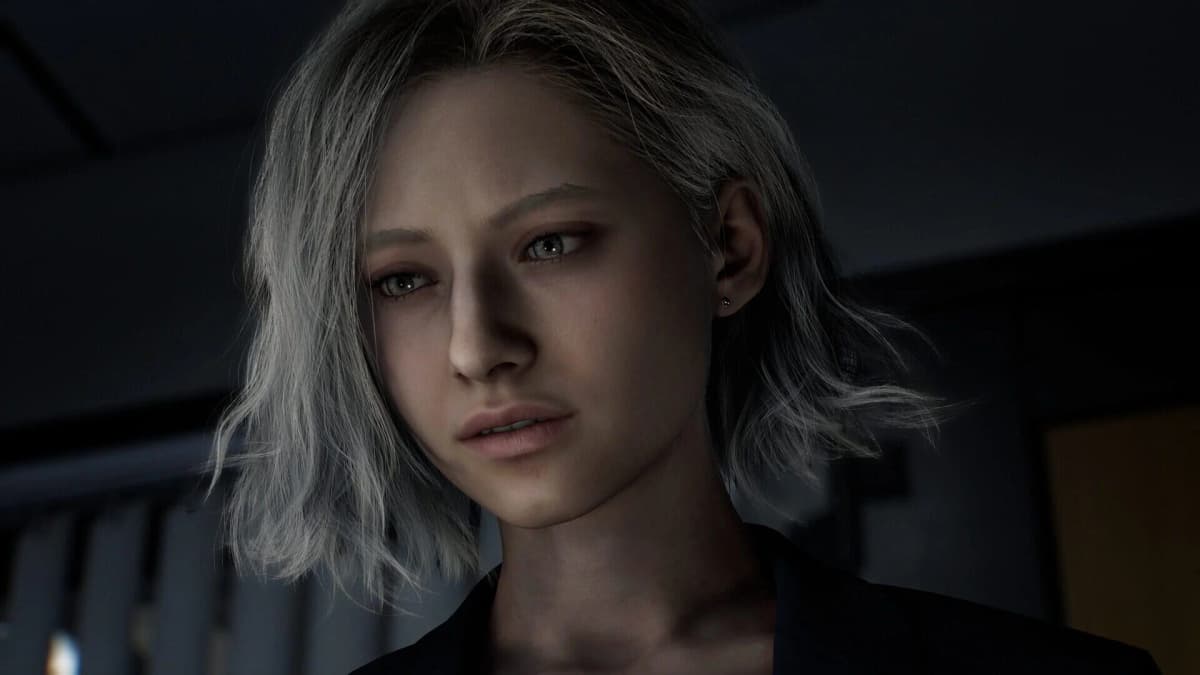
Visually, Requiem on Switch 2 is way above “portable port” territory. On my 1080p monitor, it honestly looked shockingly close to what you’d expect from a lower-end current-gen console. On the 4K OLED, the gap to PS5 is more obvious: texture detail is lower, fine geometry is simplified, and hair in particular looks like we’ve gone back a console generation or two. Grace’s hair is the one big tell; it’s clearly using simpler, card-based hair rather than the fancy strand systems you get on more powerful hardware.
The secret sauce behind all this is Nvidia’s DLSS. Digital Foundry measured an internal resolution floating around 540p that’s then upscaled to your screen, and you can absolutely feel the trickery. In motion, especially in darker interior scenes, it looks surprisingly clean. Edges are decently sharp, and the overall image is way better than a raw 540p feed has any right to be. If you pause and pixel-peep, you’ll notice smeared fine detail on textures and some temporal wobble, but during actual gameplay it’s more than good enough.
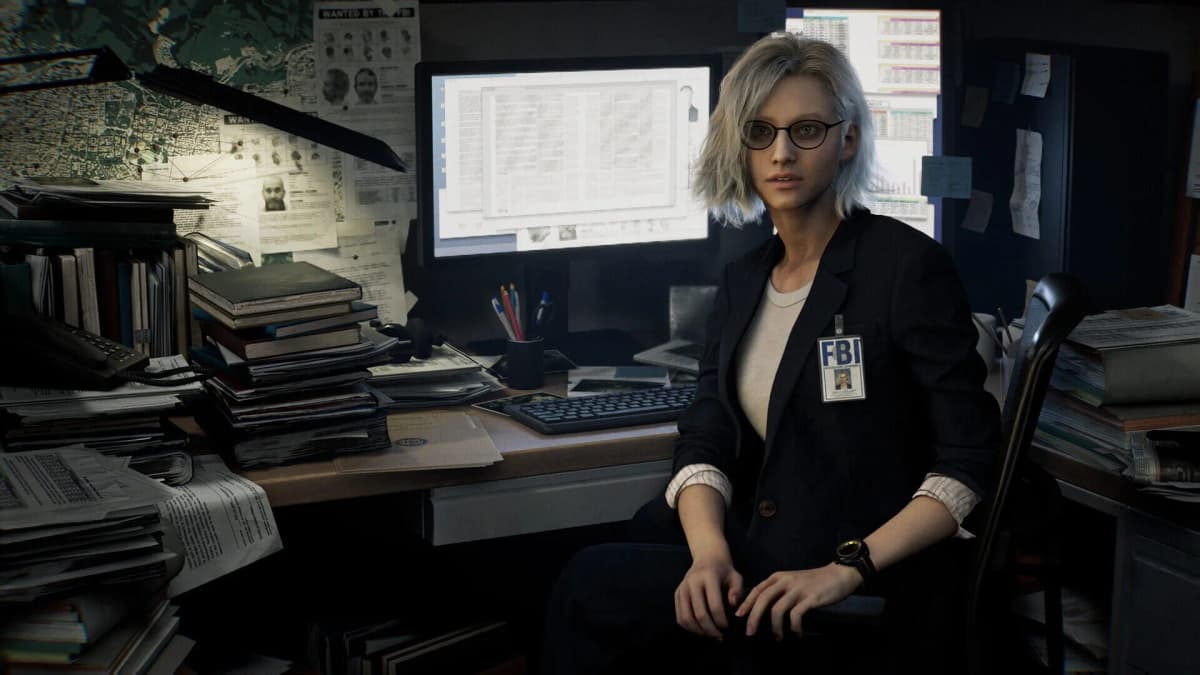
There’s no ray tracing here, and shadows and reflections are clearly pared back versus what I’ve seen on PS5, but the art direction and lighting still do the heavy lifting. The RE Engine is just absurdly good at this kind of moody horror, and Capcom clearly knows exactly where they can cut on Switch 2 without breaking the atmosphere.
The Framerate Elephant in the Room
Now for the part that kept nagging me the entire playthrough: performance.
Capcom is clearly aiming for 60 fps on Switch 2, and in smaller, corridor-heavy areas – especially in Grace’s first-person segments – it comes very close to that target. Those sequences feel smooth, snappy, and responsive. Fast camera pans don’t smear too badly, aiming feels tight enough, and if you didn’t have a frame counter running, you’d probably assume it was close to a locked 60.
Step into larger, more open combat arenas – which tend to be Leon’s playground – and things get rougher. The framerate starts bouncing between the 40s and 50s. Nintendo’s VRR support on compatible displays does help docked, smoothing out a lot of that jitter so it doesn’t feel as choppy as the numbers suggest. But you can’t hide the drop in responsiveness when enemies rush you and you’re trying to line up quick headshots.
It never devolves into slideshow territory, nothing like the worst offenders from the PS3/360 era where games ambitiously “targeted” 60 and sat in the 20s. But there are specific combat encounters where I could feel my crosshair lagging just a bit behind my intent, especially if I was playing on Joy-Con rather than the Pro Controller.
I kept wishing Capcom had included a simple Performance vs Quality toggle just for Switch 2. Lock this thing at 40–45 fps with a bit more conservative visual settings, or drop some bells and whistles for a near-locked 60 in combat. As it is, you get one dynamic setup doing its best in every scene, and the result is “mostly okay, sometimes really good, occasionally annoying.”
Handheld Horror vs Docked Showpiece
Requiem is absolutely playable in handheld, and there’s something uniquely nasty about horror this detailed on a small screen you’re holding inches from your face. The smaller display hides some of the DLSS softness, and at first, I actually preferred playing Grace’s slow-burn sections in bed, lights off, headphones on.
But handheld is also where the performance compromises are harder to ignore. The Switch 2 has to drop clocks to stay within its portable power envelope, and you feel that most in the busier outdoor and hub-like areas. There’s more shimmering, more obvious resolution dips, and the framerate can sag enough that fine aiming feels mushy. If you’re sensitive to that stuff, handheld Leon chapters are going to be your least favorite way to play.
Gyro aiming is supported and helps a ton, especially in handheld. A quick flick of the wrist to line up a headshot feels much better than pure stick aiming when the framerate’s wobbling. Just be aware that Joy-Con still aren’t as precise or comfortable as the Pro Controller. More than once, I swapped back to docked play simply because my hands were cramping from clutching the system through a long, combat-heavy stretch.
Revisiting RE7 and Village on Switch 2
The other half of this story is the mini-Resident Evil collection that arrives alongside Requiem. Capcom brought over Resident Evil 7: Biohazard and Resident Evil Village as native Switch 2 ports, both based on their complete editions with DLC bundled in.
Resident Evil 7 is the clear winner here. On Switch 2, it runs at a pretty much rock-solid 60 fps with very short load times, even in its nastier, more detailed spaces. Visually, it’s not some jaw-dropping remaster – it looks like a slightly cleaned up version of the original console release – but the performance and handheld playability make it a fantastic way to experience what’s still one of the most important horror reboots of the last decade.
It’s honestly hilarious to remember that on the first Switch, 7 was only playable via a cloud version that felt terrible in most home internet setups. There’s no upgrade path from that old cloud release to this native port, which stings if you were one of the unlucky early adopters, but technically speaking, this is the way these games were meant to be played on Nintendo hardware.
Resident Evil Village feels a little more compromised. Docked, it’s fine – sometimes even impressive – but you can tell the game is pushing harder. The central village hub, which connects the different areas of the game, is where the framerate and image quality wobble the most, especially in handheld. Interiors and smaller spaces look solid; step into the big snowy hub, and the Switch 2 starts to sweat. It’s never unplayable, but after seeing how clean RE7 runs, Village’s rough spots stand out.
Overall, though, having 7, Village, and Requiem all running natively on a hybrid that you can undock and take to the couch or bed is kind of wild. If you own only a Switch 2, you’re no longer getting some bizarre, compromised version of the modern Resident Evil experience. You’re getting the real deal, just with a few visual scars.
Switch 2 vs PS5 / Xbox Series: What You’re Giving Up
I did spend a couple of hours with the PS5 version at a friend’s place, mostly to sanity-check what my eyes were telling me on Switch 2. The differences aren’t subtle if you compare them side by side on a good TV.
On PS5 and Series X, you’re looking at higher native resolutions, sharper textures, better hair and material rendering, and – most importantly – much more stable framerates in big encounters. Camera movement and aiming feel more immediate, especially during Leon’s busier fights. It doesn’t suddenly make the Switch 2 version “bad,” but if you have both systems, there’s no universe where I’d tell you to pick the hybrid port unless handheld horror is a non-negotiable for you.
That said, Digital Foundry’s breakdown isn’t exaggerating when it says DLSS lets Switch 2 punch above its weight. Strictly in terms of what’s on screen, it looks closer to a trimmed-down current-gen game than some weird in-between cross-gen thing. If you’re coming from a PS4 or Xbox One, the Switch 2 version doesn’t feel like a downgrade; in some ways, it’s a sidegrade with different trade-offs.
What Actually Bothered Me
Across all this time with Requiem and its older siblings on Switch 2, a few issues stuck out more than anything else:
- Inconsistent framerate in key combat areas – Leon’s larger battles don’t feel as good as they should, especially if you’re a stick-aiming purist and don’t lean on gyro.
- No performance/quality toggle – On a hybrid that clearly has different power envelopes docked vs handheld, having some level of control over visual/performance priorities feels like a must.
- Joy-Con precision isn’t great – Between the lighter sticks and performance dips, handheld combat can feel mushy compared to using a Pro Controller on a TV.
- No free upgrade from cloud versions – If you bought RE7 or Village via the cloud on the first Switch, you’re paying again for the native versions. That’s not a technical flaw, but it leaves a sour taste.
On the flip side, Capcom deserves real credit for how much of the original experience they’ve preserved here. The atmosphere, the dual-structure campaign, the sound design, the general “Resident Evil-ness” of it all – none of that feels compromised. The issues are very specifically tied to the realities of hybrid hardware and the choice to chase high framerates without giving players options.
Who Should Play Requiem on Switch 2
If you own only a Switch 2 and you’re into survival horror at all, Requiem is almost a no-brainer. You’re getting one of the most ambitious modern Resident Evil campaigns – with that cool split between first-person terror and third-person carnage – in a form that’s totally playable both docked and handheld, with some technical caveats.
If you’re the kind of player who notices and cares deeply about inconsistent performance, especially in shooters, you need to be honest with yourself. The framerate dips will bother you, and you’ll have a smoother ride on PS5, Series X, or PC.
If you already own those other platforms and you don’t specifically crave the idea of curling up in bed with a blanket and a portable horror game, I’d say keep Requiem on the big-boy hardware and maybe grab RE7 on Switch 2 later as a handheld replay. 7 in particular feels like the perfect match for the system: tight, focused, and technically rock-solid.
FinalBoss // Gear
Level up your setup
01Best-selling Switch 2 gameson Amazon→02Switch 2 accessorieson Amazon→038BitDo controllerson Amazon→04Discounted game keyson Kinguin→
Affiliate links · As an Amazon Associate, FinalBoss earns from qualifying purchases.
Want to Level Up Your Gaming?
Get access to exclusive strategies, hidden tips, and pro-level insights that we don't share publicly.
Ultimate Reviews Strategy Guide + Weekly Pro Tips