
Table of Contents (9)
30 years of Resident Evil in one very haunted package
I booted up Resident Evil Requiem on a late weeknight “just to see the intro” and suddenly it was 2am, my DualSense battery light was flashing, and I was crouched under a Rhodes Hill hospital desk holding my breath in real life because a blistered corpse was doing laps around the nurse’s station. That first session told me two things very quickly: Requiem understands why Resident Evil works, and it’s more interested in playing with the series’ history than simply pointing at it.
I’ve been on this ride since tank controls and pre-rendered corridors on a chunky CRT. My brain keeps a weird scrapbook of Resident Evil moments: the dog window in 1, the sewer spiders in 2, Nemesis stomping through a save room door in 3, the village bell in 4, Chris’s boulder arms in 5, the dinner table in 7, the first glimpse of Castle Dimitrescu. Requiem is built for people who have that mental scrapbook, but the thing that surprised me is how often it turns those memories into moving parts instead of decorations.
Key takeaways
- Dual protagonists split the game between first-person survival horror (Grace) and third-person, RE4-style action (Leon), and both sides feel fully formed.
- Nostalgic callbacks rarely sit in the background; they’re wired into inventory systems, level layouts, and character arcs.
- The second-half tour of Raccoon City is indulgent but emotionally satisfying if you’ve been with the series for years.
- Puzzles sit on the lighter side, and the story mainly exists to justify a 30-year victory lap.
- As a 30th-anniversary celebration for long-time fans, it’s excellent; as a starting point for newcomers, it’s a rough place to begin.
My first night in Rhodes Hill: Grace and the return of real fear
I started Requiem with Grace, because the menu even nudges you that way. First-person, new protagonist, no comforting history to lean on. Within fifteen minutes I was creeping through the Rhodes Hill Chronic Care Center with only a scalpel and bad fluorescent lighting for company. Rhodes Hill is essentially a spiritual cousin to the Spencer Mansion: looping hallways, locked wings that tease future routes, a central lobby that slowly fills in as you gain keys and codes. There’s no explicit lore line drawn between them, but the layout and pacing are absolutely old-school Resident Evil coded.
What struck me is how fragile Grace feels. Her movement has that slightly clumsy weight RE7 and Village used so well, where sprinting is possible but always feels like a bad idea. Enemies here aren’t just “zombies” either; they’re blistered, half-fused things that twitch in their beds, then explode into loud, frantic aggression if you slip. Ammo is painfully rare on her side of the campaign, so the early hours become this nerve-fraying dance of listening at doors, counting every handgun round, and properly reading the map instead of barreling ahead.
That first encounter where I realized stealth was genuinely viable – watching patrol patterns through a grimy observation window, planning how to break a line of sight, weighing whether a single bullet was worth the noise – flipped a switch. This wasn’t just “the horror half” as a palate cleanser between Leon’s set-pieces. Grace’s chapters hold up as a full survival-horror game in their own right.
Two heroes, two eras of Resident Evil
A couple of hours in, the campaign flips to Leon S. Kennedy, and the camera swings out into that comfortable over-the-shoulder view. Muscle memory from Resident Evil 4 kicked in immediately. The way the laser sight lines up, the way enemies stagger under precise shots, the little micro-stutters as Leon shoulders through a door with his gun drawn – it all feels intentionally like “modern” Resident Evil, but not a copy-paste of 4 or the recent remakes.
Where Grace tiptoes around two enemies because every encounter is dangerous, Leon ends up kite-running half a street of infected through abandoned cars, kicking ladders down behind him, planting proximity mines in doorways. His sections are faster, bloodier, and framed like a string of escalating set-pieces: an early siege in a tenement corridor, a boss fight on an elevated train, the kind of ridiculous skyscraper motorbike escape that feels like it teleported in from RE6 but is shot with much more confidence.
What ties these halves together is that Capcom doesn’t treat them as separate “modes”. The stories dovetail and occasionally intersect in ways that matter, and the tone of each campaign quietly comments on where the series has been. Grace feels like the lineage of RE1 and RE7, all anxiety and door creaks. Leon channels RE4 and 5’s love of bombast, but older, frayed, a little past his expiry date as an action hero.
On my playthrough I alternated whenever the game handed me control of the other protagonist, instead of marathoning one then the other. Played that way, Requiem turns into a conversation between two eras of Resident Evil design. That alone would be a clever anniversary trick. The part that really sold me, though, is how deep the mechanical callbacks go.

Nostalgia as design: dual inventories, deep cuts, and fixed cameras on the wall
Requiem’s best trick is that most of its fan service lives in decisions you make, not collectibles you examine for two seconds. The clearest example: the two inventory systems. Grace runs on a classic slot-limited inventory with storage boxes, every item a painful choice. Carry the shotgun or the extra healing spray. Bring the key item now or backtrack later. It’s the same flavor of stress that defined the PS1 games, reinforced by conveniently inconvenient item boxes that force some route-planning.
Leon, on the other hand, uses a stylized attache-case grid that screams RE4. Rearranging grenades and rocket launcher tubes to squeeze in one more herb becomes a mini-game again. Weapons and upgrades occupy different shapes, and his entire playstyle – swapping between pistol, shotgun, and crowd-control tools on the fly – lines up with that Tetris-like inventory. Both systems are instantly readable if you’ve lived with this series, but they aren’t just nostalgic skins; they actively shape how each campaign feels to play.
The character callbacks work similarly. Grace’s mother is Alyssa Ashcroft, a name that only really means anything if you remember the Outbreak spin-offs. Requiem doesn’t stop to explain that, it just quietly connect the dots through Grace’s lockpicking talent, some scattered files, and a late-game conversation that reframes why she is so unnervingly calm around catastrophe. It lands much harder if you know Alyssa’s history, but it still functions as character-building even if you do not.
Walking through Rhodes Hill, I spotted a bank of security monitors in one wing. For a second I thought they were just another detail, then realized the angles being displayed were straight-up fixed-camera perspectives, like someone feeding the PS1 era through CCTV. That’s the vibe all over Requiem. OS version numbers on in-universe computers hide backward-written release dates. A children’s ward art project mirrors a certain iconic Raccoon City landmark. It’s everywhere, but it rarely stops the game dead to wink at you. It keeps moving, dragging your memories along with it.
Raccoon City, one last time
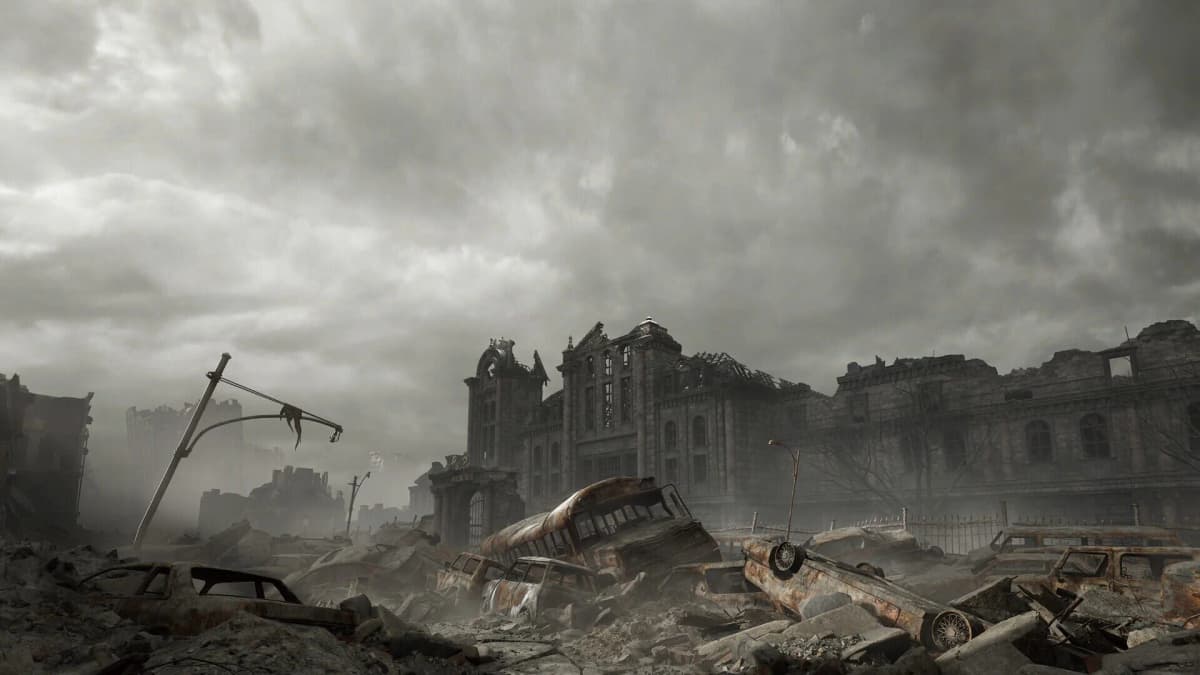
The back half of Requiem leans much harder into direct revisiting, and this is where opinions are going to diverge. For me, Leon’s return to Raccoon City hit that sweet spot between indulgent and earned. The layout is not a 1:1 recreation of the police station or streets, but it plays with your expectations in a way only a long-running series can. A side alley that used to be a safe route in RE2 now funnels you into a brutal mini-siege. A shutter that famously stayed closed finally opens, only to reveal something much worse than the mind filled in over decades.
The game absolutely indulges in a “greatest hits” stretch. The giant spider makes an appearance. So does a gloriously disgusting mutant plant fight that turns a familiar greenhouse layout into a toxic maze. Mr. X gets an encore that exists almost entirely to let modern players face that silhouette with modern controls and lighting. I rolled my eyes once or twice at how hard the game was reaching for my lizard-brain memories, and then immediately forgave it when I found a battered team photo tucked away in the RPD that wordlessly sold where Leon’s head is at.
This second half also gives Leon something like closure. He is visibly older, more brittle, and the game lets that inform his arc instead of pretending he is eternally 28. His snark never fully disappears, but there is a heavy, quiet note running under his return to the city that made him and ruined him in the same weekend. Watching him limp out of one last chaos spiral, finally allowed (maybe) to retire, felt more satisfying than I expected.
Scares, combat, and those slightly thin puzzles
On a moment-to-moment level, Requiem feels sharp. Gunplay on PS5 has just enough recoil and animation snap to make every headshot count, and enemies react with that grisly, exaggerated stagger that the series has practically patented at this point. A few of the new infected types stand out, especially the “blister-head” variants that lunge unpredictably and screech loud enough to pull others into the fray. Fighting them as Leon is a blast, dancing between melee kicks and explosive rounds. Facing them as Grace is sheer panic; the only winning move often feels like not being seen at all.
Resource balancing is strong across both campaigns. I never drowned in ammo as Leon, but I also never hit the miserable dry stretches that some older entries loved. Grace’s side regularly pushed me to craft improvised tools using contaminated blood samples and scavenged chemicals, with a simple but effective system that let me choose between, say, a stronger single-use stun tool or a weaker but reusable distraction. It makes narrative sense (using the infection against itself) and gave me just enough agency to feel clever while still under pressure.
Where the game feels lighter is in its puzzles. There are some standouts – a Rhodes Hill generator rerouting sequence that had me tracing cables through multiple wings while managing enemy patrols, and a late-game RPD safe combination that leans on a Resident Evil 2 deep cut in a smart way. Too often, though, the “puzzles” boil down to color-coded keys, simple symbol-matching, or rotating a few objects until something clicks. They serve pacing, spacing out combat and exploration, but anyone craving the layered weirdness of the original mansion’s puzzle chains might be left wanting.
Performance, visuals, and audio on PS5
I played Requiem on a PlayStation 5 in Performance mode. The frame rate stayed steady through everything, including the busier Raccoon City street fights and that frankly absurd bike-on-skyscraper sequence. Loading between areas is quick enough that dying never felt like a chore. Visually, this is Capcom’s RE Engine flexing again: wet floors that reflect flickering neon, skin textures that are almost too detailed, and expressive faces even under splashes of gore.
Rhodes Hill, in particular, is a lighting showcase. Emergency reds and sickly greens bleed through smoke-filled corridors. ICU wards are bathed in that harsh white that makes every shadow feel like a threat. Raccoon City, meanwhile, leans into color and chaos: burning streets, dripping alleyways, and familiar skylines warped by time and destruction. It feels like stepping into an exaggerated memory of RE2 and 3 rather than a remake, and that’s exactly what this kind of anniversary project should go for.
Audio does a huge amount of work. Playing with headphones, the 3D audio had footsteps and distant screams bouncing off my mental map. More than once I froze as Grace because I could hear something dragging a limb somewhere above me without being able to place which vent it was using. The soundtrack slides between low, droning tension and bombastic horns when Leon gets into full action mode, sometimes weaving in motifs from older games just long enough for the spine to register them.

Voice work is solid across the board. Leon’s actor leans into a tired, sardonic delivery that fits this stage of his life, and Grace sells the mix of competence and barely contained terror. The script itself can be uneven – a couple of exposition dumps and one eye-rolling one-liner during the skyscraper chase – but it never derailed things for me.
Who Resident Evil Requiem is really for
Requiem wears the “30th anniversary” label proudly, and that comes with trade-offs. As someone who has stuck with the series through its weirdest detours, I felt constantly rewarded. My brain kept firing off little “I know that” sparks, but crucially those sparks usually connected to something I was actively doing – a route I chose, an item I prioritized, a door I was scared to open because the last time that layout appeared, something horrific waited behind it.
For newcomers, though, this is a dense, sometimes impenetrable experience. The game explains itself mechanically, but emotionally it expects a lot of background. Character beats, especially Leon’s, gain most of their power from thirty years of baggage. More practically, the tonal whip between Grace’s slow-burn horror and Leon’s near-blockbuster action might feel disjointed if there is no pre-existing attachment to those styles of Resident Evil.
If someone comes in hoping for pure action in the vein of RE5 or 6, Grace’s chapters might feel like they hit the brakes too hard. If they only care about creeping horror, Leon’s larger firefights and boss arenas could read as noisy distractions. For players who like both sides of the franchise and have history with it, though, the split is a strength rather than a compromise.
FinalBoss // Gear
Level up your setup
01Top-rated gaming headsetson Amazon→02High-refresh gaming monitorson Amazon→03Gaming chairson Amazon→04Discounted game keyson Kinguin→
Affiliate links · As an Amazon Associate, FinalBoss earns from qualifying purchases.
Want to Level Up Your Gaming?
Get access to exclusive strategies, hidden tips, and pro-level insights that we don't share publicly.
Ultimate Reviews Strategy Guide + Weekly Pro Tips