
The ugly surprise with Extract in Timberborn is that unlocking it feels like progress right up until the first real production run. On paper, the chain sounds simple: collect Badwater, send it to a Centrifuge, get Extract. In practice, this is where a comfortable colony suddenly discovers how thin its power grid, hauling routes, and storage planning really are. If you only need the quick answer, here it is: Extract is a universal mid-to-late-game resource made by refining 5 Badwater into 1 Extract at a Centrifuge, and the real challenge is not the recipe itself but keeping enough Badwater, power, and Logs flowing to make the building worth running.
Table of Contents (11)
What Extract is and why it matters
Extract is one of Timberborn’s key advanced industrial materials. It is not faction-locked; the recipe is available to all factions, which makes it a shared part of the late-game economy instead of a niche branch for only one beaver society. That matters because once your colony starts leaning into advanced manufacturing, Extract stops feeling optional and starts behaving like a bottleneck.
The reason is simple: Extract feeds other important products, including Explosives, Catalyst, and Grease. So even if you are not chasing Extract for its own sake, you will run into it when you want terrain editing, deeper industrial chains, or more demanding production setups. A lot of players loosely associate it with “the dynamite part of the game,” but that undersells it. It is better understood as a core intermediate material that unlocks several powerful late-game tools.
How you get Extract in Timberborn
Extract comes from Badwater, which Timberborn treats as both a hazard and a resource. That dual role is the first thing to understand. Badwater is dangerous if it reaches the wrong places, but it also powers this entire refinement chain. Depending on your map and current version context, you will encounter it through badwater map features and other contamination-driven flows rather than through the normal fresh water loop.
Step 1: Collect Badwater
The standard setup begins with a badwater collection point, typically using the dedicated badwater pumping side of the system introduced alongside Update 5’s badwater mechanics. The important practical lesson is that you should collect volume, not obsess over perfect efficiency. Since the recipe eats 5 units of Badwater for every 1 Extract, your biggest problem is almost always total supply.
Step 2: Buffer it in storage
If your colony only refines Badwater as it arrives, your Extract line will keep starting and stopping. That is why experienced layouts usually place storage close to contamination sources. Capturing Badwater during active periods and stockpiling it for later keeps the rest of the chain stable during dry spells, drought-like gaps, or maps where Badwater is more event-driven than constant.
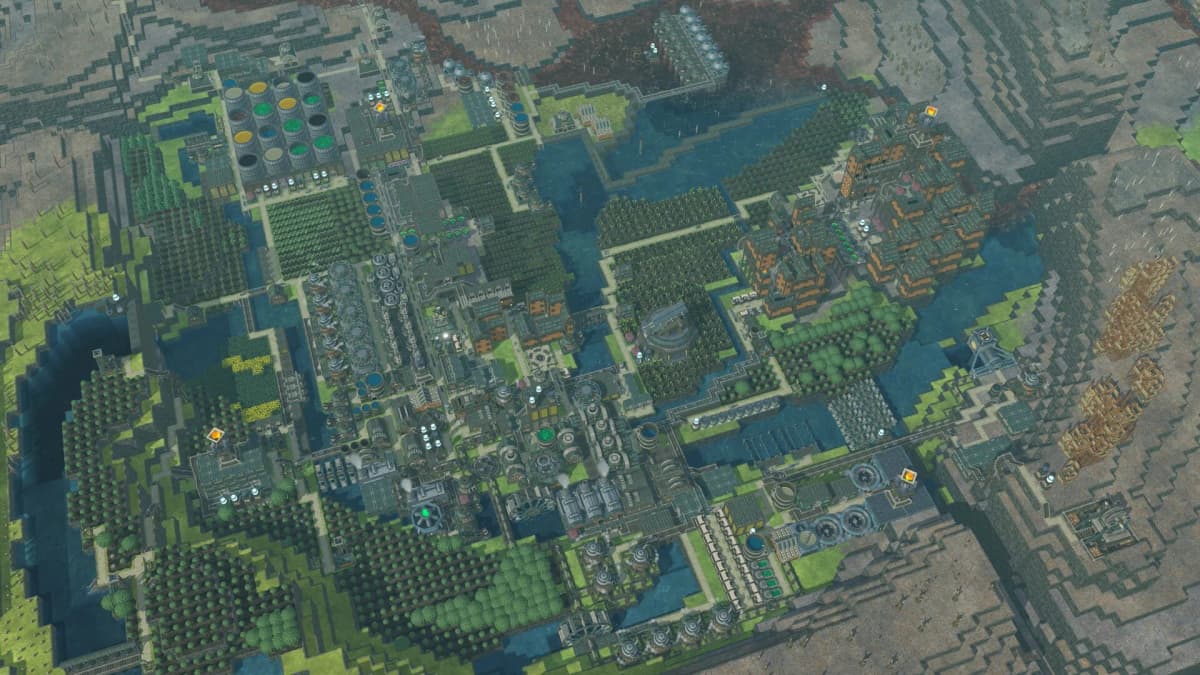
Step 3: Refine it at the Centrifuge
The Centrifuge is the only part of the chain that actually produces Extract. Current public documentation lists it at 200 horsepower, taking 2 hours per batch, and also consuming Logs as fuel. That combination is why Extract production feels heavier than many players expect. You are not just feeding one machine one liquid input. You are supporting a building that wants strong power, a steady hauling network, and raw materials on multiple fronts.
- Input: 5 Badwater
- Output: 1 Extract
- Building: Centrifuge
- Extra support needed: Power and Logs
Why Extract production feels slow even when the setup is “correct”
This is the part Timberborn players often misread. If you build one Centrifuge, hook it up, and expect a dramatic stockpile, the numbers do not support that optimism. At the currently documented values, a single Centrifuge running continuously only produces about 0.5 Extract per hour. That is not a bug. It is the game telling you Extract belongs in a scaled, supported industrial district, not a single-building side project.
That low output has two big consequences. First, one Centrifuge is enough for experimentation but often not enough for sustained advanced industry. Second, interruptions hurt more than they seem to. If the building sits idle because your haulers are late with Logs, your Badwater tanks emptied, or your power dipped at the wrong time, your already modest throughput gets worse fast.

It also means that raw Badwater capture usually matters more than fancy micromanagement. A player who stockpiles large amounts of Badwater and keeps one or two Centrifuges consistently busy will usually outperform a player with a prettier layout but weak intake. Extract rewards reliability more than elegance.
The best way to build an Extract chain
The most practical Extract district is a short, ugly, efficient line: collect Badwater, store it nearby, place the Centrifuge close to both storage and Log supply, and connect it to a power source that does not wobble. The goal is to remove travel time and eliminate the little delays that keep expensive buildings idle.
- Put Badwater storage near the source. Long hauling routes waste your collection windows.
- Keep the Centrifuge near both Badwater and Logs. It needs both, so starving either input hurts output.
- Overbuild power before you need it. A 200-horsepower consumer is not something to bolt onto a fragile grid.
- Treat Extract as a buffered resource. Build stock when supply is good, then spend it later in manufacturing bursts.
If you are playing a version or setup with stronger automation tools, this logic becomes even more important. Extract production is exactly the kind of chain that benefits from reliable routing and buffered inputs because the machine’s appetite stays constant while Badwater availability often does not.
Advanced planning: Badwater is also a power tool
One of the more interesting late-game wrinkles is that Badwater can power water wheels just like normal water. That opens up clever industrial planning, especially for players who like building around hazardous flows instead of simply containing them. The catch is obvious: the same fluid that can support power production can also contaminate the wrong areas if your channels are sloppy.

In other words, Badwater has two jobs. It can be harvested for Extract, and it can drive power infrastructure. Those uses are not always in conflict, but they do compete for attention and map space. On a strong map, that makes Badwater a strategic asset. On a messy one, it becomes a colony-wide liability that happens to pay out industrially if you tame it properly.
Common mistakes that make Extract harder than it needs to be
- Building the Centrifuge too early. If your power grid barely covers current demand, adding a heavy industrial building will expose every weakness at once.
- Ignoring storage. Direct-feed setups look compact, but they fall apart when Badwater supply is intermittent.
- Underestimating Log demand. Players often focus on liquid input and forget the machine also wants a solid fuel stream.
- Treating Extract like a one-off unlock. Because it feeds Explosives, Catalyst, and Grease, shortages ripple into multiple later systems.
- Chasing precision instead of volume. The 5:1 ratio means you usually gain more by capturing more Badwater than by over-optimizing one tiny pump line.
How to judge whether your Extract setup is actually working
A healthy Extract chain does not necessarily look fast. It looks steady. Your Badwater reserves should rise during collection periods and fall gradually while the Centrifuge keeps running. Your Logs should arrive without long dead periods. Your downstream workshops should not keep freezing because one unit of Extract is missing. If that rhythm exists, the system is doing its job even if the stockpile grows slowly.
Also remember that public throughput numbers can shift if Timberborn balance changes in later updates. The most reliable currently available recipe data points to the 5:1 conversion, the heavy power cost, and the slow output profile, but it is smart to treat exact performance figures as “current documentation” rather than eternal law. The bigger lesson is stable no matter the branch: Extract is expensive by design, and your colony has to be built around that fact.
Bottom line
If you need Extract in Timberborn, think bigger than the recipe card. Yes, it comes from refining Badwater in a Centrifuge, and yes, the conversion is 5 Badwater to 1 Extract. But the real game is infrastructure: capture Badwater in bulk, store it near the source, feed the Centrifuge with dependable power and Logs, and expect Extract to act like a bottleneck resource instead of a casual side product. Build for consistency first, then scale. That is the difference between a colony that unlocks late-game industry and one that keeps waiting on a single missing barrel.
FinalBoss // Gear
Level up your setup
01Graphics cardson Amazon→02Gaming laptopson Amazon→03High-refresh gaming monitorson Amazon→04Discounted game keyson Kinguin→
Affiliate links · As an Amazon Associate, FinalBoss earns from qualifying purchases.
Want to Level Up Your Gaming?
Get access to exclusive strategies, hidden tips, and pro-level insights that we don't share publicly.
Ultimate Guide Strategy Guide + Weekly Pro Tips