
The Trial of Aether stops most players in one specific spot: the room where you have to juggle two elements at once. Everything before it is a warm-up. The real test is learning to throw a projectile, then switch its element mid-flight to hit the right mechanism. Get that habit down and the dungeon falls apart in your favor.
Table of Contents (9)
The short version
- Inside the Hall of Trials, Juno receives the Power of Aether from Libra. Your weapons now carry two elements: Physis (press
1) and Aether (press2). - The whole dungeon is one rule wearing different costumes: throw a projectile into a mechanism, then switch element while it is still in play to drive it where you need it.
- The Chakram is your Aether weapon; the Crossbow fires Physis.
- The hardest room is the two-section element-switching puzzle. Solve the left side with crystals and barriers, then the right side using Filia’s rings and a purple floating block.
- Clear the trial, leave the Hall, and the dungeon’s reward is the Aether element itself — not a separate “upgrade” pickup. The chapter boss, Rana Lingua Magna, waits just outside.
First, understand what you just unlocked
You enter the Hall of Trials with one element, Physis, and Libra hands you the second, Aether, partway through. That is the entire point of the dungeon: it teaches you to swap between the two on the fly. Physis is bound to 1 and your Crossbow; Aether is bound to 2 and your Chakram. The crucial detail nobody tells you up front is that you can change element after a projectile is already thrown into a mechanism — which is exactly how the late rooms force you to think two steps ahead.
If a room feels impossible, you are almost always trying to brute-force it with one element instead of switching. Slow down, look at which mechanisms expect Aether and which expect Physis, and plan the order before you throw anything.

The element-switching room: left section
This is where the trial earns its name, and where most failed runs happen. The left side is a sequence of mechanisms and two crystals, gated by a barrier. The solution is a fixed order — once you know it, it is fast.
- Switch to Aether (
2) and throw your first projectile into the mechanism, forwarding it into the Aether mechanism. - Press
1to switch to Physis — this also swaps your ranged weapon. Throw the second projectile in, then move it downward to hit the Physis mechanism and drop the barrier. - Press
2again and forward your Aether projectile into the mechanism below. - Now the timing beat: in quick succession, hit the first crystal with Aether, then immediately press
1and hit the second crystal with Physis.
That last step trips people because they treat the two crystals as separate problems. They are one move with a mid-action element swap. If only one crystal lights, you were too slow on the switch — reset and run the pair as a single rhythm.

The element-switching room: right section
The right side hands control of the environment to Filia. You interact with rings to let her weave platforms and spawn pieces, then move a purple block into place. Work it in this order:
- Interact with the rings so Filia can shape the surroundings. A block with a golden mechanism spawns.
- Hit the golden hand first to activate the purple floating block, then use the Aether Chakram to catch it and place it inside the block’s mechanism.
- Drag the block onto the nearby floor switch to drop the barrier. These switches only stay active while something is pressing them, so the block is doing double duty.
- Throw Physis projectiles into the mechanisms to raise the bridges, push the block along the path, and stop it on each switch as you go.
- Finally, switch to Aether (
2) and push the purple floating block into the electric generator to finish the section.
If the block will not move or a barrier refuses to drop, you almost certainly skipped a floor switch or pushed the block past one. Backtrack and re-seat it — the room is consistent, the failure is always a missed switch.
About the Dirty Quill
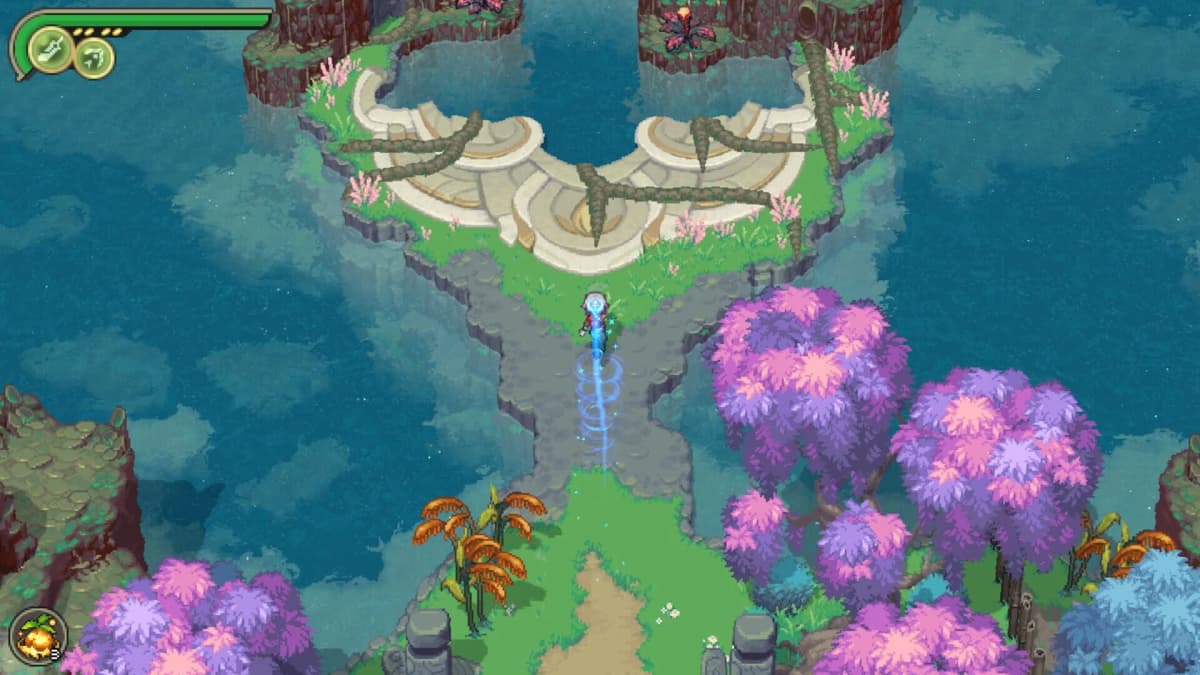
The Dirty Quill confuses a lot of players, so be clear on what it actually is: it is a gem, looted from a chest you reach through a ring-and-orb sequence after you leave the Hall of Trials. It is not hidden inside the trial, and it is not required to complete any of the Aether puzzles. If a room is stalling, the Dirty Quill is never the missing piece — check your element order and your floor switches instead. Grab the gem on your way through, but do not waste time hunting for it mid-trial.
What clearing the trial actually gives you
The reward for the Trial of Aether is the Aether element itself — the dual-element kit you used to solve the dungeon is the prize, and it stays with you. There is no separate “Aether Essence” item to collect, despite what some early write-ups claim. The real progression milestone comes later: after you beat the chapter boss at the Nyx Spire, you earn Divine Connection: Harmony Level 2.
Speaking of that boss — the moment you exit the Hall, you face Rana Lingua Magna, the massive toad that caps Chapter 1. Everything you just practiced matters here: the fight leans on the same purple floating blocks and the electric generator mechanic in its final phase, so the trial is effectively a tutorial for the boss.
Common mistakes that cost the most time
- Trying to clear a room with one element. The dungeon is built on switching
1(Physis) and2(Aether) mid-puzzle. If you are stuck, you are probably not swapping. - Switching too slowly on the crystals. The left-section finish is one beat: Aether crystal, then immediately Physis crystal. Treat it as a single move.
- Losing track of the purple block. Floor switches only hold while pressed. Push the block past one and the barrier slams back up.
- Hunting for the Dirty Quill inside the trial. It is a gem found after the Hall, in a chest behind a ring/orb sequence, and it is not needed for any puzzle.
- Expecting an “Aether Essence” reward. There isn’t one. The element kit is the reward; Harmony Level 2 comes from the Nyx Spire boss later.
Practical takeaway
The Trial of Aether is a switching drill, not a reflex test. Grab the Power of Aether from Libra, then treat every mechanism as a question of which element it wants and when. In the big room, run the left section’s fixed order and finish on the Aether-then-Physis crystal beat, then use Filia’s rings and the purple block to clear the right section into the electric generator. Ignore the Dirty Quill until you are out, skip the search for a phantom upgrade, and walk straight into the Rana Lingua Magna fight with the exact mechanics you just learned.
FinalBoss // Gear
Level up your setup
01Top-rated gaming headsetson Amazon→02High-refresh gaming monitorson Amazon→03Gaming chairson Amazon→04Discounted game keyson Kinguin→Affiliate links · As an Amazon Associate, FinalBoss earns from qualifying purchases.
Want to Level Up Your Gaming?
Get access to exclusive strategies, hidden tips, and pro-level insights that we don't share publicly.
Ultimate Guide Strategy Guide + Weekly Pro Tips