
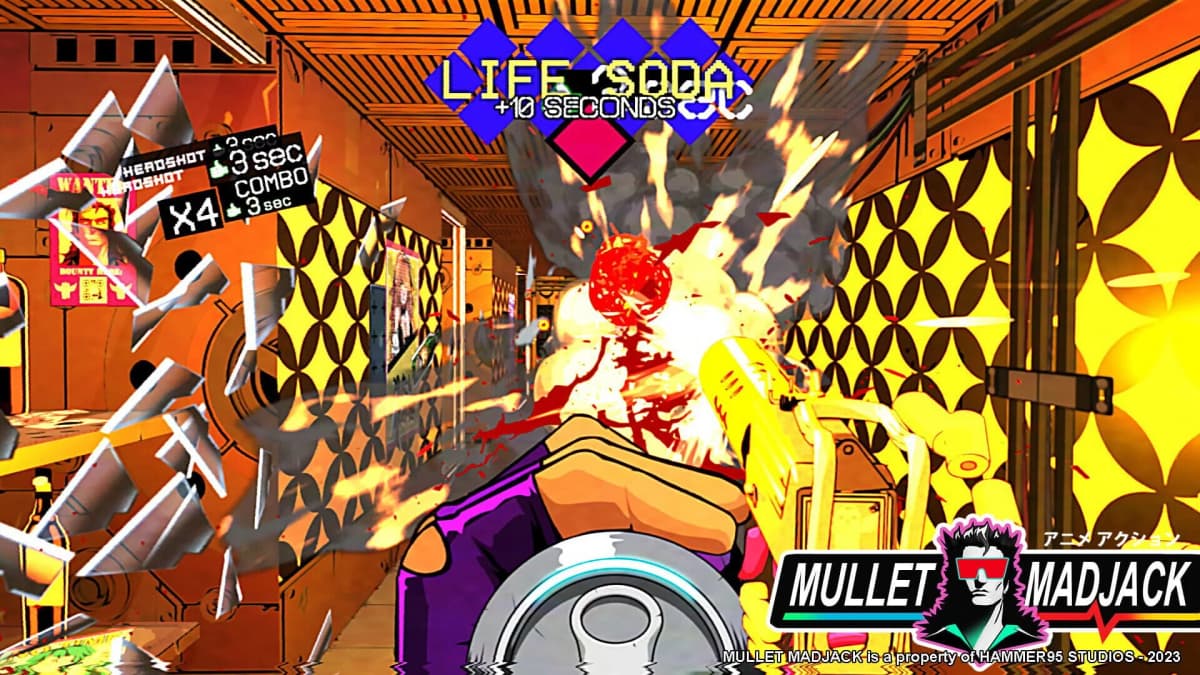
Mullet MadJack throws neon, gunfire, and a draining survival timer at you fast enough that it feels like there should be a hidden character-select screen with three extra protagonists behind a brutal clear condition. There is not. The game runs on one playable lead, a small named cast you meet through the story, and an enemy economy that decides your runs far more than any roster ever could. This guide lays out every named character, how you encounter each one, and which of them actually changes how you play.
Table of Contents (12)
The short version
- You play one character. Jack Banhammer (also written Mad Jack / Mullet MadJack) is the protagonist, available from the start. There is no second playable runner to unlock.
- The Influencer / Princess / Influencer Princess are the same person – your rescue target, not a playable pick.
- Mr. Dopamine is an actual boss, not background lore: you beat him in a rock-paper-scissors duel, it sets a checkpoint, and the building’s defense system wipes him out of existence.
- Mr. Bullet is the main antagonist; the Robillionaires are the machine-elite faction; the robots are the real combat roster you fight.
There is no multi-character roster – here is why
When people search “Mullet MadJack characters,” they usually expect a fighting-game-style lineup. The game does not work that way. You control Jack Banhammer and only Jack. Everyone else is a story target, a villain, a faction, or an enemy type. So the useful question is not “which hero do I pick,” but “who is in the game, how do they show up, and which of them affect a run.”
Two naming overlaps trip people up. The rescue target is called The Influencer, Princess, and Influencer Princess – these are one character, not three. Likewise, Jack Banhammer, Mad Jack, and Mullet MadJack all name the same protagonist.
Complete Mullet MadJack character roster
- Jack Banhammer / Mad Jack / Mullet MadJack – playable protagonist, available from the start, classified in-fiction as a “Retrohuman, Moderator.”
- The Influencer / Princess / Influencer Princess – the rescue target you progress toward, not playable.
- Mr. Bullet – main antagonist and boss, encountered through the story, not playable.
- Mr. Dopamine – a boss fought as a rock-paper-scissors challenge; the “Brain Resurrection Wizard 1.6” head-trauma rehab AI.
- Streamer – supporting cast tied to the game’s media-broadcast framing, not a playable pick.
- PEACE Corp – a faction in the setting, not an individual selectable character.
- Robillionaires – the machine-elite antagonist faction that defines the world.
- Robot enemies and bosses – the combat roster you actually fight every run.
Jack Banhammer: the only playable character
Jack is the entire player side of the game. You do not unlock him, buy him, or earn him from a side challenge – he is your default from the moment you start. That matters because every weapon pickup, dash, slide, kick, and time-extension route is balanced around his toolkit. The build conversation is never “which character,” it is “how efficiently do you use Jack’s movement to keep kills, and the timer, flowing.”
In-fiction, Jack is classified as a “Retrohuman, Moderator” – a Moderator sent into the tower to rescue the Princess. His look is a deliberate 90s-action throwback: director Alessandro Martinello has said the character is based on Mel Gibson’s Riggs from Lethal Weapon, with the mullet itself inspired by Policenauts. (The Guts-from-Berserk comparison you will see floating around comes from fan lists of anime influences, not from the developers.)
Acquisition: available from the start, no unlock condition.
Meta relevance: total – he is the only player character, so mastering his mobility and weapon handling is the meta.
The Influencer / Princess: the goal of the run
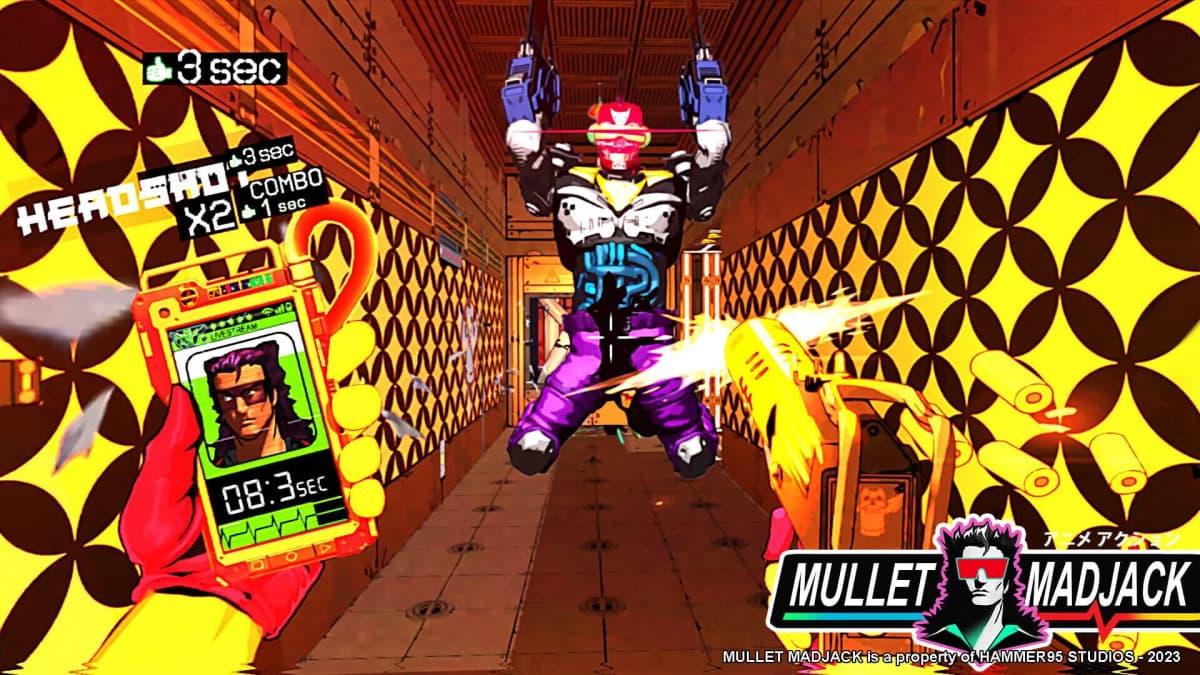
The Princess is the cleanest example of why “character” searches mislead here. She is one of the most important named people in the game, but her weight is narrative, not roster-based: Jack’s whole mission is built around rescuing her from Mr. Bullet, so she drives the plot even though you never control her.
Acquisition: not playable; reached through story progression as the person you are trying to rescue.
Meta relevance: high for progression, low for buildcraft – she sets your objective, not how you fight.
Mr. Bullet: the antagonist who checks your whole run
Mr. Bullet is the main antagonist in the named cast, and his importance is easy to miss if you only count playable avatars. In a speed-driven shooter, the main villain is the pressure point at the end of your route: a weak build, sloppy movement, or poor time management gets exposed hardest when the run finally cashes out against him.
Acquisition: story encounter and boss progression, not a selectable fighter.
Meta relevance: very high as a skill check – he shapes how much you value survivability, weapon consistency, and pace.
Mr. Dopamine: the boss most players miss
If there is one non-Jack character worth knowing in detail, it is Mr. Dopamine – and the common mistake is treating him as background lore. He is not. Mr. Dopamine is the “Brain Resurrection Wizard 1.6,” a head-trauma rehabilitation AI, and you fight him as an actual boss encounter: a rock-paper-scissors duel. Win it and the game grants you a checkpoint, then the building’s defense system wipes Mr. Dopamine out of existence.
That fight is also why his name fits the game’s loop. Mullet MadJack runs on stimulation and survival – you kill to feed the timer and keep moving – and a “resurrection” AI sitting at a checkpoint is the on-the-nose expression of that retry-friendly, momentum-first design.
Acquisition: not playable; encountered as a boss, removed from the game once defeated.
Meta relevance: high – he is a concrete fight on your route and a guaranteed checkpoint, not just flavor.
Streamer, PEACE Corp, and the smaller named cast
Streamer belongs to the game’s media-broadcast framing – the cast and tone, not a gameplay option or unlock. Treat Streamer as part of the world, not a progression target.
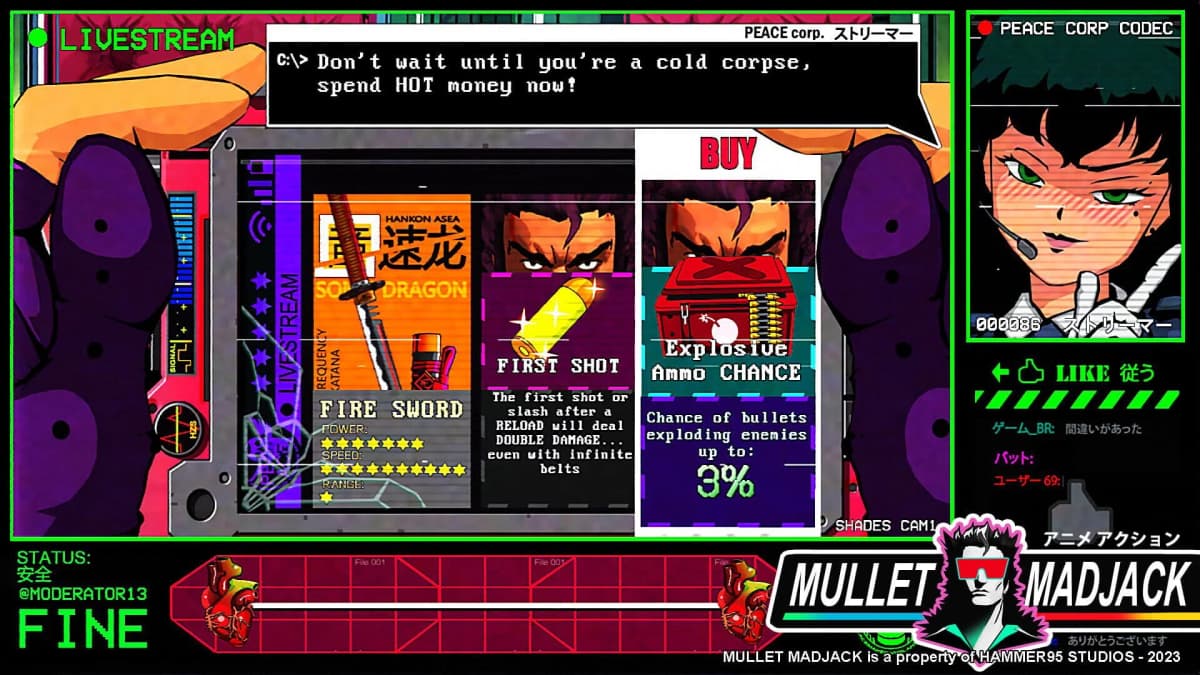
PEACE Corp is a faction, not a person, so do not read it as a hidden hero slot. It belongs in a complete roster guide as part of the setting’s satire of media obsession and corporate violence.
Acquisition: neither is a playable character; both are world and story elements.
Meta relevance: low in gameplay, useful for understanding the world.
Robillionaires and robots: the roster you actually fight
The Robillionaires are not a character pick, but they are central to the cast: they are the machine-elite who run this world and produce the enemy pressure you have to chew through. The robots are the honest version of the “Mullet MadJack roster” – Jack on one side, a tower of robotic targets on the other.
Those enemies are the real economy of the game. You kill them to gain time, stabilize the run, hold momentum, and reach the next floor or boss with resources intact. If a weapon erases robot packs fast and safely, that is the closest thing the game has to roster optimization.
Acquisition: encountered throughout runs as enemy factions, rooms, and bosses.
Meta relevance: massive – clear speed against robots beats any hypothetical character variety. Pair this with the right loadout in our best builds and loadouts guide.
Which characters matter most to a run?
- Jack Banhammer – the entire playable foundation.
- Robot enemies – the combat roster you are really optimizing against.
- Mr. Bullet – the antagonist who turns your route into a real check.
- Mr. Dopamine – a concrete boss fight and a checkpoint, worth knowing before you reach him.
- The Influencer / Princess – vital to the story, not to build decisions.
- Streamer, PEACE Corp, Robillionaires – setting and enemy context more than tactics.
Common mistakes
- Hunting for unlockable characters. There are none. Time spent looking for a second runner is better spent on Jack’s movement.
- Treating Mr. Dopamine as lore. He is a rock-paper-scissors boss and a checkpoint – do not walk into him expecting a cutscene.
- Counting The Influencer, Princess, and Influencer Princess as separate characters. They are one person.
- Repeating the “Jack is based on Guts” claim. The director cites Mel Gibson’s Riggs and Policenauts, not Berserk.
Practical takeaway
Use the roster question to reset your expectations. There is no fighting-game lineup to unlock – Jack is your character from the start, and the rest of the cast exists to set your objective, gate your route, and supply the enemy pressure. Mr. Dopamine is the one “character” people overlook as a real fight, so know it is coming. To go faster, stop looking for hidden picks and read the game the way it is built: one protagonist, one escalating tower of robots, and a meta defined by how efficiently you turn enemies into time. When you are ready to push clear times, see our best builds for fast clears and our achievements and S-Rank guide.
FinalBoss // Gear
Level up your setup
01Top-rated gaming headsetson Amazon→02High-refresh gaming monitorson Amazon→03Gaming chairson Amazon→04Discounted game keyson Kinguin→
Affiliate links · As an Amazon Associate, FinalBoss earns from qualifying purchases.
Want to Level Up Your Gaming?
Get access to exclusive strategies, hidden tips, and pro-level insights that we don't share publicly.
Ultimate Guide Strategy Guide + Weekly Pro Tips