
Table of Contents (11)
Iron Teeth, explained: who they are and how to access them
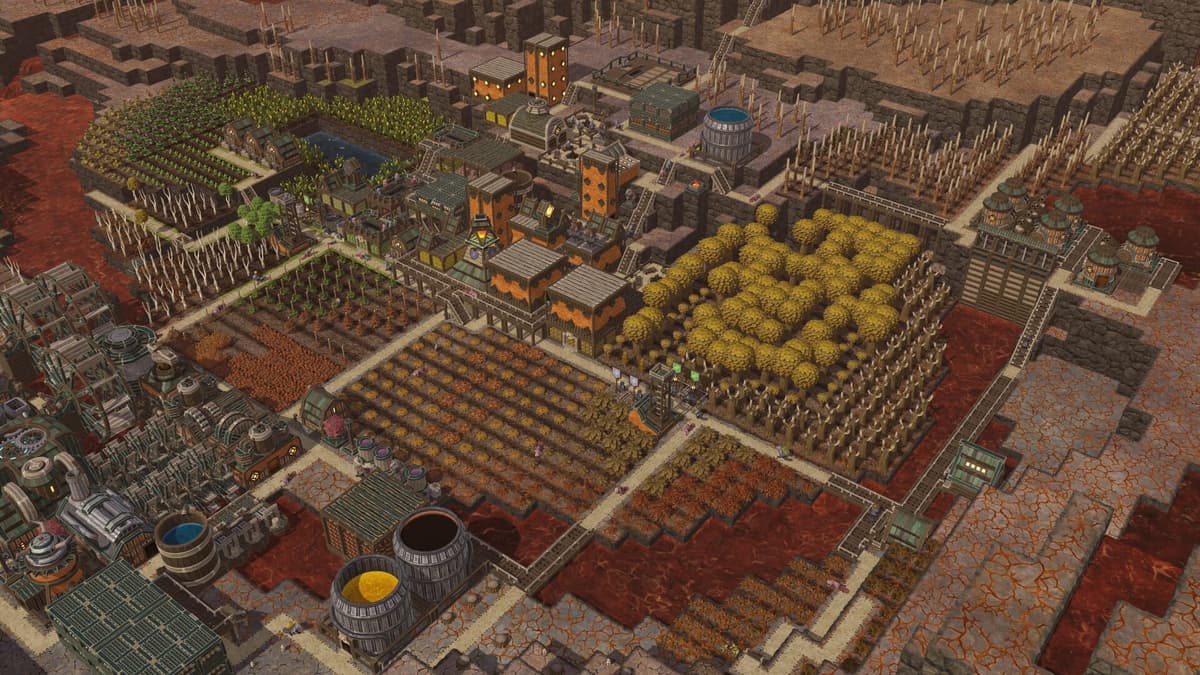
If your first Iron Teeth colony keeps stalling out, the faction is not the problem — the order you build in is. Iron Teeth are Timberborn’s industrial faction, built around metal, engines, and heavier late-game production rather than the Folktails’ greener toolkit. They shipped at the game’s Early Access launch on September 15, 2021 as the second playable faction, and back then you unlocked them by hitting a Well-Being threshold while playing Folktails. Today there is no hidden unlock at all: you simply pick your faction during setup when you start a new settlement.
The short version
- Iron Teeth grow population with Breeding Pods (which consume water and berries), not the Folktails’ natural housing-driven growth.
- They use a standard Farmhouse; the Folktails’ Farmhouse is the more efficient one, so Iron Teeth food chains ask for more labor and planning.
- They get the Efficient Mine, an Iron Teeth-only building that yields more Scrap Metal than the regular Mine.
- They can run engines that burn logs for horsepower — a strong drought-proof power backup that puts extra strain on your wood supply.
- Build in this order: water pump, water storage, food, then Breeding Pods. Pause pods whenever food is tight.
The real point is not that Iron Teeth are “the tech faction.” It is how that label changes the pace of your colony. Their early game still starts like Folktails: secure wood, berries, and water, then stabilize food and housing before pushing into faction-specific systems. The difference is that Iron Teeth run tighter on food and demand more deliberate population control, so a sloppy opener punishes you harder.
How Iron Teeth compare with Folktails
Iron Teeth are harder in the opening and stronger once your industry is online. That suits players who like colonies that start lean and grow into machine-heavy settlements. If you want a smoother first hour and an easier food economy, the Folktails are more forgiving — their more efficient Farmhouse alone makes early calories simpler. If you enjoy managing production pressure and building around industrial bottlenecks, Iron Teeth are the more interesting pick. If you are still deciding, the Folktails vs Iron Teeth comparison breaks down the tradeoffs side by side.
The biggest trap is reading “advanced tech” as “rush tech immediately.” That is wrong on almost every map. Iron Teeth need the same survival basics as everyone else, and they get punished hard if you overbuild before food and water are locked in. Their strength shows up after stability, not before it.
The best early-game plan is boring on purpose
Build in a fixed order: water pump first, then water storage, then food production, then Breeding Pods. That sequence matters because Iron Teeth become manageable the moment water is safe, but they spiral fast if you create more beavers before the farms are ready. Their early game is less about clever tricks and more about avoiding one bad expansion turn.
- Get basic water income running immediately.
- Add storage before the first dry stretch becomes a problem.
- Scale food next, not later — Iron Teeth want more breathing room than you think.
- Only then build Breeding Pods, and do not hesitate to pause them.
- Start tree production early, because engines and growth ramp your wood demand quickly.
Follow that sequence and Iron Teeth feel stable. Reverse it to chase growth first and the faction looks far weaker than it is. Most failed starts come from population pressure arriving before harvest capacity — not from any hidden flaw in the faction. For a full opening-to-endgame walkthrough, see how to play Iron Teeth from early to late game.
Food is the real Iron Teeth skill check
Food is the main early constraint for Iron Teeth, and the reason is mechanical: they use a standard Farmhouse, while the Folktails get the more efficient version. You make up the gap with labor, field coverage, and timing. A farm that looks fine for Folktails will feel underbuilt for Iron Teeth once Breeding Pods start producing new beavers.
In practice, expand farmhouses and harvest throughput earlier than your instincts suggest. Do not wait until the food graph is already dipping. Iron Teeth want extra margin because their population tools can outpace their harvest tools if left unchecked. For the opener itself, prioritize a reliable early calorie crop and a clean transition into more scalable farming once labor and water are under control — committing fields early matters more than which specific crop you lead with.
Breeding Pods are powerful — if you treat them like a valve
Breeding Pods are the mechanic that most clearly separates Iron Teeth from Folktails. Instead of growing naturally through housing, Iron Teeth produce new beavers through pods that consume water and berries, which lets you control growth directly. The mistake is leaving every pod active all the time. Good Iron Teeth play means building several pods early, then pausing and unpausing them based on food, water, and available jobs.
That control is one of the faction’s hidden strengths. If your district is food-tight, pause pods before a shortage turns into a colony-wide crisis. If you just unlocked new workplaces and have stable supplies, unpause them and let growth catch up. Iron Teeth reward players who treat population as a managed resource rather than something that should always rise at maximum speed.
Engines make the midgame safer, but wood becomes a constant concern
One of the best reasons to pick Iron Teeth is access to engines that burn logs for horsepower. They are invaluable when gravity batteries fall short, when drought disrupts your normal power rhythm, or when you need reliable output for key buildings before your wider power setup matures. Engines are not flavor — they are a practical backup that keeps an industrial district running through awkward phases of the game.
The tradeoff is easy to underestimate: engines push even more pressure onto your wood economy. That is why forestry deserves heavy emphasis. Lean on a forester-based tree production setup and get it under control early, because oak takes a long time to mature while your settlement’s appetite for logs climbs fast. If your engines feel amazing for ten minutes and then your colony starves for wood, the cause is almost always forestry treated as a later problem.
Metal is where Iron Teeth justify the harder opening
Iron Teeth earn their industrial identity partly through the Efficient Mine — a building only they can construct, which produces more Scrap Metal than the regular Mine, with a secondary recipe that uses Explosives to push yields even higher. Better scrap flow smooths the transition into the faction’s later production systems and reinforces their role as the faction that scales well once the settlement stops merely surviving and starts specializing.
If you enjoy Timberborn most when the colony starts to feel like a machine instead of a campsite, this is the payoff. Iron Teeth are not the faction that makes the first food crisis easiest. They are the faction that feels best once power, metal, and structured production chains become the center of play.
Watch for outdated Iron Teeth advice, especially around badwater
The biggest version-sensitive warning is that old Iron Teeth tutorials can mislead you on polluted maps. Update 5 (Badwater) reworked irrigation and removed the Irrigation Tower entirely (it was a Folktails-only building), so any guide that still relies on it is obsolete. The same update introduced the Badwater system — badwater pumps, decontamination pods, and centrifuges — and Badwater Discharge is a real Iron Teeth mechanic you can combine with the Large Water Wheel for power.
- Keep badwater away from crop zones first. Protecting food land stays priority one.
- Plan for extraction and processing — pumps, centrifuges, decontamination pods — not just containment.
- Account for sickness recovery buildings in your district layout.
- Do not follow a pre-Update-5 farming guide without checking whether its irrigation advice still applies.
On current polluted maps, Iron Teeth work best with a two-track plan: defend your farmland from contamination while preparing the badwater handling chain that supports recovery and advanced production. That is one more reason they feel more technical than Folktails. For the full routing approach, read how to handle badwater safely.
Common mistakes
- Rushing tech before survival. Iron Teeth still need water and food locked in first. Overbuilding early is the most common cause of collapse.
- Leaving every Breeding Pod active. Treat pods like a valve — pause them whenever food or water is tight, unpause when supplies and jobs are stable.
- Building Folktails-sized farms. The Iron Teeth Farmhouse is the standard, less efficient version. Expand fields and farmhouses earlier than feels necessary.
- Ignoring forestry once engines are online. Engines burn logs constantly. Set up a forester-based supply early or your power backup starves your wood economy.
- Trusting pre-Update-5 badwater guides. The Irrigation Tower is gone and the badwater toolkit changed. Verify any old polluted-map advice.
Practical takeaway
Pick Iron Teeth if you want a stricter opener, explicit population control through Breeding Pods, a stronger industrial identity, and real reasons to care about metal and backup power. Skip them for your first few settlements if you mostly want an easier food economy and gentler early expansion. Their weakness is not power — it is impatience. If your Iron Teeth colony keeps collapsing, the fix is simple: build water and storage first, scale food sooner, pause your pods when food is tight, and treat wood production as infrastructure rather than cleanup.
FinalBoss // Gear
Level up your setup
01Graphics cardson Amazon→02Gaming laptopson Amazon→03High-refresh gaming monitorson Amazon→04Discounted game keyson Kinguin→
Affiliate links · As an Amazon Associate, FinalBoss earns from qualifying purchases.
Want to Level Up Your Gaming?
Get access to exclusive strategies, hidden tips, and pro-level insights that we don't share publicly.
Ultimate Guide Strategy Guide + Weekly Pro Tips