
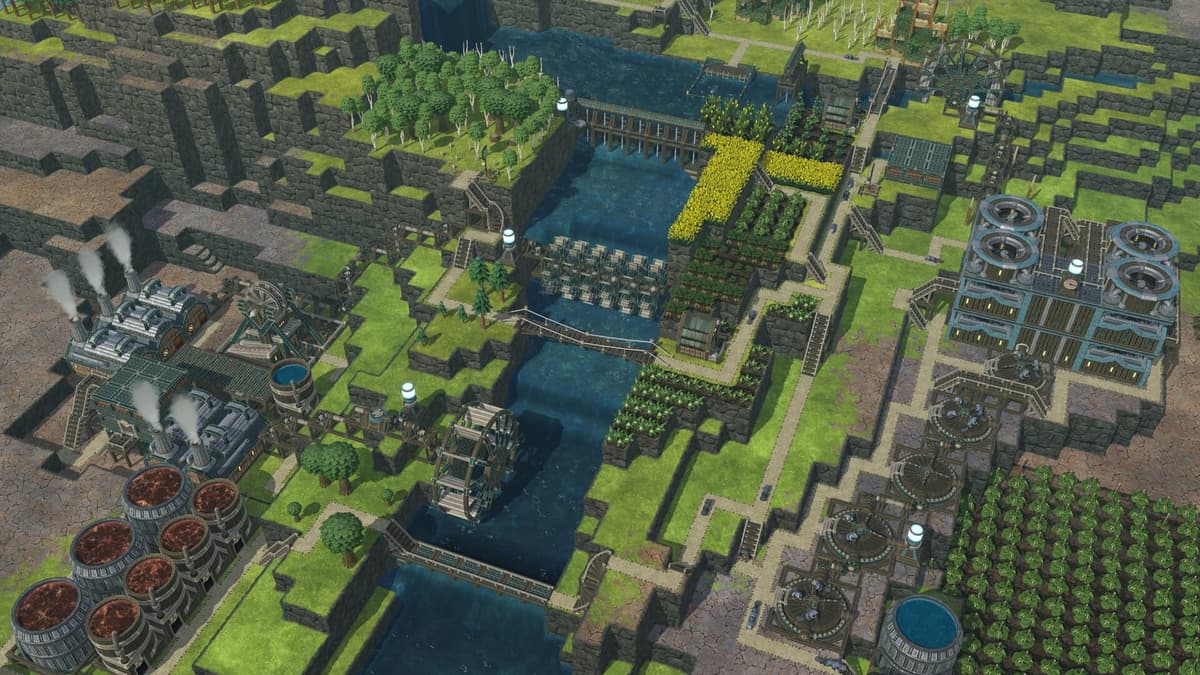
Timberborn makes you pick a faction before you place a single building, and the choice is permanent for that save. The short answer: start as Folktails for your first colony, then move to Iron Teeth once drought prep, water storage, and production chains feel routine. Folktails grow on autopilot through housing; Iron Teeth grow through a building you have to feed. That single difference shapes everything else.
Table of Contents (9)
The short version
- Pick Folktails first. Population grows naturally through Lodge housing, with no resource-cost breeding building to manage.
- Iron Teeth are unlock-gated. You unlock them by reaching an average Well-Being score of 15 while playing Folktails. They are not selectable from a brand-new install until you hit that milestone.
- Iron Teeth grow via the Breeding Pod, which consumes 5 Water and 5 Berries over about 5 days to produce one kit, independent of housing.
- Iron Teeth scale harder industrially thanks to exclusive buildings: the Engine (constant power from logs), the Large Water Wheel, the Industrial Lumber Mill, the Efficient Mine, dense Barrack housing, and Tubeways plus Ironbots for automation.
- Rule of thumb: Folktails to learn, Iron Teeth to optimize.
What faction choice actually changes
Your faction is not cosmetic. You select it on the new-game screen, and it changes how your beavers reproduce, which power and production buildings you can build, and what kind of city layout pays off later. Both factions play the same core game of water control, food production, drought survival, and vertical building, but they solve those problems with different tools.
- Folktails – nature-oriented, beginner-friendly, growth driven by housing.
- Iron Teeth – industrial, automation-friendly, growth driven by the Breeding Pod, with a steeper early curve.
The gap is small in your first few days, when both factions just need logs, planks, food, water, and shelter. It widens once population growth, power generation, and storage start pushing your colony in a direction.
Are Iron Teeth locked or available from the start?
Iron Teeth are unlock-gated. You unlock them by reaching an average Well-Being score of 15 while playing as Folktails. Until you clear that milestone, Folktails are your starting faction. Older guides muddy this with talk of a “Happiness level of 15” or a “well-being score of 8” – both are wrong. The mechanic is well-being, and the number is 15.
So the practical path is built into the game: play Folktails, push well-being into solid territory, and Iron Teeth open up. That is also the order most new players should follow anyway, because Folktails teach the survival loop with less punishment. For a deeper breakdown of how the tech faction plays once it is unlocked, see our Iron Teeth guide.
The biggest difference: population growth
If you compare one system before choosing, compare population growth. It changes almost everything downstream.
Folktails reproduce naturally through Lodge housing. Couples raise kits whenever there is spare housing capacity, with no resource cost beyond keeping food and water flowing. Build more lodges, keep the supply chain healthy, and the colony expands at a pace that tracks your visible infrastructure. There is no breeding building to budget for. (Worth clearing up a common mix-up: campfires are well-being buildings, not housing – lodges are what grow your population.)
Iron Teeth grow through the Breeding Pod. Each pod consumes 5 Water and 5 Berries over roughly 5 days to produce a single kit, and it works independently of housing. That decouples growth from spare beds: you can push population deliberately by running more pods, or pause them to hold steady. The cost is that breeding becomes another production chain. If the pods outrun your water and berry supply, you crash the economy faster than Folktails ever could.
- Choose Folktails if you want expansion to track with housing capacity and zero breeding upkeep.
- Choose Iron Teeth if you want on-demand growth and can guarantee the water and berry supply the pods need.
Why Folktails are the better first faction
Folktails are easier to learn because their economy is more forgiving. Growth follows housing, so there is no breeding chain to starve. That matters on your first serious map, because Timberborn’s real difficulty is rarely one dramatic disaster. It is a chain reaction: you add beavers, water use spikes, a drought hits, a field dries out, hauling backs up, and a colony that looked healthy collapses from one weak link. Folktails give you more room to spot those links before they break, which is exactly why they pair well with learning how to survive your first drought.
Folktails also suit wider, more organic town planning. Their pacing supports a settlement that expands as resources arrive instead of forcing early investment into breeding infrastructure. If you are still learning where to place pumps, how much storage a district needs, or how early to overbuild water reserves, Folktails teach those lessons without much punishment. They are the faction for stability – not weak, just trading some late-game industrial intensity for a smoother early and midgame.
Why Iron Teeth win industrial runs
Iron Teeth are the stronger pick once your idea of a good save is a compact, high-output machine. Their edge is concrete, not vibes – it comes from exclusive buildings Folktails simply cannot build:
- The Engine – burns logs to generate constant horsepower, so your power output does not swing with wind or water flow.
- The Large Water Wheel – higher output per build than the standard wheel for water-driven power.
- The Industrial Lumber Mill – faster plank throughput than the basic mill, feeding bigger build queues.
- The Efficient Mine – the Iron Teeth mining variant (the plain Mine is the Folktails version).
- Barrack housing – denser than lodges, packing more beavers into less footprint.
- Tubeways and Ironbots – transport and automation tools for moving goods and labor across a tight, centralized layout.
Add Breeding Pod control on top, and Iron Teeth can scale on command rather than waiting for housing-driven growth. The combination rewards block-style planning: production next to storage, storage next to distribution, everything arranged to cut wasted hauling. For the power side of the comparison – and why Folktails lean on windmills while Iron Teeth lean on the Engine and water wheels – see our Folktails windmill power guide.
How faction choice changes map planning
With Folktails, planning is simpler: secure water, add fields, add lodges, then widen as hauling and storage improve. Growth follows housing, so you can read your expansion in a natural order. That forgiveness helps on unfamiliar maps where you are still learning where to dam, where to terrace farms, and how hard the opening droughts hit.
With Iron Teeth, the map question gets technical. Because the Breeding Pod consumes water and berries and the faction leans on dense industry, you care whether the opening area can support concentrated production without long hauling routes. Water access still matters, but so do compact farm footprints, tight storage clusters, and centralizing work without pathing waste. A broad valley with easy early farmland flatters Folktails; a layout that rewards dense vertical building and short industrial loops often feels better with Iron Teeth once you are established.
Common faction-choice mistakes
- Trying to start as Iron Teeth. You can’t until you hit an average Well-Being of 15 as Folktails. Plan to learn the game on Folktails first.
- Treating Breeding Pods as free population. Each kit costs 5 Water and 5 Berries over ~5 days. Pump those pods without securing the supply and the colony starves.
- Judging Iron Teeth too early. Their exclusive buildings – Engine, Industrial Lumber Mill, Efficient Mine – pay off at scale, not in the first few days.
- Assuming Folktails are only for beginners. They are easier to learn but still a strong faction when you value consistency over maximum output.
- Copying layouts between factions. Folktails tolerate a spread-out town; Iron Teeth reward tight storage, short hauling, and centralized production around Tubeways.
Practical takeaway
Start with Folktails. Their housing-driven growth and zero-upkeep population let you learn water control, food planning, and drought prep without a breeding chain fighting you. Once an average Well-Being of 15 unlocks Iron Teeth – and once those systems feel routine – roll a second colony with the tech faction. The Breeding Pod, the Engine, the Industrial Lumber Mill, and Tubeways turn into real advantages exactly when you are ready to optimize instead of merely survive.
FinalBoss // Gear
Level up your setup
01Graphics cardson Amazon→02Gaming laptopson Amazon→03High-refresh gaming monitorson Amazon→04Discounted game keyson Kinguin→
Affiliate links · As an Amazon Associate, FinalBoss earns from qualifying purchases.
Want to Level Up Your Gaming?
Get access to exclusive strategies, hidden tips, and pro-level insights that we don't share publicly.
Ultimate Guide Strategy Guide + Weekly Pro Tips