
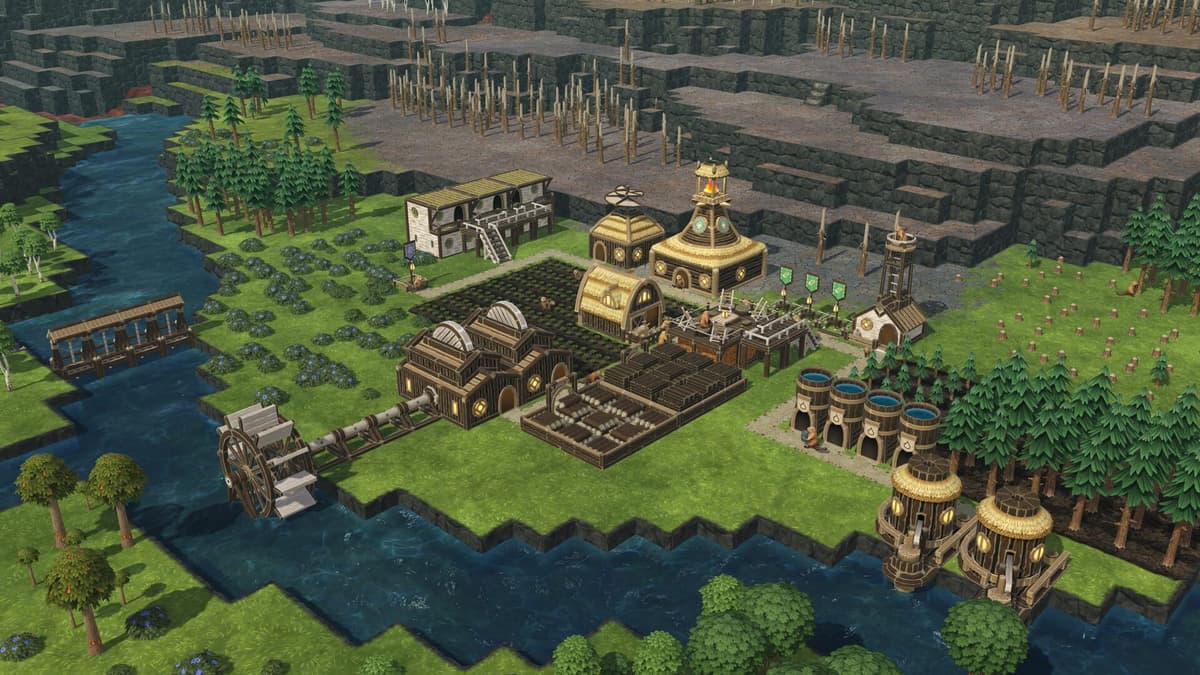
The Windmill looks like a clean, set-and-forget power source, and that is exactly why new Timberborn colonies stall on it. It is a useful Folktails generator, but it is not a reliable backbone on its own: its output rides on wind strength, it can drop to zero, and flooding switches it off entirely. Treat it as a buffered piece of a larger grid instead of the whole grid and it pulls its weight well.
Table of Contents (9)
The short version
- Faction: the Windmill is Folktails-only. The Iron Teeth do not get it.
- Output: 0 to 200 hp, scaling with current wind strength.
- Cutoff: it produces no power below 30% wind. Below that line it contributes nothing.
- Placement: position and altitude do not change output. Hilltops give you no horsepower bonus.
- Hard rule: flooding disables it. Keep every windmill on permanently dry ground.
- Best use: one shared power grid plus batteries so strong gusts charge storage and lulls drain it.
What the Windmill is
Start with faction access. The Windmill is a Folktails-only power building, so it is part of the Folktails power lineup, not a universal option. If you play Iron Teeth and go looking for it, it is not missing by mistake; it simply is not theirs. That shapes how each faction scales power, which is worth weighing when you pick between Folktails and Iron Teeth.
In gameplay terms, the Windmill converts wind into mechanical power for your network. The important catch is that it does not behave like a water wheel, where placement and water conditions are the whole puzzle. Windmills are driven purely by the current wind level, and map placement does not change their output. That runs against the instinct most strategy games train, where ridgelines and exposed plateaus reward you. In Timberborn, altitude does nothing for wind power.
How Windmill output works
The Windmill produces 0 to 200 hp, and it produces no power at all below 30% wind. Those two numbers explain almost every success and failure. Wind power is not mildly inconsistent; it is fundamentally variable. Drop under the 30% threshold and the building gives you nothing. When the wind is strong, it can be excellent. When the wind is weak right as your workshops spin up, the production chain stalls unless you planned for the gap.
So evaluate a Windmill by its downtime, not its peak. A 200 hp ceiling sounds strong until your sawmills, gristmills, and pumps all need steady throughput and the wind slumps. Plan around the possibility of zero, then take the high-output windows as bonus power rather than building the colony as if every gust arrives on schedule.
Where to place Windmills
Because location does not affect output, placement is about safety, footprint, and grid logistics, not chasing a better wind score. The “put turbines on the highest hill” instinct is cosmetic here. Build on high ground only when it keeps the structure safe and the land tidy, not for extra horsepower.
The placement rule that actually matters: flooding disables windmills. Low ground near rivers, channels, reservoirs, or any area that routinely gets wet is a bad long-term home for wind infrastructure. Even a tile that is dry most of the time turns your “backup” into dead weight the moment it floods. Players lose trust in wind when they stack risks together: variable wind on flood-exposed ground with no stored power.
A solid Windmill site has three traits:
- It stays dry in normal flow and in bad flood management alike.
- It connects easily into the main power network with shafts.
- It does not eat premium space needed for farms, housing, or critical waterworks.
A hilltop that gives you those three is a good spot. A flat terrace beside your industrial core that gives you those three is equally good. The best location is the one that reduces flood risk and wiring headaches, not the one most exposed to the breeze.
The best way to use Windmills: one grid, plus batteries
Connect all power buildings into one system and use batteries to absorb the Windmill’s swing. Gravity batteries store power between production spikes and wind lulls: strong wind charges storage instead of wasting surplus, and when the wind dies the batteries keep industry moving. This matters more with wind than with almost any other source, because the strong windows can be brief.
A disconnected wind farm serving one corner of the map wastes good gusts and then fails locally when the breeze drops. A unified grid lets surplus flow where it is needed and lets stored energy cover the weak moments. Even on a spread-out colony, it is usually worth running extra shafts to pool generation and demand together. For the Folktails-specific approach to scaling this, see our guide on using windmills efficiently.
If the colony has repeated brownouts, the fix is rarely “more windmills everywhere.” It is usually some mix of:
- Add more storage so high-wind periods actually help later.
- Reduce dependence on wind-only power for always-on industry.
- Blend Windmills with steadier sources instead of isolating them.
What role Windmills should play
The right role is supplemental generation. The Windmill helps during productive weather, feeds batteries, and eases pressure on labor or water-based systems. What it should not be, especially in a growing industrial district, is your only serious source of power. If every core building depends on wind arriving on time, one bad lull cascades into delayed planks, delayed gears, slower construction, and slower recovery.
That is why strong setups pair Windmills with water wheels, shafts, and storage. Water gives steadier base generation on suitable maps, wind adds free surplus during stronger periods, and batteries sit between both to smooth demand. There is a bonus: because location does not change output, Windmills are easy to slot into awkward, low-priority dry spaces a terrain-sensitive building would reject. They make excellent fillers once your main colony shape is set, especially on safe land that is too remote or oddly shaped for dense housing or farming but still easy to reach with a shaft.
Small vs. large Windmills
Folktails get more than one wind option, and the larger windmill is generally worth upgrading toward as you scale. The reason is the same one driving everything above: bigger wind infrastructure asks for less babysitting and fits better into a battery-backed grid. Once the larger version is available, many late-game layouts lean on it and stop investing in the small one.
What is not worth copying is a raw forum count like “you need X dozen windmills” for a mature settlement. Those numbers swing wildly across maps, populations, district layouts, and industrial goals. If a colony is underpowered, diagnose it by when the outages hit and what stalls first. Crashes during low wind mean you need storage or mixed generation. Crashes all day mean you need total capacity.
Common mistakes
- Building in flood-prone low ground. A flooded Windmill is not “variable” — it is off.
- Expecting hilltops to boost output. Placement does not change power generation, so never sacrifice layout efficiency for a wind bonus that does not exist.
- Running a wind-only core industry. Wind is best buffered or mixed, never carrying every essential workshop alone.
- Ignoring batteries. Without storage you waste strong-wind windows and feel every lull immediately.
- Splitting the power grid too aggressively. Separate micro-grids make wind harsher, because surplus in one area cannot cover a shortage in another.
Practical takeaway
The Windmill is a good building wrapped in a bad fantasy. Expect a set-and-forget renewable backbone and it disappoints. Use it as a Folktails-exclusive supplemental generator — 0 to 200 hp, dead below 30% wind, indifferent to altitude, and switched off by flooding — and it earns its place. Build it on dry ground, wire it into one shared grid, and let gravity batteries turn irregular gusts into steady colony power. The best Windmill play is not hunting the windiest hill. It is building a resilient system around an intentionally inconsistent machine.
FinalBoss // Gear
Level up your setup
01Graphics cardson Amazon→02Gaming laptopson Amazon→03High-refresh gaming monitorson Amazon→04Discounted game keyson Kinguin→
Affiliate links · As an Amazon Associate, FinalBoss earns from qualifying purchases.
Want to Level Up Your Gaming?
Get access to exclusive strategies, hidden tips, and pro-level insights that we don't share publicly.
Ultimate Guide Strategy Guide + Weekly Pro Tips