
If your Dual Swords keep running dry on Ki after one short string, you are building Flowing Flame wrong. It is not a single-hit fire nuke. In Nioh 3, this beginner Dual Swords build wins by stacking fast hits, applying Scorch quickly, draining enemy Ki, and cashing out on punish windows with Water Sword and Sign of the Cross.
Table of Contents (16)
The short version
- Weapon: any strong Dual Swords. Prioritize reduced Ki consumption and Life Drain over raw sheet damage early.
- Armor: the Goichimonshu set, for Life, Life Drain on Martial Arts, and Martial Arts Ki-consumption reduction.
- Status: Scorch (fire) is your main plan; Saturated (water) is the strongest secondary pairing.
- Skills: Water Sword, Sign of the Cross, Spinning Dragon, plus Random Slice or God of Wind.
- Support magic: Power Talisman, Steel Talisman, an elemental Familiar Talisman, and Weakness Talisman.
- Passives: Oppressive Strength, Unshakable, Weight Bearer for sustain and stability.
What Flowing Flame actually is
The easiest mistake is assuming “Flame” means every part of the build should chase raw fire damage. It does not. Fire is the status layer, not the engine. The engine is Dual Swords pressure: fast attacks, repeated Martial Arts, consistent Ki damage, and enough sustain to stay in the enemy’s face longer than a heavier weapon can.
That is why it works as a starter. You do not need one irreplaceable named sword. Any decent Dual Swords carries the build early if the affixes are useful. The best lines keep you attacking longer: reduced Ki consumption, Martial Arts efficiency, and Life Drain that rewards aggression. If you want the wider context on which starter kits open up fastest, our Nioh 3 early-power guide covers the best start skills, magic, and gear.
Weapon and armor priorities
Use any strong Dual Swords first, then optimize for pressure
Start with Dual Swords that let you keep attacking without going dry on Ki after one short string. When you choose between slightly higher sheet damage and better Ki economy, take the Ki economy. Dual Swords scale harder from uptime than from one bigger number on the equipment screen.
- Prioritize reduced Ki consumption wherever it appears.
- Take Life Drain or sustain effects when they land on a good pair.
- Value Martial Arts bonuses, because that is where the build snowballs.
- Do not wait for a perfect weapon before committing to the playstyle.
The Goichimonshu set is the armor backbone
The armor that anchors this build is the Goichimonshu set (you may see it rendered Gochi Monshu in some menus — it is the same set). It supports exactly what Dual Swords want early: Life, Life Drain on Martial Arts, Martial Arts Ki Consumption reduction, and a mix of offensive and defensive bonuses.
That choice tells you the build’s identity. Even on the aggressive Flowing Flame route you are not abandoning survivability — you are making aggression sustainable. If your gear recovers health while spending less Ki on your best skills, you can hold the pressure that makes Dual Swords dangerous. For a heavier sword build that trades this speed for stagger and lightning scaling, compare the Righteous Lightning Samurai sword build.
How fire scaling works on this build
Fire scaling here is about how quickly Dual Swords apply elemental buildup, not one massive multiplier. Because the weapon hits so often, it inflicts Scorch faster than slower weapons. That makes fire the natural identity for a beginner build, where easy status application beats elaborate combo routing.
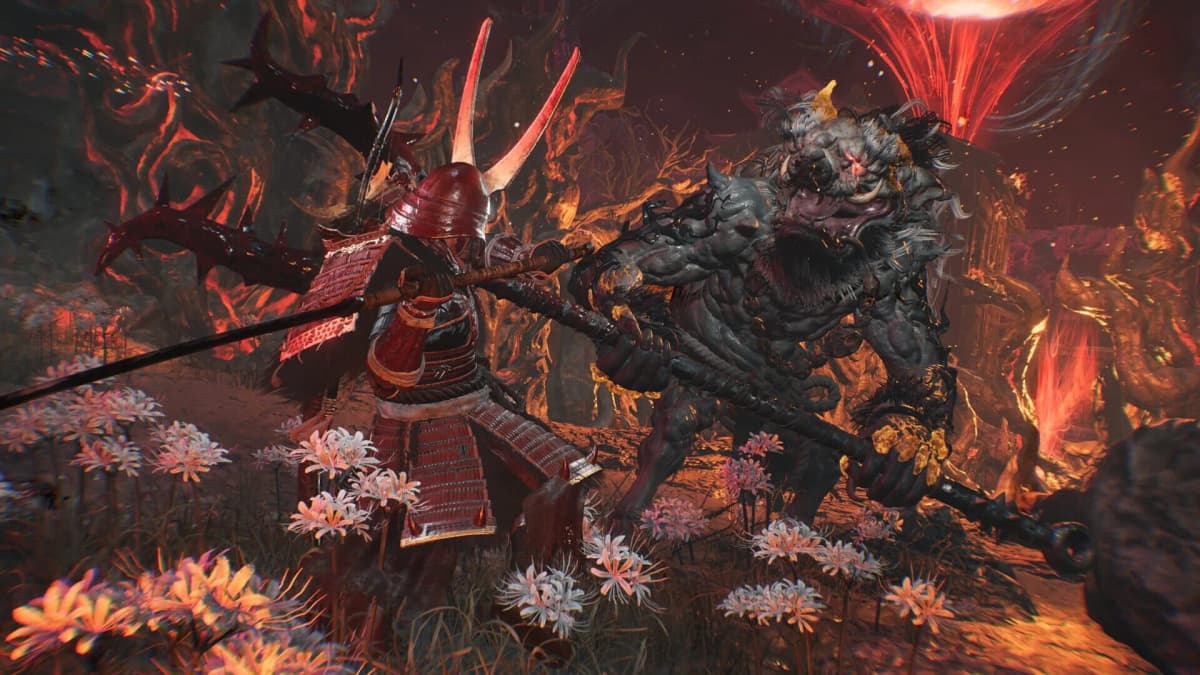
Fire is not mandatory, though, and that flexibility matters. If a boss is awkward for fire or your gear favors another element, the shell still works because the real scaling is tied to rapid-hit status application and Ki pressure. That is why water is the strongest secondary pairing: Water Sword is already one of the best Dual Swords punish tools, and water support inflicts Saturated for extra damage on tougher targets.
The rule is simple: keep Scorch as your main status plan for general play, but do not refuse a strong water-assisted hybrid when your support options lean that way.
Best skills to build around
The Dual Swords toolkit is consistent. Each of these skills solves a different combat problem.
- Water Sword – your best answer to long punish windows, especially after an enemy is locked down or out of Ki.
- Sign of the Cross – excellent for shorter punish windows where Water Sword would overcommit.
- Spinning Dragon – a pressure tool that keeps your offense flowing.
- Random Slice or God of Wind – movement and pressure tools that keep you glued to targets.
Round it out with passive support skills. Oppressive Strength, Unshakable, and Weight Bearer do not change your combo structure — they make the build more forgiving by improving offense, stability, and load handling.

The core rotation for Flowing Flame
This build feels best when you stop thinking in terms of “full combo” and start thinking in pressure phases. Your job is to force the enemy into repeated bad states: burning, low on Ki, stuck blocking, or recovering from stagger.
1. Start buffed, but keep the setup short
If you run support magic, open with a Power Talisman and Steel Talisman, add an elemental Familiar Talisman to match your status plan, and use a Weakness Talisman on tougher targets. Do not overbuild the setup — enter the fight ready to apply Scorch fast and survive your first aggressive sequence.
2. Open with fast contact, not a greedy finisher
Use Spinning Dragon or another fast-engage option to establish contact and begin Scorch buildup. Early in the exchange your goal is not maximum damage — it is making the enemy respect your hit rate and start losing Ki.
3. Chain Martial Arts while your Ki is healthy
This is the heart of the build. Keep the enemy pinned with short, repeatable pressure. Dual Swords get scary when you use Martial Arts often enough that the target never fully resets. That is why Ki-consumption reduction is so valuable, and why the Goichimonshu set bonuses fit so well.
4. Use Sign of the Cross for brief windows
When a boss gives you a short punish — after a whiff, a burst of movement, or the end of a tight recovery — Sign of the Cross is the safer cash-out. It hits hard without locking you in as long as Water Sword.

5. Save Water Sword for true punish states
Water Sword is where players throw runs away. It is excellent when the enemy is trapped, cornered, winded, or stuck in a long recovery. It is terrible into mobility, armor, or a half-read opening. Treat it as a confirmed punish tool, not a neutral opener.
6. Reset before empty Ki forces the reset for you
The cleanest play is aggressive, not reckless. If your Ki bar is getting thin, back off, pulse cleanly, re-center, and go again. The build falls apart when you confuse “constant pressure” with “never disengage.”
Common mistakes that make the build feel weak
- Building for raw damage only. Ignore Ki economy and your pressure strings end before the build starts working.
- Overcommitting to Water Sword. It is a finisher, not your default button.
- Forcing pure fire in every matchup. Scorch is the signature, but water support and Saturated are there for a reason.
- Skipping survivability. A little Life, Life Drain, or defense goes a long way at close range.
- Wearing heavier gear without supporting it. If your loadout crushes mobility, add Weight Bearer instead of pretending it does not matter.
Practical takeaway
Use any strong Dual Swords, prioritize reduced Ki consumption and sustain, and anchor the build on the Goichimonshu set. Keep Scorch as your main status, pair water for Saturated on hard fights, and run the rotation around fast pressure into Sign of the Cross or Water Sword punishes. If you want to weigh this against the other two starter weapons, our best beginner builds for Talons, Dual Swords, and Split-Glaive lays them side by side.
FinalBoss // Gear
Level up your setup
01Top-rated gaming headsetson Amazon→02High-refresh gaming monitorson Amazon→03Gaming chairson Amazon→04Discounted game keyson Kinguin→
Affiliate links · As an Amazon Associate, FinalBoss earns from qualifying purchases.
Want to Level Up Your Gaming?
Get access to exclusive strategies, hidden tips, and pro-level insights that we don't share publicly.
Ultimate Guide Strategy Guide + Weekly Pro Tips