
The best Timberborn house layout is a compact district core: keep homes tight against the District Center, place storage between housing and work, hang leisure off a short side loop, and only spread outward once platforms, stairs, and transit make expansion worth it. Use that rule from the first district and your beavers waste less time walking, hauling stays smooth, and later upgrades slot in without bulldozing half the colony.
Table of Contents (11)
The short version
- Anchor on the District Center. Housing belongs in the center mass, never the scenic edge.
- Storage goes in the middle. Put it between homes and workplaces so it acts as a buffer, not a remote warehouse.
- Go vertical once you have platforms and stairs. Stack housing with a path on every occupied level.
- Match the plan to your faction. Folktails build the Lodge line; Iron Teeth build Barracks and stack denser.
- Split, do not sprawl. Big colonies want satellite districts linked by Ziplines or Tubeways, not one endless neighborhood.
What house layout actually decides
House layout in Timberborn is not decoration. It is the part of your district plan that sets how much dead travel your beavers do every day between sleeping, eating, hauling, leisure, and work. Short loops beat sprawling neighborhoods every time, because a beaver pathing across the district is a beaver not working.
You meet housing almost immediately, since shelter is part of the first district’s core needs. The real early question is not “where do I fit a few houses” but “what should housing anchor?” The answer: the same functional cluster as storage and daily services, never a corner far from everything.
The job of house layout shifts as the colony grows:
- Early game: keep the starter district efficient and stable.
- Midgame: save land by moving housing upward instead of outward.
- Large colonies: split population between a dense residential core and smaller satellite work hubs. (See our districts and expansion guide for the mechanics of splitting.)
The strongest starter layout: a compact core
The cleanest starter pattern is a tight, near-square district with the District Center in the middle, housing on one side, workplaces on the opposite side, storage between the two, and leisure tucked off to a side branch. Do not chase a fixed tile count. Timberborn district size is bounded by the District Center’s range and path distance, not a set grid, so the footprint flexes around terrain. What matters is the loop, not the dimensions.
- District Center near the middle
- Housing clustered close to it
- Storage sitting between housing and production
- Workplaces on the outer side of the storage line
- Leisure attached nearby, but never blocking the main route
This works because beavers gain nothing from a pretty commute. Homes beside storage, storage beside work — that is the whole trick. Small mistakes snowball: a storage yard at the wrong edge forces repeated long hauls, and a house row placed too far from the core turns every daily cycle into extra walking.
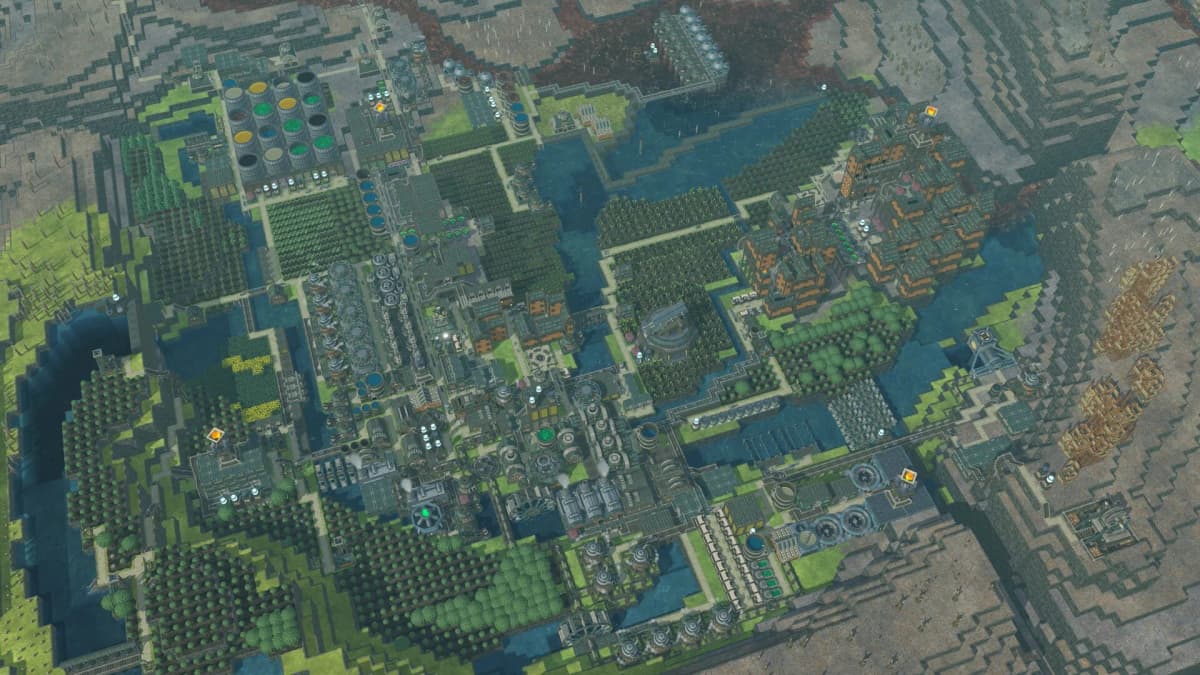
How to place the starter block
- Place the District Center first and treat it as the anchor.
- Reserve one side of that center for homes.
- Leave a band of space between homes and work for storage.
- Put the first leisure buildings on a side branch — close enough to reach quickly, but out of the hauling traffic.
- Keep pathing direct. Avoid zigzags, decorative dead ends, and single-tile choke points through the heart of the district.
If terrain forces you to bend the shape, preserve the distances rather than the perfect square. An awkward footprint with short routes beats a beautiful layout that sends haulers on long loops.
Why storage placement makes or breaks housing
Storage should sit near both homes and production. That is why efficient plans wedge it between the residential block and the work block, where it acts as a buffer zone in the middle of the district instead of a remote warehouse. Once vertical construction is available, building storage directly under or beside houses works even better in tight districts — it keeps the residential footprint useful instead of a dead zone on the map.
If your district feels sluggish even though nothing is technically broken, check housing-to-storage distance first. A colony can look compact and still underperform if the paths force constant backtracking between homes, goods, and job sites.
When to switch from flat to vertical housing
Once you have platforms and stairs, a flat row of houses stops being the best use of land. This is where midgame layout turns from neighborhood planning into vertical planning — stacking housing grows population without the footprint a ground-level sprawl would demand.
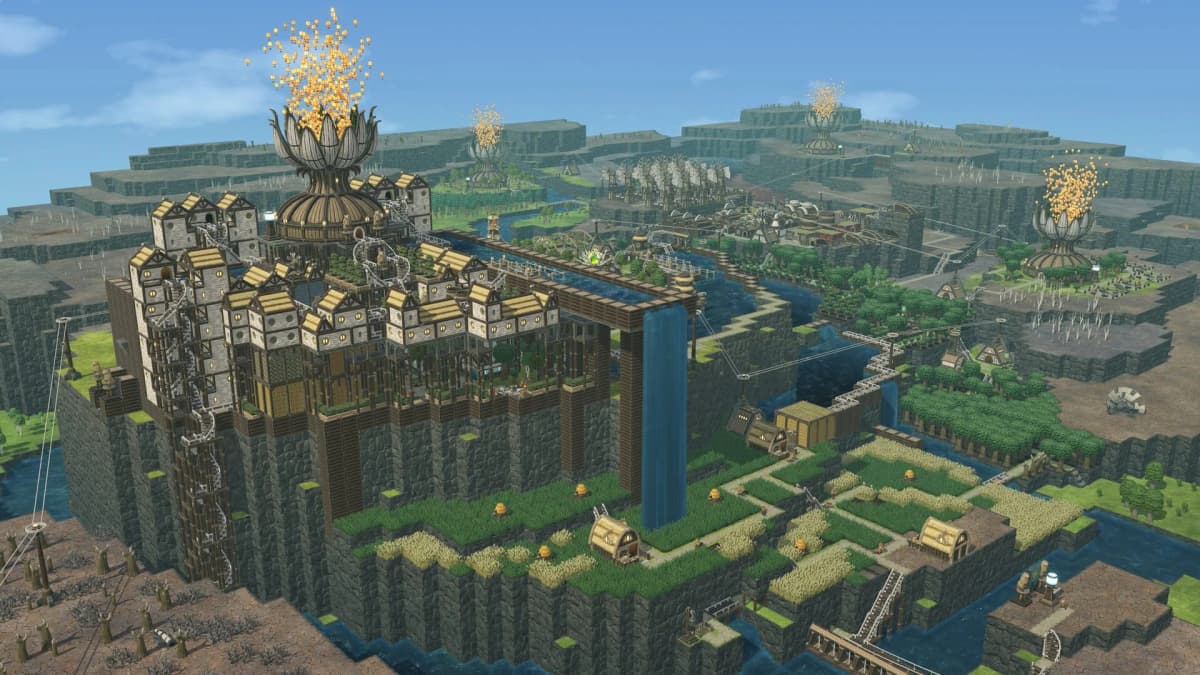
The rule that matters most: every platform level needs proper path access. A stacked block only works if beavers can move across the upper levels as functional paths, not just reach one staircase and get stranded in a tower. Good apartment-style layouts run paths on every occupied platform level, not only the ground.
- Ground level reserved for core paths, storage, or mixed-use support buildings
- Stairs placed where they do not interrupt the main hauling lanes
- Platforms extending full access across each residential level
- Housing stacked in a repeatable module so later expansion does not force a redesign
The common failure is building a clever-looking tower first and solving access afterward. In Timberborn, access is the design. If the upper floors do not connect naturally into your district paths, the stack is inefficient no matter how compact it looks from above.
Folktails and Iron Teeth need different housing plans
The broad principles hold for both factions, but the buildings differ, and that changes how the housing block performs.
Folktails build the Lodge line — Lodge, plus the Mini, Double, and Triple Lodge variants. Their districts read like a residential neighborhood around a central hub. Note that campfires are not housing; they are well-being and social buildings, so place them near the Lodges as services rather than treating them as part of the housing count. Folktails plans leave a little room for quality-of-life placement around the compact core.
Iron Teeth build the Barrack and Large Barrack (plus Rowhouse and Large Rowhouse) and lean industrial and vertical: tight stacking, heavy platform use, and housing welded directly into the production block rather than wrapped in a village shell. The result is denser and more infrastructure-heavy. For a deeper look at the tech faction’s buildings, see our Iron Teeth faction guide.
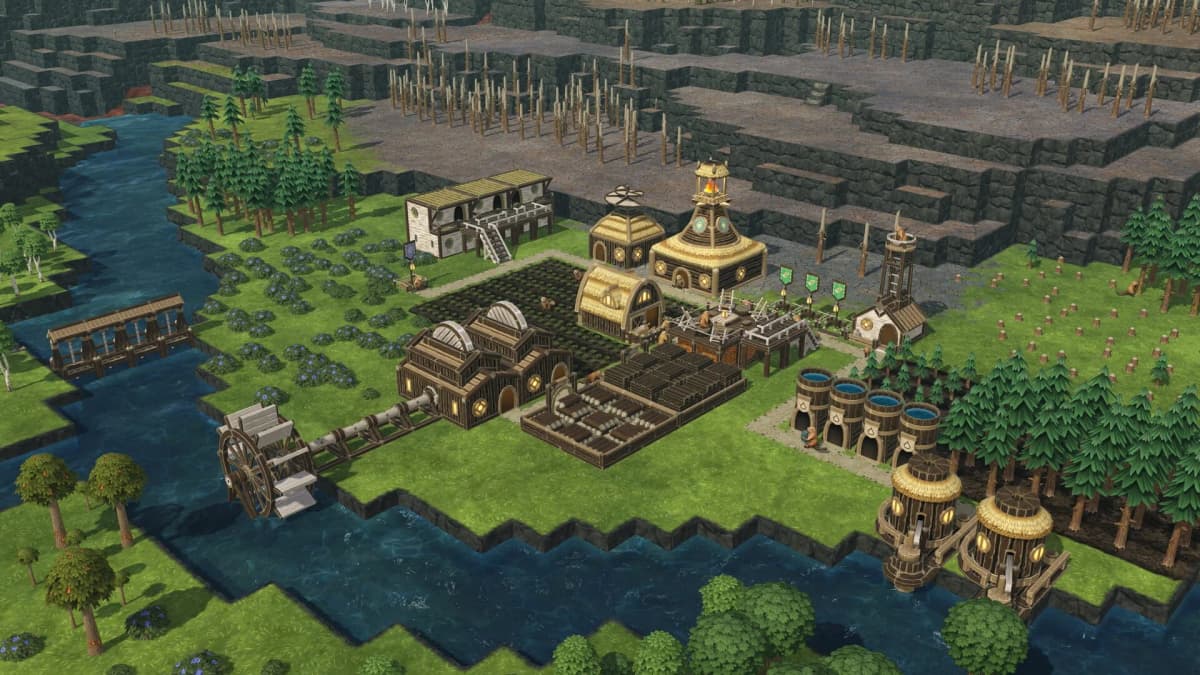
If you swap factions and keep the same blueprint, the layout feels wrong even when it technically works. Folktails reward a compact-but-livable district center; Iron Teeth reward a stripped-down, layered approach where the housing mass integrates straight into the industrial block.
Compact grid or aesthetic neighborhood? Match it to the stage
A strict compact grid with direct routes and tightly grouped functions is one valid approach; a square-around-the-center neighborhood with decorative outer layers is another, especially for Folktails. Neither is wrong — the deciding factor is colony stage:
- Early game: compact efficiency first. You need short travel, simple hauling, and room for correction.
- Midgame: start leaving deliberate gaps and terraces if you know vertical expansion is coming.
- Late game: aesthetic shaping is fine, but only after routes, access, and storage flow are solved.
This is why good layouts intentionally leave awkward-looking gaps. Those gaps are not wasted if they are reserved for future stairs, extra platform levels, or upgraded housing blocks. A district that looks slightly unfinished is often better planned than a perfect early square with no room to grow.
Common house layout mistakes
- Putting housing on the edge of the district. It looks tidy but stretches daily travel for no gain.
- Exiling storage to its own remote zone. This piles extra hauling distance between home, goods, and jobs.
- Going vertical without pathing each level. Stacked housing fails the moment access gets clumsy.
- Counting campfires as Folktails housing. They are well-being buildings — your housing is the Lodge line.
- Overcommitting to a decorative plan too early. While you are still solving food, hauling, and drought prep, keep the layout flexible.
- Forcing every resident into one giant neighborhood forever. Large colonies run better on specialized satellite districts.
How housing changes once the colony gets large
At high population, the answer is not “build one bigger housing block.” Split into specialized satellite districts linked by better transit. Update 7, titled “Ziplines & Tubeways,” added exactly these systems — modular Ziplines and Tubeways that move beavers across the map. Keep the main district carrying the fullest residential core, and give each satellite only the housing and services its local jobs need. (Our Ziplines transit guide covers placement and routing.)
That keeps each district readable. Instead of one residential sprawl beside every production chain, the main housing center stays dense and efficient while remote work areas get a minimal support package. This is especially useful on maps where terrain breaks the colony into plateaus, riverbanks, or separate production terraces.
Practical takeaway
Do not chase a single perfect house template. The rules are more dependable than any one screenshot: anchor housing on the District Center, keep storage between homes and work, stack vertically once platforms and stairs arrive, build the Lodge line for Folktails and Barracks for Iron Teeth, and split into satellite districts with Ziplines or Tubeways before your one neighborhood becomes the bottleneck. Short routes win.
FinalBoss // Gear
Level up your setup
01Graphics cardson Amazon→02Gaming laptopson Amazon→03High-refresh gaming monitorson Amazon→04Discounted game keyson Kinguin→
Affiliate links · As an Amazon Associate, FinalBoss earns from qualifying purchases.
Want to Level Up Your Gaming?
Get access to exclusive strategies, hidden tips, and pro-level insights that we don't share publicly.
Ultimate Guide Strategy Guide + Weekly Pro Tips