
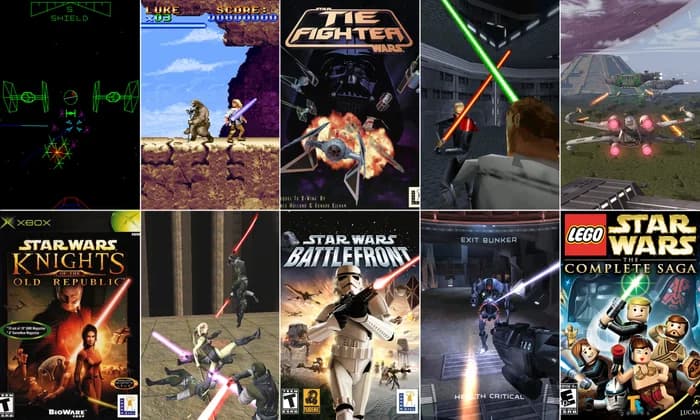
Old Star Wars games should be dead by now.
Not culturally dead. Obviously not. Star Wars has the survival instincts of a cockroach in Jedi robes. I mean technically dead. Buried under dead operating systems, broken installers, vanished CD-ROM drives, obsolete multiplayer services, abandoned patches, and enough controller weirdness to make a modern player question every life choice that led them to Windows compatibility mode.
And yet, here we are.
People are still flying X-wings in 90s space sims. Still swinging lightsabers in Jedi Academy. Still modding Empire at War like the Clone Wars never ended. Still arguing about Knights of the Old Republic with the seriousness usually reserved for constitutional law. Still logging into SWTOR, a 2011 MMO that has somehow outlived several “future of gaming” trends that were supposed to replace it.
That’s the strange thing about Star Wars games. They don’t survive because the industry protects them particularly well. They survive because players, modders, storefronts, port studios, preservation nerds, and occasionally the rights holders themselves keep dragging them across the finish line.
Sometimes lovingly.
Sometimes with duct tape.
Often both.
Table of Contents (8)
Star Wars games have always been weirdly tied to technology
The history of Star Wars gaming is basically a history of hardware headaches.
The arcade cabinets were spectacle machines. X-Wing and TIE Fighter were PC flight sim beasts from an era where owning a joystick made you feel like you had joined a slightly suspicious society. Dark Forces arrived when shooters were still figuring out how to be more than Doom clones. Jedi Knight pushed lightsaber combat into first-person and third-person chaos long before “cinematic action combat” became a phrase people said in meetings.
Then came KOTOR, Battlefront, Republic Commando, Empire at War, The Force Unleashed, SWTOR, Battlefront II, Jedi: Fallen Order, Jedi: Survivor, and everything in between. If you want the full scope of the madness, the All Star Wars games ever made list is a pretty good reminder that this franchise has been thrown at almost every genre imaginable.
Space combat. RPGs. Shooters. RTS. MMOs. Kart racing. Chess. Motion control nonsense. Mobile gacha. Browser games. Educational software. Yes, really.
That variety is part of the problem. There is no single “preserve Star Wars games” button. Keeping TIE Fighter alive is not the same job as keeping Battlefront II playable, and neither of those looks anything like preserving SWTOR.
A single-player DOS-era space sim needs wrappers, emulation, input fixes, and digital distribution. A multiplayer shooter needs servers, netcode, matchmaking, and a player base that hasn’t scattered into dust. An MMO needs live infrastructure, licensing, content updates, and enough revenue to justify someone keeping the lights on.
Every era comes with its own little technological curse.
Storefronts became the new attic
For a long time, old PC games survived the way old books survive: someone had a copy lying around.
Maybe it was a jewel case in a drawer. Maybe it was a scratched disc from a charity shop. Maybe it was an ISO sitting on a hard drive with a filename like “backup_final_REAL_THIS_ONE.” The legal and technical details were often messy, but the instinct was simple: keep the thing playable.
Digital storefronts changed that.
Steam made old games easy to buy. GOG made old games feel like they might actually run without performing a ritual sacrifice to Windows XP. That matters more than people sometimes admit. Convenience is a preservation tool. Not the noblest one, maybe, but one of the most effective.
FinalBoss has already covered how GOG’s preservation push has become surprisingly serious, with rights wrangling and detective work turning into part of the job. That’s not glamorous. It’s also exactly the sort of boring, unsexy work that keeps games from becoming trivia answers.
The Star Wars back catalogue benefits from that. X-Wing, TIE Fighter, Rebel Assault, Dark Forces, Jedi Knight, KOTOR, Empire at War and other LucasArts-era titles have all had second lives because digital storefronts made them reachable again.
Reachable is not the same as preserved perfectly.
But it’s better than “hope your old disc still works and your laptop has an optical drive,” which is now basically asking your computer to wear a powdered wig.
01Star Wars: Knights of the Old RepublicKinguin ›02Star Wars Jedi: SurvivorKinguin ›03Star Wars: Battlefront IIKinguin ›04Star Wars: Empire at War GoldKinguin ›05Star Wars: Dark Forces RemasterKinguin ›06Every Star Wars game, boxed & collectionsAmazon ›
Affiliate links — buying through them supports FinalBoss at no extra cost.
Dark Forces shows the good and bad version of preservation
Dark Forces is one of the cleanest examples of how this can go right and wrong at the same time.
On the good side, Nightdive’s Star Wars: Dark Forces Remaster is the kind of treatment old games deserve. It doesn’t pretend Dark Forces was secretly a modern shooter trapped in 1995. It lets the game stay itself, but makes it easier to play today with modern resolution support, smoother performance, improved rendering, and controller support.
That’s the sweet spot. Not sanding off every rough edge. Not turning Kyle Katarn’s first mission into a theme park ride. Just making sure the game doesn’t collapse when it meets a modern PC.
On the bad side, the original Dark Forces has also become part of the wider delisting problem. FinalBoss covered how Disney quietly pulled Dark Forces and other titles from Steam, leaving existing owners with access but cutting off new buyers from that specific version.
That’s where preservation gets ugly.
A remaster can be great and still not replace the historical value of the original release. Those are different things. One is a modern doorway into an old game. The other is the old game itself, with all its context, quirks, and weird little fingerprints intact.
Players should be able to have both.
Fan patches are the real Jedi archives
Official releases matter, but let’s not pretend the industry has carried this alone.
Fan communities have done absurd amounts of unpaid preservation work for Star Wars games. Sometimes that means widescreen patches. Sometimes it means compatibility fixes. Sometimes it means restoring cut content, rebuilding launchers, fixing broken multiplayer, or keeping mod tools alive through sheer refusal to move on.
Jedi Academy and Jedi Outcast are still playable and moddable today in large part because of projects like OpenJK, a community effort to maintain and improve the engine while keeping compatibility with the original games and mods.
That last part is crucial.
A bad modernization effort treats the original as raw material. A good one treats it as a living thing. OpenJK isn’t trying to turn Jedi Academy into Jedi: Survivor. It’s trying to make sure Jedi Academy remains Jedi Academy, just less likely to throw a chair through your setup when you run it on a modern machine.
That’s preservation with manners.
The same spirit runs through KOTOR modding, Empire at War total conversions, Battlefront II community patches, and the endless fan work that keeps old LucasArts games in circulation. Some of it is polished. Some of it is held together with forum posts from 2009 and download links that feel like haunted houses. But without it, the official catalogue would look a lot thinner in practice.
Battlefront proves nostalgia is not enough
The Battlefront games are where this conversation gets a bit more painful.
The original 2004 and 2005 Battlefront titles are not just “old Star Wars shooters.” They were sleepover machines. LAN party fuel. Split-screen chaos generators. Games where half the fun came from barely controlled nonsense on maps that somehow still live rent-free in people’s heads.
That emotional attachment is powerful. It’s also dangerous, because nostalgia makes people easy to sell to.
FinalBoss already had a strong look at Star Wars: Battlefront 2 beyond the controversy, and that game is a useful reminder that Battlefront as a name carries baggage from multiple eras now. The Pandemic originals, the DICE reboot, the loot box disaster, the redemption arc, the abandoned potential. It’s all layered together.
Then came the Battlefront Classic Collection, which should have been an easy win. Put two beloved games on modern platforms. Make the online work. Don’t break the basics. Cash the cheque.
Somehow, even that was too ambitious.
FinalBoss’s piece on how the Battlefront Classic Collection broke trust in lazy remasters gets to the heart of it: preservation is not just availability. A bad re-release can technically make a game accessible while making the experience worse.
That’s not preservation. That’s taxidermy with a season pass.
Classic games don’t need to be flawless to survive. Most of them never were. But if a re-release strips out basic functionality, launches with broken online support, or feels worse than the version people already own, then the publisher hasn’t preserved the game. It has preserved the logo.
Players can tell the difference.
Emulation and hardware are part of the same fight
There is a tendency to talk about emulation like it exists in a moral fog, somewhere between museum work and piracy goblinry.
The reality is less dramatic and much more useful. Emulation, FPGA projects, cartridge dumpers, controller adapters, fan launchers, source ports, and compatibility layers all exist because old games are tied to old machines. Those machines fail. Discs rot. Batteries die. Servers shut down. Operating systems move on with all the sentimentality of a trash compactor.
FinalBoss’s review of the Epilogue SN Operator nailed something that applies far beyond SNES carts: preservation is often about rescuing your own memories before entropy eats them. That same logic applies when Star Wars players keep old installs, back up mods, archive patches, or find ways to make ancient input systems work on modern hardware.
And the deeper tech arguments matter too. The FinalBoss piece on how the Neo Geo AES+ blurs the line between hardware and emulation is not about Star Wars, obviously, unless SNK has been hiding a lightsaber fighter from us for 30 years. But the broader point fits: “real hardware versus emulation” is usually a less useful argument than “does this accurately and respectfully preserve the experience?”
For Star Wars games, that question is everything.
Does the X-Wing music still hit right? Does TIE Fighter still feel like you’re one shield failure away from becoming space dust? Does Jedi Academy still let a duel turn into an undignified Force Push slap-fight? Does KOTOR still pause for that fraction of a second before a line delivery that has been living in your brain since 2003?
Accuracy is not just pixels. It’s feel.
SWTOR is the preservation problem nobody wants to think about
Single-player Star Wars games are complicated enough. Live games are worse.
SWTOR is still active, which makes it easy to avoid talking about preservation. The game is there. You can install it. You can play the class stories. You can visit planets that still look weirdly lovely in that very 2011 MMO way. You can stand on the fleet and watch people argue about balance, fashion, and whether the game was better before whatever patch they personally disliked.
But one day, SWTOR will not be live.
Not tomorrow, necessarily. Not next week. Spare me the doom posts. The point is broader than one game. MMOs are fragile because they are not just software. They are worlds held together by servers, databases, account systems, licenses, payment structures, customer support, and a terrifying amount of backend machinery nobody thanks until it breaks.
FinalBoss has already touched on this wider problem with live-service preservation. The hard truth is that you can’t preserve an MMO the same way you preserve Dark Forces. You can’t just slap a wrapper on it and call it done.
For SWTOR, the most realistic preservation may end up being partial. Offline story access, archived builds, video documentation, database preservation, art and writing archives, developer interviews, private museum builds, or some future official solution that doesn’t currently exist.
None of that is as satisfying as “just keep the whole thing playable forever.”
But pretending live-service games are immortal because they currently launch is how we lose them badly.
Star Wars games survive because players refuse to let them become disposable
The industry likes to sell the future. New engines. New platforms. New subscriptions. New libraries. New launchers, because apparently every publisher looked at the Tower of Babel and thought, “Good start.”
Classic Star Wars games survive because players keep dragging the past into that future whether the industry planned for it or not.
Sometimes that means buying a careful remaster. Sometimes it means using GOG instead of gambling on an ancient Steam build. Sometimes it means installing a fan patch from a forum that still looks like it was designed during the Clone Wars. Sometimes it means refusing to accept a lazy re-release just because it has the right logo on the box.
That refusal matters.
Because Star Wars gaming history is not just a museum shelf of old titles. It’s the reason newer games have anything to build on. Dark Forces proved Star Wars could work as a shooter. TIE Fighter proved playing the Empire could be more than moustache-twirling villain cosplay. KOTOR proved Star Wars RPG storytelling could stand beside the films. Battlefront proved the fantasy of being a random soldier in a galactic war was just as powerful as being the chosen one with glowstick privileges. Empire at War proved strategy players deserved a seat at the cantina table. SWTOR proved the Old Republic era had enough fuel to run for well over a decade.
Technology keeps changing.
The good games keep finding a way through.
Author Bio
Søren Ahrensborg Kamper runs Star Wars: Gaming, a long-running Star Wars gaming site covering classic LucasArts titles, SWTOR, KOTOR, modern Star Wars games, mods, retro releases, and the strange corners of Star Wars gaming history that never really disappear.
FinalBoss // Gear
Level up your setup
01Retro consoleson Amazon→028BitDo controllerson Amazon→03Capture cards (Elgato & more)on Amazon→04Discounted game keyson Kinguin→
Affiliate links · As an Amazon Associate, FinalBoss earns from qualifying purchases.
Want to Level Up Your Gaming?
Get access to exclusive strategies, hidden tips, and pro-level insights that we don't share publicly.
Ultimate Gaming Strategy Guide + Weekly Pro Tips