
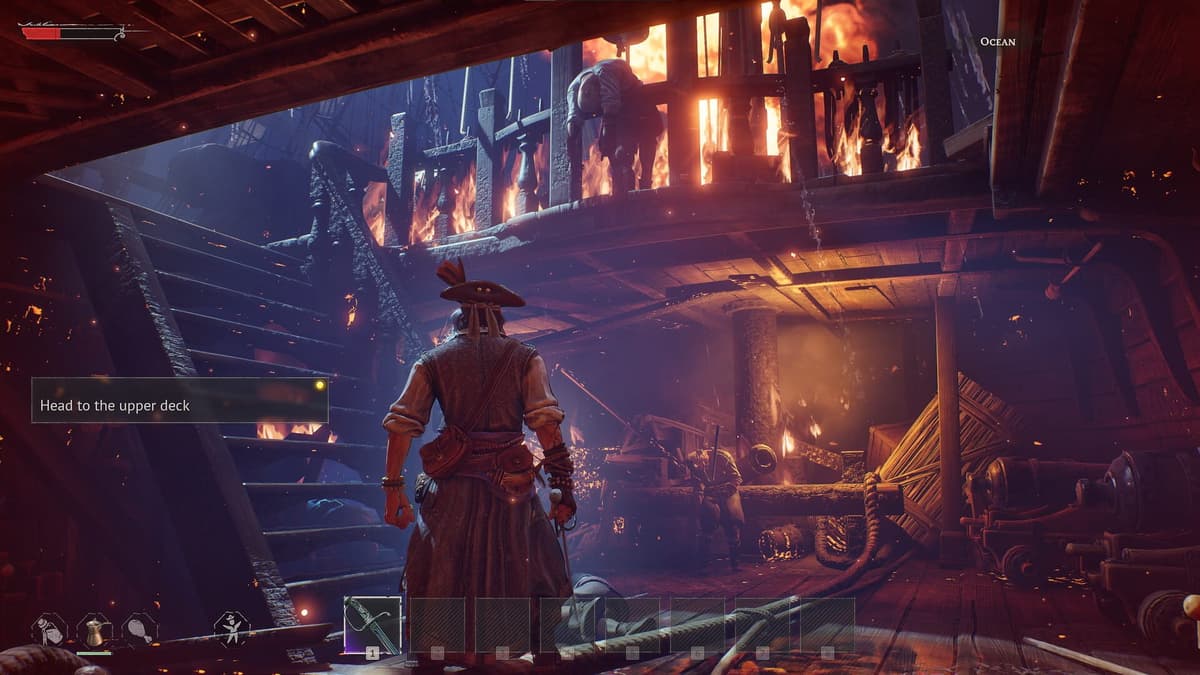
Windrose gives you 16 backpack slots and 8 quick slots at the start, and it is not enough for a game that expects you to haul ore, hides, food, tools and quest items simultaneously. The fix is a four-tier bag chain, each crafted from the previous one: Torn Sailcloth Bag (+4) at Workbench Level 1, Sailor Backpack (+8) at Level 2, Bosun Backpack (+12), and Quartermaster Backpack (+16). Get the first bag inside your first hour, the second before you leave the starter island, and the last two as you push into the Foothills and Cursed Swamp. Everything below is the current chain on build 0.10.0.8 (8 July 2026), the latest Early Access patch.
Table of Contents (19)
The full backpack chain at a glance
| Bag | Slots added | Workbench | Recipe |
|---|---|---|---|
| Base inventory | 16 backpack + 8 quick | — | — |
| Torn Sailcloth Bag | +4 | Level 1 | 2 Coarse Fabric + 1 Rope |
| Sailor Backpack | +8 | Level 2 | 1 Torn Sailcloth Bag + 5 Rough Hide + 2 Copper Ingots |
| Bosun Backpack | +12 | Level 3 | 1 Sailor Backpack + 5 Tanned Leather + 2 Foothills Iron Ingots |
| Quartermaster Backpack | +16 | Higher tier | 1 Bosun Backpack + 5 Crocodile Hide Pieces |
Two things follow from that table and they govern the whole guide. First, each bag consumes the previous one, so there is no branching decision to get wrong — you just climb. Second, the numbers are replacements, not additions: the Quartermaster’s +16 is your total bonus over base, not +16 on top of the Bosun’s +12. Plan your farming around the recipe, not around a running total.
Step 1 — Base, bonfire, workbench
Every bag is crafted at a workbench, so the first objective is a small functional camp.
- Place a Bonfire somewhere central, ideally next to a shrub cluster and within reach of trees.
- Open the build menu (
Bon keyboard) and place a Workbench (Level 1). - Keep the workbench inside the bonfire’s build radius. Stations outside that radius do not register as part of the base, and this is the single most common reason a player’s workbench refuses to accept an upgrade later.
Step 2 — Torn Sailcloth Bag (+4), craftable in minutes
The first bag is trivially cheap and there is no argument for delaying it. You need 2 Coarse Fabric and 1 Rope, and both break down to the same raw material:
- Coarse Fabric = 3 Plant Fiber each → 6 Plant Fiber for two
- Rope = 3 Plant Fiber
- Total: 9 Plant Fiber
Plant Fiber comes from shrubs and low vegetation all over the starter island. The efficient method is a tight loop rather than wandering: find a shrub cluster near your bonfire, run a circuit that hits eight to twelve bushes, and come back. By the time you have crafted, the first shrubs have usually respawned.
At the bench: craft 2 Coarse Fabric, 1 Rope, then the bag. To equip it, open your inventory (Tab), find the Bag slot on the character panel, and drag the Torn Sailcloth Bag in. Your 8 quick slots are separate and do not change.
Step 3 — Workbench Level 2 and the Sailor Backpack (+8)
This is the upgrade that actually changes how you play, because it doubles your bonus and lands right when you start hauling ore.
Getting to Workbench Level 2
- Build a Sawhorse near the workbench, inside the same bonfire radius.
- Bank enough Copper Ingots to fund the upgrade — budget around 10 ingots, which is roughly 40 Copper Ore.
- Use the workbench upgrade interface with both structures placed correctly.
Copper nodes show a small pickaxe icon on the map, most reliably in the northern mine area of the starter island. Craft a Pickaxe, mine to about 40 ore, and smelt at a Furnace. This is the same copper you need for a shovel and early tools, so it is not a detour.
The Sailor Backpack recipe
- 1 × Torn Sailcloth Bag (consumed)
- 5 × Rough Hide
- 2 × Copper Ingots
Rough Hide comes off boars and wolves, most densely in the Coastal Jungle and similar early zones. Bring a basic melee weapon or bow and loot hide alongside meat and bones. If you are playing co-op, split it: one player mines, one hunts. You need both inputs and they are in different places.
Make sure the Torn Sailcloth Bag is in your inventory rather than equipped when you craft, or the recipe may not see it. Then equip the Sailor Backpack in the Bag slot.
Step 4 — Bosun Backpack (+12), your Foothills goal
The Bosun is the first bag that requires you to have progressed geographically rather than just ground materials near camp:
- 1 × Sailor Backpack (consumed)
- 5 × Tanned Leather
- 2 × Foothills Iron Ingots
Tanned Leather is a processed material — you produce it from hide rather than looting it directly, so keep a hide surplus rather than selling every skin you pick up. Foothills Iron is exactly what it sounds like: it gates this bag behind reaching and safely farming the Foothills. Treat +12 slots as your reward for clearing that zone rather than as an early-game target.
Step 5 — Quartermaster Backpack (+16), the endgame bag
- 1 × Bosun Backpack (consumed)
- 5 × Crocodile Hide Pieces
The recipe is short and the difficulty is entirely in the ingredient. Crocodile Hide means hunting crocodiles in the swamp zones, which is a real fight rather than a boar farm. Go with food buffs, healing on the hotbar, and a weapon you can reposition with. The payoff is the largest bag in the game and, in practice, the end of inventory management as a daily annoyance.
Storage is half the answer
Bags alone will not fix Windrose’s inventory pressure — the game clearly expects you to use external storage aggressively.
Base chests
- Craft several Wooden Chests early and place them around the bonfire.
- Assign one resource family per chest: ore and ingots, wood and fiber, hides and bones, food.
- Label them if nameplates are available, and use any quick-deposit function to auto-sort matching stacks.
The point is not tidiness. It is that a labelled chest wall turns a ten-minute crafting session into a two-minute one, every session, forever.
Ship cargo
Once the main story pushes you toward your first Ketch, ship storage becomes your expedition locker. Reserve it for expedition-critical supplies — repair materials, spare weapons, food, region-specific tools — and leave bulk stone and wood stacks in base chests. Moving raw bulk by sea is rarely worth the trip unless you are relocating the whole base.
Habits that keep the bag empty
- Stop carrying stockpiles “just in case.” Large stacks belong in chests. For an excursion, carry only what the objective needs.
- Retire half-broken tools at base. Three versions of the same pickaxe is three slots you are not using.
- Loot selectively when tight. Metals, hides and unique drops first; low-tier junk can wait until you have a bigger bag.
- Keep crafting stations clustered. A Sawhorse outside bonfire range silently blocks your workbench upgrade, which blocks your next bag.
- Empty before a fight, not after. A full bag when a chest opens or a boss drops means loot on the ground, and ground loot blends into Windrose’s textures badly.
FAQ
What is the maximum inventory in Windrose?
16 base backpack slots plus 8 quick slots, plus +16 from the Quartermaster Backpack — the largest bag currently in the game on build 0.10.0.8.
Do I lose the old bag when I craft the next one?
Yes. Every tier from Sailor upward consumes the previous backpack as an ingredient. There is no way to keep both, and no reason to want to.
Which bag should I rush?
Torn Sailcloth Bag immediately, Sailor Backpack before you commit to serious exploration. Bosun and Quartermaster arrive naturally as you unlock the Foothills and swamp zones — do not try to rush them out of order, because the materials simply are not available in the starting region.
Is a bigger bag coming in a future update?
Nothing confirmed. Windrose is still in Early Access — it launched on 14 April 2026 and the current patch is 0.10.0.8 from 8 July 2026. The announced Ashlands update adds a volcanic biome, a new faction, new ship classes and expanded base building, but no published material lists new backpack tiers. Plan around the four bags that exist.
Practical takeaway
Windrose’s inventory is tight by design, but the chain out of it is short and completely linear: 9 Plant Fiber gets you +4 within your first hour, copper and hide get you +8, the Foothills get you +12, and the swamp gets you +16. Build the chest wall alongside it, keep every crafting station inside the bonfire radius, and stop treating your backpack as long-term storage.
More Windrose guides
- All our Windrose guides and coverage
- Windrose Beginner Guide: 5 things to know when starting out
- Best stats to allocate early game — Endurance first
- How to fast travel with Bells
FinalBoss // Gear
Level up your setup
01Top-rated gaming headsetson Amazon→02High-refresh gaming monitorson Amazon→03Gaming chairson Amazon→04Discounted game keyson Kinguin→Affiliate links · As an Amazon Associate, FinalBoss earns from qualifying purchases.
Want to Level Up Your Gaming?
Get access to exclusive strategies, hidden tips, and pro-level insights that we don't share publicly.
Ultimate Guide Strategy Guide + Weekly Pro Tips