
Crimson Desert hides simple mechanisms behind a lot of visual noise, and the Grey Forest Ruins dial puzzle is the clearest example. The answer is not in a riddle or a hidden note — it is in how the statue, the light beam, and the rotating plate line up. If you just want the direct solution: head to the ruins in the Delesyia region, step onto the central plate, clear the broken pillar with Nature’s Grasp, then use the Stab ability to turn the black dial. The symbol order is amphora/jar → mirror → horse.
Table of Contents (19)
The short version
- Location: Delesyia region, southeast of the “Delesyia” map label, on the right side of the Benu Bandit Camp near Mount Benus.
- Step 1: Stand on the central circular plate to activate the mechanism.
- Step 2: Clear the broken pillar with Nature’s Grasp — PS5
Triangle + Circle, XboxY + B, PCF + Left Click. - Step 3: Rotate the dial with the Stab ability — PS5
R1 + Triangle, XboxRB + Y, PCShift + Right Mouse Click. - Symbol order: amphora/jar, then mirror, then horse.
- Reward: an Abyss Artifact from the Abyss Cresset pedestal, plus a fast-travel point.
Players lose time here for one of three reasons: they never activate the platform, they try to rotate the dial while the broken pillar is still in the way, or they swing normal attacks instead of the Stab move the mechanism expects. Fix those three things and the puzzle reads itself.
Where to find the Grey Forest Ruins dial puzzle
The puzzle sits in the Delesyia region, southeast of the “Delesyia” map label, on the right side of the Benu Bandit Camp near Mount Benus. If you are already sweeping that side of the map for ruins and statue interactions, you are in the right place. This is an exploration puzzle, not a combat gate, so the challenge is reading the mechanism correctly — there is no boss to survive.
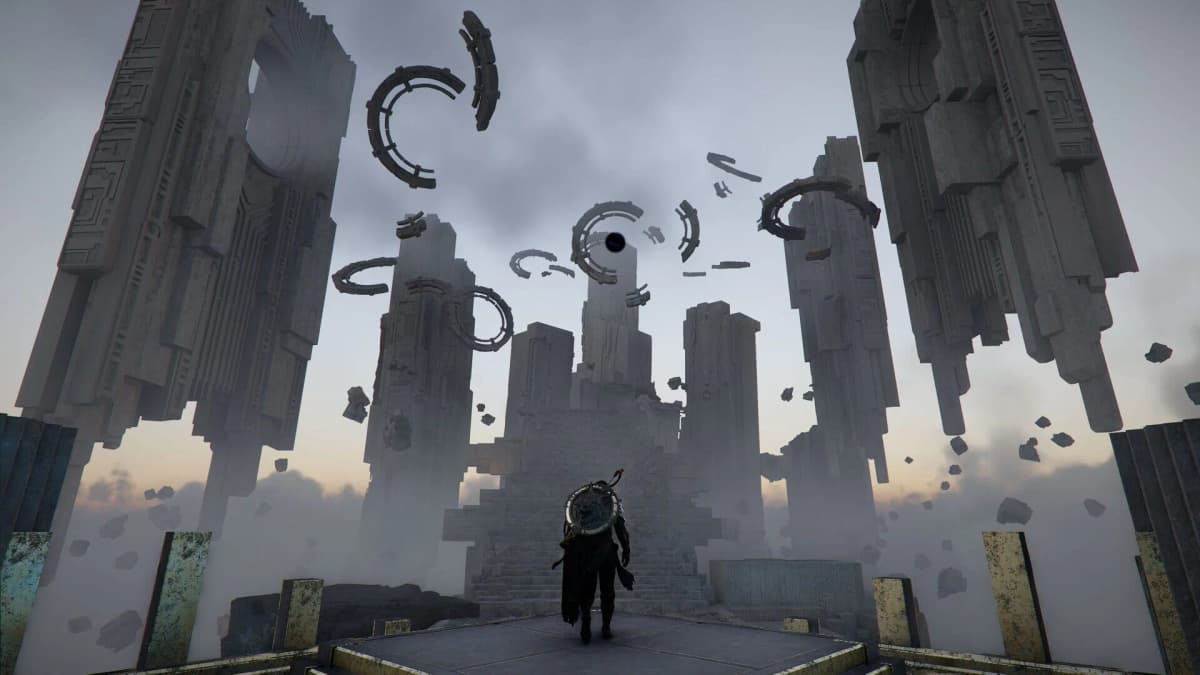
When you arrive, look for the circular platform with a statue in the middle and a ring-shaped dial around it. It looks inactive at first, which is why some players walk past it as decorative ruins instead of an interactable device.
Step 1: Activate the puzzle before doing anything else
The first action is simply walking onto the circular plate in the center. That powers the mechanism and starts the statue’s projection. Skip it and start hitting the device, and you get almost no feedback — it feels unresponsive because it still is.
This is the first thing to check if the dial seems dead. Do not assume it is bugged until you have stepped onto the activation plate and seen the statue begin its visual cue. The whole puzzle is built around observation after activation.
Step 2: Clear the broken pillar with Nature’s Grasp
Before the dial will turn cleanly, you have to clear the obstruction in the middle. A broken pillar blocks the mechanism’s path. Pull it out with Nature’s Grasp: PS5 Triangle + Circle, Xbox Y + B, PC F + Left Click. Leave it in place and the ring looks like it should move while the central blockage quietly prevents alignment.
This is not optional cleanup — it is the setup step that makes everything after it work. Treat the broken pillar like a lock pin: until it is gone, every attempt to read the symbols is wasted effort. Nature’s Grasp is the same debris-clearing pull you use on the Blue Thicket Ruins puzzle, so if you have cleared that one, the input will feel familiar.
Step 3: Use the Stab ability to rotate the dial
The mechanism does not respond to ordinary swings the way a destructible object would. You need the Stab ability to plant your weapon into the mechanism and turn the dial: PS5 R1 + Triangle, Xbox RB + Y, PC Shift + Right Mouse Click. A standard light or heavy slash will not engage the ring.
If your character is just striking the device without catching the ring, you are using the wrong move. The point is not damage — it is using the attack type that grips the dial’s rotation state. Once the weapon is set, you can turn the black ring to the position you want.
How the dial puzzle works
The statue in the center projects a beam toward a golden symbol on the ring. Your job is to rotate the black dial so it matches the symbol the statue is currently indicating. After one correct alignment, the puzzle advances to the next symbol. That sequential logic is the whole encounter.
This is where players overthink it. The plate is not a static combination lock you solve all at once — it is sequential. Only care about the symbol the statue is asking for right now. Solve the active target, then wait for the next one. One symbol at a time makes the board easy to read.
Grey Forest Ruins dial puzzle solution order
Rotate the dial to these three symbols in order:
- Amphora / jar
- Mirror
- Horse
Find each pictogram on the outer ring and rotate the black dial until the active symbol is framed. The plate is solved entirely from the symbols engraved on it — there is no hidden text clue elsewhere in the ruins.
First symbol: amphora / jar
After activation, find the amphora-shaped icon on the outer ring and rotate the dial until the black section lines up with it. When your alignment matches the statue’s beam, the puzzle acknowledges the step. If nothing changes, stop spinning randomly and recheck that the pillar is removed and you are turning the correct ring segment.
Second symbol: mirror
The mirror is where players second-guess themselves, because the board gets busier after the first alignment. Follow the statue’s current cue instead of trying to preserve a whole imagined pattern. The puzzle wants the new active symbol, not your guess at the final layout.
Third symbol: horse
Finish on the horse symbol. Once that final alignment is accepted, the puzzle resolves and the Abyss Cresset pedestal at the center yields its Abyss Artifact, and a fast-travel point unlocks in the area.
Common mistakes that make the puzzle feel harder than it is
- Rotating before activation: step onto the central plate first or the puzzle stays inert.
- Ignoring the broken pillar: clear it with Nature’s Grasp or the mechanism is not truly ready.
- Using normal attacks: the dial only responds to the Stab ability, not generic swings.
- Solving the whole board at once: it is sequential — track only the symbol the statue is highlighting.
- Misreading the icon: tilt the camera slightly above and off-center; flat, straight-on views make similar pictograms blend together in busy ruin lighting.
What you get for solving it
Completing the sequence opens the Abyss Cresset pedestal at the center of the statue, handing you an Abyss Artifact and unlocking a fast-travel point in the area. That makes the Grey Forest Ruins dial worth finishing even if you only passed through while exploring Mount Benus or moving out of Delesyia. If you are collecting Abyss content across the map, it pairs naturally with the Abyss Challenges and Axiom Force guide.
Practical takeaway
Run the puzzle in this order: activate the plate, clear the broken pillar with Nature’s Grasp, use the Stab ability to turn the dial, then align amphora, mirror, and horse. Trust the statue’s current light cue rather than forcing a full-pattern read, and the Grey Forest Ruins dial goes from obscure to a two-minute stop.
FinalBoss // Gear
Level up your setup
01Top-rated gaming headsetson Amazon→02High-refresh gaming monitorson Amazon→03Gaming chairson Amazon→04Discounted game keyson Kinguin→
Affiliate links · As an Amazon Associate, FinalBoss earns from qualifying purchases.
Want to Level Up Your Gaming?
Get access to exclusive strategies, hidden tips, and pro-level insights that we don't share publicly.
Ultimate Guide Strategy Guide + Weekly Pro Tips