
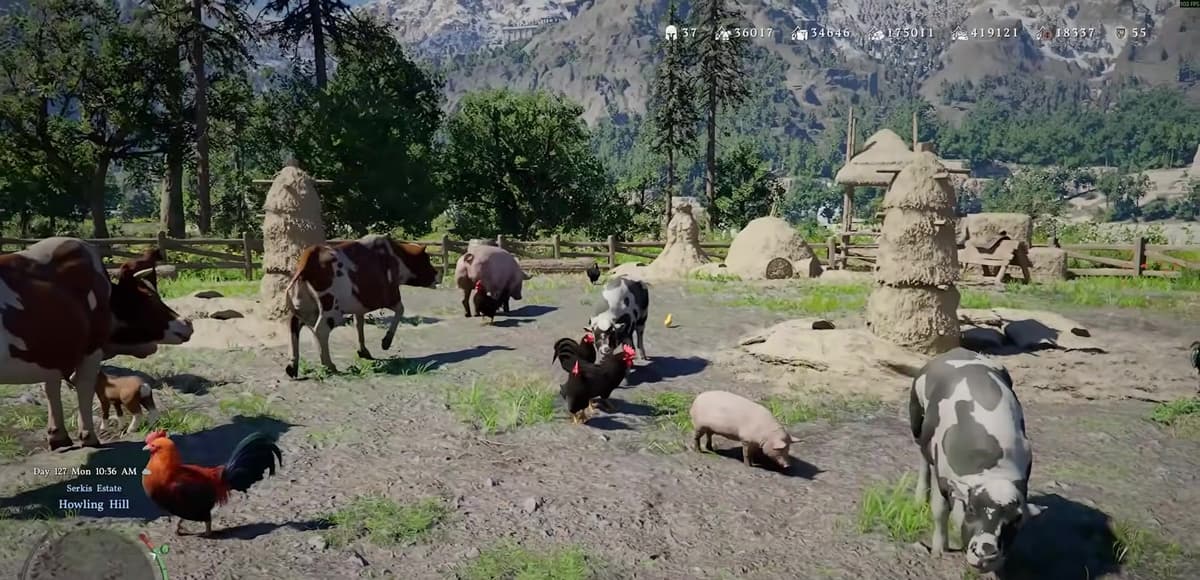
You unlock Crimson Desert’s ranch by pushing the Grounds of Sunrise camp questline (available from roughly Chapter 4), recruiting Ben at Howling Hill, and completing his dispatch chain. The ranch opens with room for 25 animals and upgrades to 35 through camp construction – not through Ben. Almost every species beyond chicks is gated behind raising a specific NPC’s Trust to 100, after which that animal appears in Ben’s Buy Livestock list. Once it is running, recurring-product animals (cows, sheep, goats, chickens) out-earn one-off sales by a wide margin.
Checked against version 1.13.01 (all-platform hotfix, 8 July 2026). Nothing across the post-launch patch cycle – up to and including the 1.13 Abyss update – has changed the 25-to-35 capacity ceiling, the Trust-100 unlock model, or the broad profitability order below.
Table of Contents (30)
Why the ranch is worth the setup time
The ranch is not a cosmetic side feature. Once it is running properly it becomes one of the most consistent, low-maintenance sources of money and crafting materials in the game. The core loop is simple – unlock animals, house them at Howling Hill, feed and grow them, then either harvest products on a timer or sell and butcher – but several hidden rules govern unlocks, Livestock Quality, capacity and profitability, and they are what separate a decorative pen from an income engine.
This guide covers the pieces that actually move your income:
- How to unlock the ranch and Ben as your livestock manager
- How Trust with specific ranch NPCs unlocks each animal in Ben’s shop
- How Livestock Quality and capacity (25 to 35) cap your earnings
- Which animals to prioritise – and why recurring products usually beat one-off sales
Step 1 – Unlocking the ranch and Ben
The ranch is tied to story progression and the Grounds of Sunrise camp questline, which opens up once you are a few hours into the main story (around the Chapter 4 window in most playthroughs). Open Journal → Faction Quests → Grounds of Sunrise at camp to track it.
The sequence runs like this:
- A Rumor in Goldleaf Trading Post – the Greymanes camp quest that introduces Ben (ranch manager) and Kamu (farm manager) and opens the whole chain.
- Meet Ben at Howling Hill and start Field of Abundance.
- Send the Bloomwood Ranch dispatch – the Milk Harvest mission. You can sleep in a camp bed to fast-forward dispatch timers.
- Run the ranch construction dispatch from Howling Hill once the milk mission returns. This is what physically builds the ranch at your camp.
- Complete Ben’s Request, the short tutorial that teaches registration and basic livestock handling – typically by catching a wild goat and registering it.
After that, Ben is permanently stationed at the ranch. Talking to him opens a menu with:
- Buy Livestock – purchase any animals you have unlocked
- Manage Ranch – register and move animals into pens, sell them, or slaughter them
- Ranch info – current headcount against your maximum
Even when you capture animals in the field, the game expects you to route them through Ben’s registration flow rather than bypassing him.
Step 2 – Trust and animal unlocks
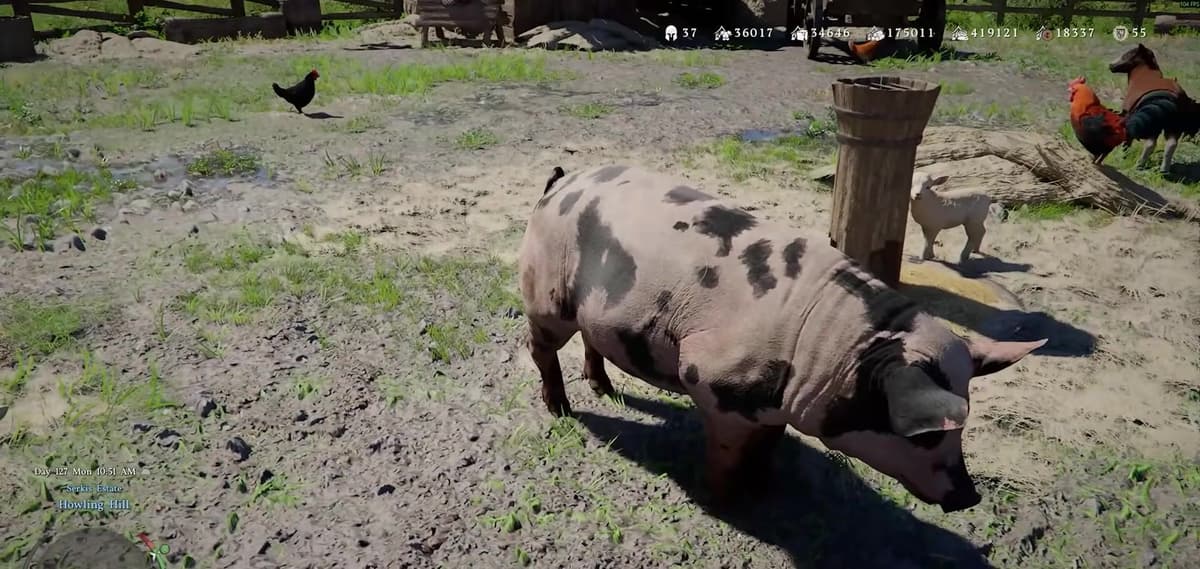
The ranch does not hand you every animal type. Livestock is gated behind a Trust-based unlock system tied to specific NPCs: Ben sells the animals, but other ranch owners around the world effectively sponsor each species. Max their Trust and that animal appears in Ben’s Buy Livestock menu back at Howling Hill. You never buy the animal from the sponsoring NPC directly – the visit only raises Trust.
The unlocks players have documented:
- Baby Pigs – raise Ben’s own Trust to 100.
- Calves (cows) – raise Bremer’s Trust to 100 (Muckroot Ranch).
- Lambs (sheep) – raise Willian’s Trust to 100 (Bloomwood Ranch).
- Goats – raise Ibano’s Trust to 100 (Capra Pasture).
- Ducks – unlocked through Ben after the ranch quests and your third camp expansion.
These ranch managers are usually at their own ranches during the day and at the local inn at night. By around Chapter 5 several of them gather near Hernand Town Square, which makes topping up Trust far faster than riding a circuit.
Fastest way to build Trust
Gifting beats everything else. Dialogue and quests move the bar, but slowly.
- Coin Purses are the go-to gift for ranch-linked NPCs – hoard the ones you pick up from exploration and combat.
- When you want a specific animal, fast travel to that NPC and gift Coin Purses until Trust hits 100.
- Unlocks are permanent, so front-loading Coin Purses onto Bremer (cows) and Willian (sheep) early pays off for the rest of the run.
Step 3 – Why chicks come first
Chicks are the entry-level livestock, available from Ben the moment the ranch opens with no Trust requirement, and cheap in ordinary camp money (around 5 each). The Trust-gated species cost considerably more once unlocked.
- Talk to Ben and choose Buy Livestock.
- Select Chick and buy as many as your capacity allows.
- Raise them into hens and roosters, which then produce eggs and feathers on a timer.
Chickens are the right early investment: cheap enough that you can learn the feeding and growth mechanics without risking expensive stock, and their output feeds both cooking and steady low-level sales while you grind Trust toward the real earners.
Step 4 – Capacity and how to expand it
Capacity is the hard ceiling on ranch income. You start with room for 25 animals; the cap rises to 35 after the final camp expansion. You will hit the limit faster than you expect, so every slot needs to earn.
Checking current capacity
- Talk to Ben and open Manage Ranch.
- Read the headcount in the corner of the menu (for example
34 / 35). - When the numbers converge you need to expand, sell, or butcher.
Expanding via camp construction
Capacity comes from camp management, not from Ben. Open the camp construction menu (via the camp interface), then build the ranch and farm expansion projects with construction materials and camp money. Each completed upgrade permanently raises the animal cap, to a maximum of 35.
Prioritise these expansions alongside your key income buildings. Every extra slot multiplies the value of each efficient livestock choice you make later, so pushing capacity early compounds.
Step 5 – Registering, housing and butchering correctly
The ranch is strict about workflow. Animals must be registered into pens before you can process them, and some quests will not recognise progress if you skip a step.
- Talk to Ben, open Manage Ranch, then register or move livestock.
- Assign any unplaced animal to an appropriate pen slot.
- Only a registered animal counts for quests and becomes eligible for slaughter or product harvesting.
This matters for Ben’s own request quest specifically: drag a captured animal straight to slaughter without registering it first and the objective will not complete.
Wild capture versus purchase
- Purchase route: unlock the animal via NPC Trust, then buy from Ben as needed. Scales cleanly.
- Capture route: find wild animals, subdue them, transport them home, register with Ben. Useful before an unlock lands, but slow.
For anything you plan to keep in numbers – cows, sheep, pigs – Trust-and-purchase wins. Wild capture is for filling gaps early.
Step 6 – Animal types and their outputs
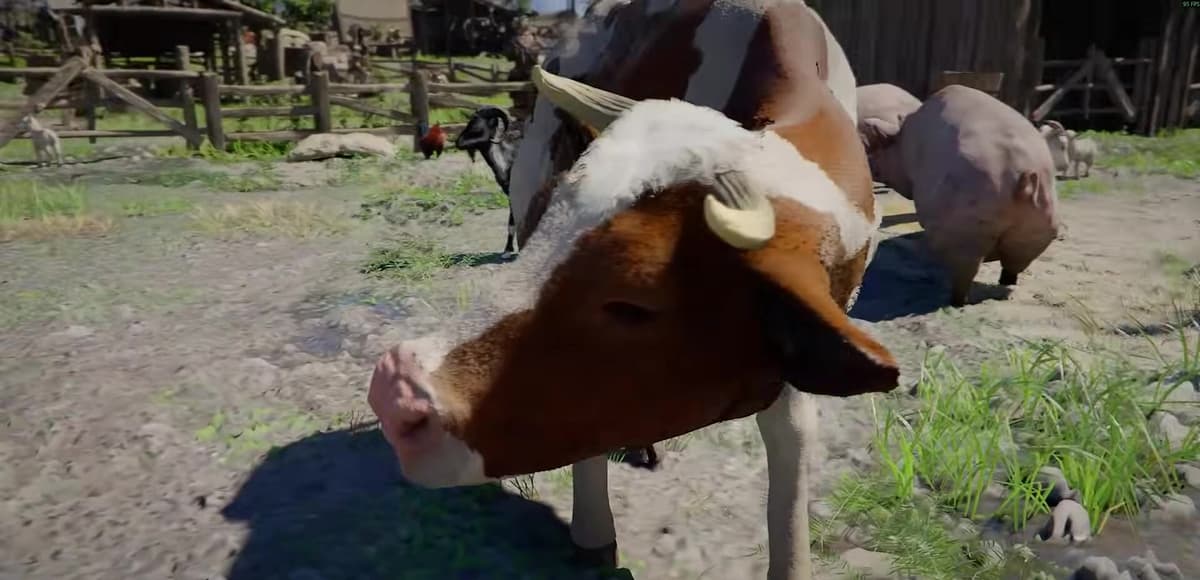
Each species earns in one of two ways: a passive product collected on a timer, or a one-off payout when sold or butchered. Knowing which is which is the whole game for income.
| Animal | Passive product | On butchering | Verdict |
|---|---|---|---|
| Chickens | Eggs, Feathers | Lean Bird Meat, Feather, Small Bone | Cheap, steady, low value. Best starter. |
| Cows (from Calves) | Milk | Meat, bone and horn materials | Top long-term earner – milk plus bones for late-game refinement. |
| Sheep (from Lambs) | Fleece | Meat, hide | Strong and reliable; fleece feeds armour and gear progression. |
| Goats | Milk, plus horn and bone materials | Meat, bone, horn | Solid mid-tier bridge before cows are unlocked. |
| Pigs | None | Marbled Meat, Thin Hide, Small Bone | Grow-and-cash-out only. A high-quality pig sells for around 1,200 camp money. |
The takeaway: cows, sheep, goats and chickens pay you repeatedly just for staying alive and fed, while pigs are a lump-sum line. In most cases, keeping a productive animal and harvesting it on a timer beats selling it outright.
Step 7 – Livestock Quality, the hidden multiplier
Every animal carries a Livestock Quality rating on a bar from 1 to 5. Higher quality means a higher sale price and better yields when you milk, shear, collect eggs or butcher. The same pig that fetches a few hundred at low quality can sell for around 1,200 camp money near the top of the scale – so quality, not headcount alone, drives profit.
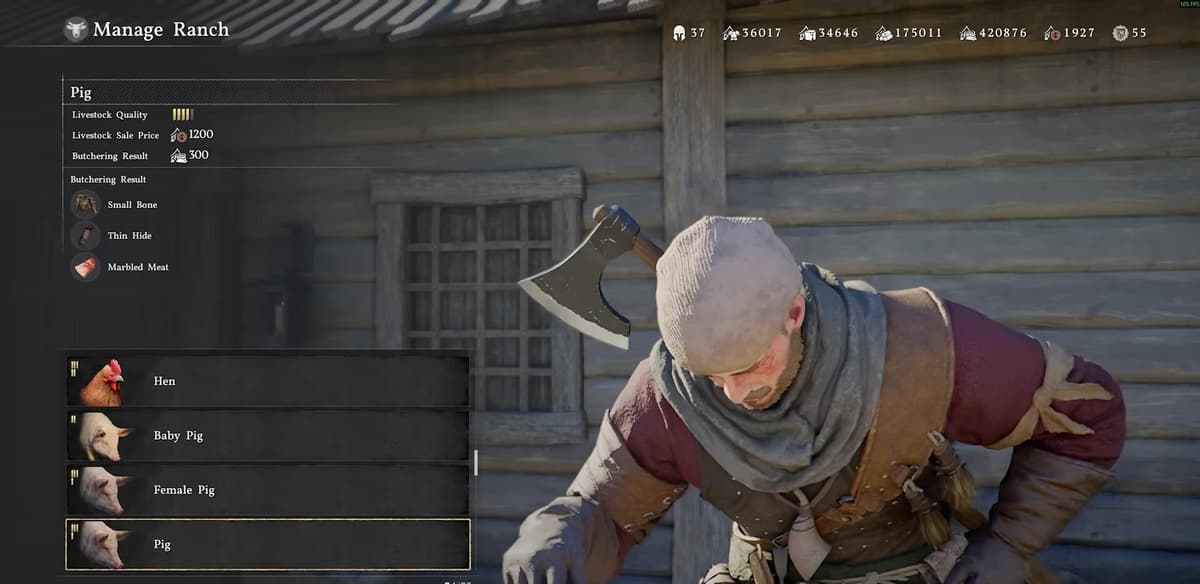
Two levers raise it: consistent feeding, and good genetics through breeding. Check the Manage Ranch screen before you sell anything – an animal one tier below the next quality band is almost always worth keeping and feeding a while longer.
Step 8 – Breeding for free animals
Breeding is the closest thing the ranch has to free money. Place a male and a female of the same species in the ranch, keep them fed, and they breed naturally over time – there is no manual command. Breeding works within a species only, so pair like with like.
Because offspring cost nothing but feed and a pen slot, a couple of breeding pairs of your best recurring-product animals quietly compound your income while you are off adventuring. Just leave headroom under the capacity cap for the new arrivals, or the ranch stalls.
Step 9 – Feeding, growth and profit cycles
Ranch profit is not instant. Animals must be fed and given time to grow or produce. Underfeeding slows growth and drags down yields and quality; burning your most expensive feed on every animal eats the margin you are trying to build. The system rewards consistent, moderate care.
- Each animal has a condition state visible in the ranch interface.
- Feed comes from farm produce – grains and vegetables.
- Higher-quality feed improves growth and condition faster, but costs more.
- Consistent feeding pushes Livestock Quality upward over time.
If you are optimising for income rather than raw speed, mid-tier feed you can farm or buy in bulk beats rationing out your rarest stock.
Step 10 – Turning the ranch into a money engine
Prices, recipes and balance shift with patches, so treat the following as structure rather than a rigid build. The aim is steady output with minimal micromanagement.
Early game, straight after unlock
- Fill most of your capacity with chicks and cheap, easily replenished feed.
- Harvest eggs for sale and for cooking that supports your own adventuring.
- In parallel, grind Coin Purse gifts toward Bremer (cows) and Willian (sheep) so your best earners come online quickly.
Mid to late game, cows and sheep unlocked
- Give the largest share of capacity to cows (milk plus bones) and sheep (fleece).
- Keep a handful of chickens or goats for steady eggs and milk.
- Run a pen or two of pigs purely as a grow-and-sell line, selling at high Livestock Quality.
- Reserve a slot or two for breeding pairs so part of the herd replenishes itself.
Syncing ranch output with the rest of your economy
- Camp vendors and wagons: move surplus meat, milk, fleece, eggs and hides to whichever market pays best.
- Crafting versus selling raw: if you cook or craft heavily, hold stock back; otherwise default to raw sales for predictable income.
- Dispatch synergy: ranch products and camp money feed the dispatch loop. Missions such as the Bloomwood Ranch milk run spend camp money and comrades to return milk plus a cash reward, so prioritise construction and dispatches that improve the ranch itself.
- Stack it with other passive income. The ranch pairs well with the Gardener Bag silver farm, which needs no capacity slots at all.
FAQ
When can I unlock the ranch?
Once the Grounds of Sunrise faction line is available – roughly Chapter 4 for most playthroughs. It then takes two dispatch cycles (Bloomwood milk run, then ranch construction) before the ranch physically exists at camp.
What is the maximum ranch capacity?
35 animals, up from a starting 25, and only via camp construction upgrades. No patch through version 1.13.01 has raised that ceiling.
Why can’t I buy cows from Ben?
Because the species is Trust-gated. Raise Bremer’s Trust to 100 at Muckroot Ranch and calves appear in Ben’s Buy Livestock list. The same pattern applies to sheep (Willian), goats (Ibano) and pigs (Ben himself).
What is the most profitable animal?
Cows, once unlocked – milk on a timer plus valuable bone materials on butchering. Sheep are a close second for fleece. Pigs pay the biggest single lump sum but produce nothing while alive, so keep them to a couple of slots.
Summary
- Progress Grounds of Sunrise to unlock the ranch at Howling Hill and Ben as your manager.
- Use Coin Purse gifting to max Trust with Ben (pigs), Bremer (cows), Willian (sheep) and Ibano (goats).
- Start with chicks – no Trust needed, cheap in camp money – to establish a resource flow.
- Push capacity from 25 to 35 through camp construction so pen limits are not your bottleneck.
- Always register animals with Ben before expecting them to count for quests or slaughter outputs.
- Lean on recurring-product animals for steady income; use pigs as a lump-sum line and sell at high Livestock Quality.
- Run a couple of breeding pairs and keep everything consistently fed.
Handled that way, the ranch becomes the stable backbone of your Crimson Desert economy rather than a decorative side activity. For the rest of the game’s systems and walkthroughs, see our Crimson Desert hub, or start earning on the water with our fishing guide.
FinalBoss // Gear
Level up your setup
01Top-rated gaming headsetson Amazon→02High-refresh gaming monitorson Amazon→03Gaming chairson Amazon→04Discounted game keyson Kinguin→
Affiliate links · As an Amazon Associate, FinalBoss earns from qualifying purchases.
Want to Level Up Your Gaming?
Get access to exclusive strategies, hidden tips, and pro-level insights that we don't share publicly.
Ultimate Guide Strategy Guide + Weekly Pro Tips